
May 29, 1453, is one of those dates that history has taught us to read backward.
We know the ending. Constantinople fell. Constantine XI Palaiologos died in the fighting. Hagia Sophia passed into Ottoman hands. The city that had been New Rome, the capital of the eastern Roman Empire for more than a thousand years, became the center of Ottoman power.
Because we know all that, it is tempting to imagine that the people inside the walls knew it too. We turn the siege into a slow march toward the inevitable: the empire was weak, the city was diminished, the Ottomans were rising, the West hesitated, and the walls held only until history finished its work.
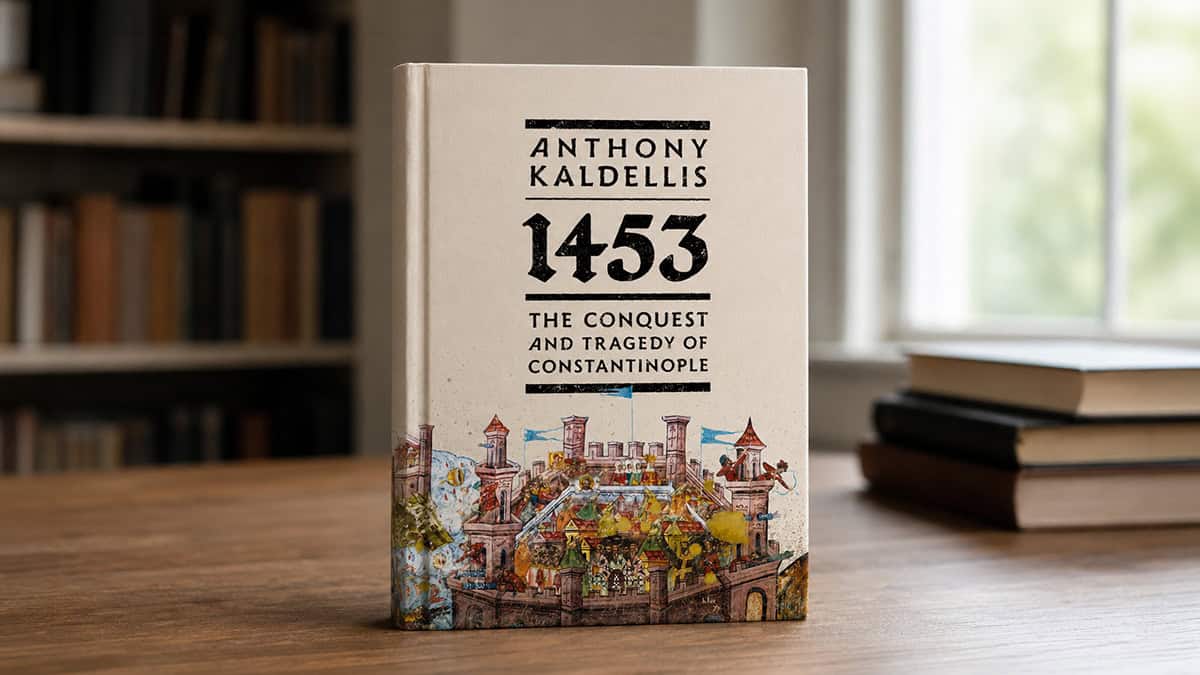
In 1453: The Conquest and Tragedy of Constantinople, Anthony Kaldellis asks readers to stop there. He does not deny the catastrophe. He does not pretend that late Byzantium was strong, or that the odds were equal, or that Mehmed II was anything less than a determined and resourceful conqueror. What he challenges is the habit of treating the fall as if it had already happened before it happened.
That is the force of the book. Kaldellis reopens 1453 not as a legend, not as a national wound, and not as a moral lesson already solved by hindsight, but as an event filled with pressure, fear, skill, confusion, contingency, and human decision.
The city fell. But it did not fall because history had already decided.
After Runciman, not against him
Any modern English-language account of 1453 enters the long shadow of Steven Runciman. His The Fall of Constantinople 1453, first published in 1965, remains the book through which many readers first encountered the siege. It is elegant, humane, sorrowful, and unforgettable.
Runciman gave the fall its modern emotional shape. His Constantinople is wounded but dignified, poor but still radiant, abandoned by a hesitant West and overwhelmed by a young Ottoman ruler of extraordinary ambition. His narrative has the power of an elegy, and that is not a small achievement. Runciman understood that the fall of Constantinople was not just a military episode. It was the end of a world.
Kaldellis does not make that older book useless. He makes it readable in a new way.
The difference is one of historical temperament. Runciman writes under the sign of loss. Kaldellis writes against the anesthesia of inevitability. Runciman’s great strength is his ability to make readers feel the sorrow of the ending. Kaldellis’s strength is his insistence that sorrow should not flatten the event into a funeral procession.
This matters because elegy can become too smooth. It can make defeat seem natural. It can turn the defenders into figures in a mural: noble, doomed, already half outside history. Kaldellis brings them back into the noise of the siege.
They were not posing for tragedy. They were trying to win.
The city before the symbol
By 1453, Constantinople was not the vast imperial capital it had been in earlier centuries. The empire around it had shrunk. Its population had fallen. Ottoman power surrounded it. Western support was uncertain and delayed. The city’s glory was real, but so was its fragility.
One of the most important corrections in Kaldellis’s approach is that he treats Constantinople as a living city before he treats it as a fallen symbol. Weakness is not the same as death. The city was still a place of worship, learning, trade, diplomacy, memory, rumor, fear, and ordinary life. It was not a museum of its own approaching ruin.
This is where the book does more than retell a famous siege. It changes the emotional angle. A dead world can be mourned from a distance. A living city being destroyed is harder to look at.
Inside the walls were soldiers, monks, priests, merchants, sailors, scholars, refugees, families, and foreign allies. They argued, repaired, negotiated, watched, prayed, waited, and listened. They heard the Ottoman cannons. They saw smoke gather over the city. They measured the danger day by day.
Kaldellis’s Constantinople is a city whose later transformation into an icon has sometimes made us forget how alive it still was.
Where inevitability breaks down
The strongest part of Kaldellis’s argument is not simply that “the fall was not inevitable.” That claim can sound like provocation if left abstract. The strength lies in the pressure points he identifies.
The defenders were badly outnumbered, but they were not incompetent. They understood the walls. They understood morale. They understood the importance of the harbor, the vulnerable sections of the land walls, and the need to hold long enough for help or a change in Ottoman calculations. They were not under any illusion that war was safe, but they did not seem to believe they were merely choosing a beautiful death.
The siege was not a morality play in which a doomed Christian city waited for the inevitable. It was a military contest in which the Ottomans had enormous advantages, but still had to solve difficult problems. Mehmed II could not simply walk into Constantinople. He had to force the issue.
Kaldellis’s handling of the walls and cannons is especially useful here. Constantinople’s sea walls were difficult to exploit without overwhelming naval control, so Mehmed’s main pressure had to fall on the land walls, among the strongest defensive works in the medieval world. The cannons changed the balance, not because technology magically erased the past, but because repeated bombardment at vulnerable points created the conditions for infantry combat at the breach.
That is a more serious account than “the old world fell to gunpowder.” The cannons mattered because they interacted with terrain, timing, manpower, fatigue, repair work, morale, and command. They opened a possibility. They did not by themselves write the ending.
The same is true of Giovanni Giustiniani, the Genoese commander whose role in the defense has always mattered but becomes even more revealing in Kaldellis’s framing. His wounding during the final assault was not just a dramatic moment. It affected command, morale, and the defense of one of the most vulnerable points in the walls.
Kaldellis is careful not to turn this into a simple “if only” explanation. Constantinople faced overwhelming pressure by that stage. But the episode shows why the fall should not be treated as mechanical. Leadership, timing, exhaustion, and morale still mattered at the decisive point.
That does not mean Constantinople was likely to win. It means the final outcome was close enough for human decisions and human breakdowns to matter.
Venice, delay, and the small causes of great disasters
The Western question has always haunted 1453. Why did help not come in time? Why did Latin Christendom watch the last Roman capital fall? Was this betrayal, exhaustion, indifference, or calculation?
The easy answer is betrayal. The better answer is uglier.
Kaldellis points toward a world in which sympathy existed but did not become action quickly enough. Venice had ships, resources, and experience. It also had investors, commercial priorities, political resentments, and short-term interests. The Venetian response was not simply a matter of grand Christian strategy. It was tangled in money, maritime logistics, risk, and local disputes.
There is something almost indecently human about that. A catastrophe later remembered in civilizational terms could turn on delayed ships, commercial hesitation, and even anger over taxes. History often looks majestic from a distance. Up close, it is full of invoices, grudges, shipping schedules, and men who wait too long.
This is one of the hidden implications of Kaldellis’s argument. He does not merely say that Constantinople might have been saved. He shows how the distance between survival and catastrophe could be made of practical failures rather than metaphysical destiny.
That is more disturbing than a clean betrayal story. Betrayal gives pain a shape. Delay does not. Delay suggests a world in which no one needed to desire the fall for the fall to happen.
The Union question without the cliché
The religious divisions inside Constantinople also need careful handling. The Union of the Churches, the attempted reconciliation with Rome, divided Byzantine society deeply. Some saw union as a desperate necessity if Western help was to be secured. Others saw it as spiritual surrender.
Older retellings sometimes allow this division to do too much explanatory work. The city fell, therefore the people must have been too divided. The Orthodox resisted union, therefore they weakened the defense. The Latins and Greeks distrusted one another, therefore common action failed.
Kaldellis complicates that picture by keeping the divisions real without making them explain everything. The mistrust was real. The memory of 1204, when Latin crusaders captured and looted Constantinople, was real. But none of that means the defense collapsed because people refused to fight over theology. Italians and Romans, Genoese and Venetians, Unionists and anti-Unionists could despise, distrust, or resent one another and still cooperate when the walls were under attack.
This is a useful correction because it resists moral simplification. The city did not fall because one faction failed the test of history. Nor did it fall because religious belief made practical defense impossible. The human world inside Constantinople was divided, but not paralyzed.
Myths after the breach
Every great disaster produces stories that make it bearable. Constantinople produced many.
The Kerkoporta story, the idea that a small gate left open allowed the Ottomans to enter, has lived for centuries because it gives the fall a symbolic hinge. A forgotten gate is easier to imagine than weeks of bombardment, exhaustion, command strain, and brutal close combat. It turns a vast catastrophe into a single mistake.
Kaldellis rejects that kind of explanation. Even if such a gate had existed in the way the legend imagines, it would not have decided the fate of the city.
The same is true of later legends surrounding Constantine XI. The last emperor became larger in memory than he could ever have been in life. That is understandable. Defeated communities often protect themselves from finality by refusing to let the last figure fully die.
These legends should not be mocked. They tell us something about grief. But they also show why Kaldellis’s work matters. Memory can preserve pain, but it can also blur the event that caused it.
The historian’s task is not to strip memory of meaning. It is to keep memory from replacing history.
The tragedy after the conquest
The title of Kaldellis’s book matters: The Conquest and Tragedy of Constantinople.
The tragedy is not only that the city fell. It is what happened to the people after the fighting stopped.
Here Kaldellis’s account becomes especially grim. He pushes against the familiar image of pure chaos and emphasizes something even more disturbing: organization. Once the Ottoman forces understood that military resistance had been neutralized, the city’s people were taken, gathered, removed, enslaved, ransomed, or resettled. The horror was not only violence. It was processing.
That image changes the aftermath. We are used to imagining conquest as noise: screaming, fire, plunder, movement, collapse. Kaldellis gives us another sound: silence.
By the end of the day, the city had been emptied. Its streets, churches, houses, and markets were no longer the living arteries of the Roman capital. The people who had given the city its life had been killed, captured, scattered, or driven into systems of enslavement and ransom.
This is where the book’s refusal of inevitability becomes morally important. If Constantinople had already been dead, the conquest becomes the closing of a ruined shell. But if the city was still alive, then the aftermath becomes what it was: the violent destruction and reorganization of a human world.
The last Roman city becomes Ottoman
Kaldellis’s larger work has long insisted that we take the Roman identity of Byzantium seriously, and in a book about 1453 that point is not academic decoration.
The people inside Constantinople did not think of themselves as “Byzantines” in the modern sense. They were Romans, Romaioi. Their language was Greek. Their faith was Orthodox Christianity. Their capital was Constantinople. Their political inheritance was Roman.
That identity mattered during the siege because the city was not merely defending territory. It was defending the last political center of a Roman world.
This does not make the story less Greek. It makes it larger. The world that fell in 1453 was Greek-speaking, Roman, Orthodox, imperial, medieval, ancient, and eastern Mediterranean all at once. It does not fit neatly inside modern national categories.
Mehmed understood the power of that inheritance. He did not merely destroy Constantinople. He wanted to possess it, repopulate it, reorder it, and rule from it. Conquest gave him not just territory, but legitimacy. The city changed the Ottomans as surely as the Ottomans changed the city.
This is another reason Kaldellis’s book is valuable. It treats 1453 not only as an ending, but also as a beginning created through violence. The conquest closed the Byzantine story, but it also opened a new Ottoman imperial future built partly from the prestige of the city it had conquered.
What Kaldellis adds
The value of Kaldellis’s book is not that it replaces sorrow with clever revision. It does something more useful. It restores uncertainty.
It asks us not to mistake weakness for death, division for paralysis, defeat for destiny, or memory for evidence.
The two books do not need to cancel each other. But they do ask different things of the reader.
Runciman asks us to mourn the fall of Constantinople.
Kaldellis asks us to look again before we mourn.
That second act is uncomfortable. It removes the comfort of inevitability. It tells us that the people inside the walls were not merely the last representatives of a dying civilization. They were actors in a crisis whose outcome still depended on choices, ships, walls, money, command, weapons, exhaustion, and fear.
In the end, Constantinople fell because Mehmed forced the issue and the defenders could not hold. But Kaldellis’s point is that this sentence should not be allowed to become a shortcut. The city did not fall because history demanded it. It fell because people acted, delayed, calculated, repaired, resisted, endured, and failed.
That is harder to summarize.
It is also closer to the truth.