
The Fall of Constantinople is no longer a living political question for most Greeks. But May 29 still carries a powerful mix of history, Orthodoxy, language, lament and myth, football culture, travel hesitation, and inherited memory.
May 29 is not a holiday in the ordinary Greek sense. There are no parades, no festive tables, no easy national pride attached to it. It sits somewhere else. It belongs to the quieter chamber of Greek historical memory, where dates become more than dates and cities become more than places.
Constantinople fell on May 29, 1453, when the Ottoman forces of Sultan Mehmed II took the city and brought the Eastern Roman Empire, known later to historians as the Byzantine Empire, to an end. By then, imperial power had been reduced largely to Constantinople and the land immediately around it, while the Ottomans controlled most of the surrounding world.
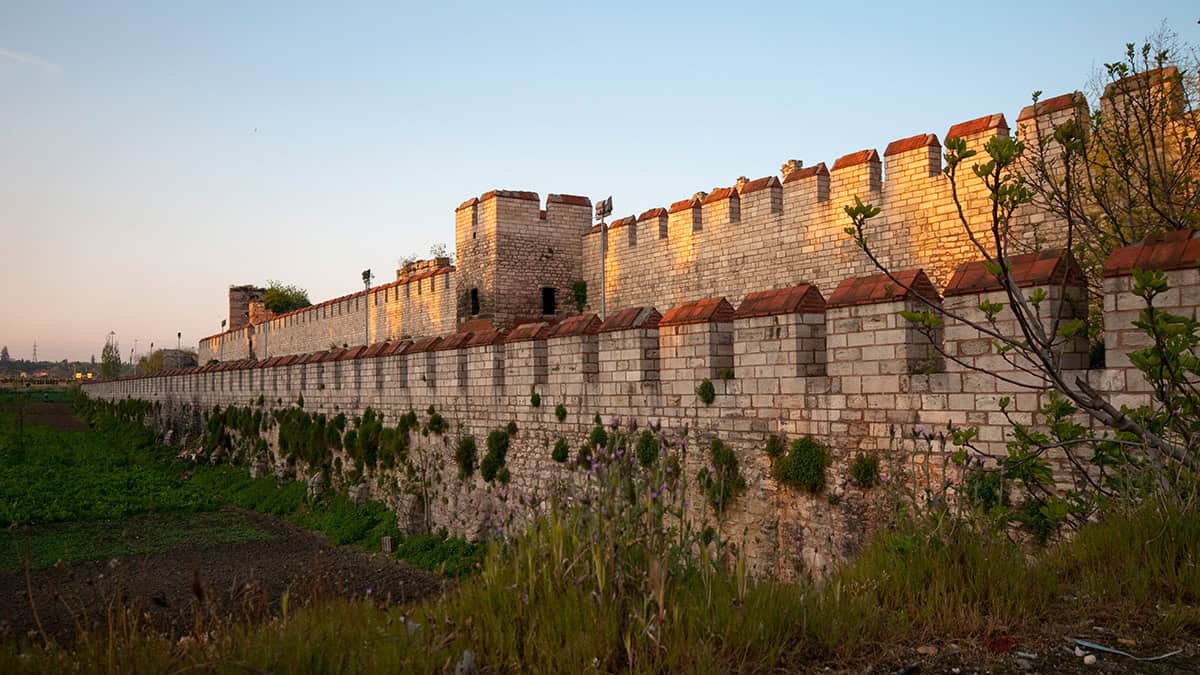
The military story has its own terrible images: the giant cannon brought from Edirne, the chain stretched across the Golden Horn, the Ottoman ships dragged overland into the harbor, and the final pressure on the land walls.
But for many modern Greeks, 1453 is not remembered as a military event alone. It is remembered through fragments: Η Πόλις εάλω, the City has fallen. The last emperor. Hagia Sophia. The walls. The old lament. The feeling that something ended and somehow did not end.
Even the name carries memory. In ordinary Greek speech, especially when history, culture, and identity are involved, Greeks usually do not say Istanbul. They say Κωνσταντινούπολη, Constantinople, or more intimately η Πόλη, the City.
That habit is visible even in formal Greek usage. The Greek Foreign Ministry refers to its mission there as the Γενικό Προξενείο Κωνσταντινούπολης, while postal addresses still use Istanbul because that is the city’s official modern address form in Turkey.
That small linguistic habit says a great deal. Athens may be the capital of the modern Greek state, but Constantinople remains something else in Greek memory. It is not simply another former capital or lost city. It is the City. The name preserves a relationship that history broke, but language never fully surrendered.
That is where the story becomes interesting. Modern Greeks do not live inside 1453. But 1453 still lives inside the modern Greek mind.
Not in one single way. Not with one emotion. Not even with one level of historical knowledge. For some, it is a wound tied to Orthodoxy and Hagia Sophia. For others, it is a schoolbook date, learned young and then half-forgotten. For others, it belongs to family language, folk song, national mythology, political rhetoric, football banners, travel choices, internet jokes, or a quiet, inherited feeling.
The same event can be a prayer, a history lesson, a family phrase, a club emblem, a travel hesitation, or an online joke. That is what makes 1453 difficult to write about honestly. It has never stayed in one place.
The gate and the need for a story
The historian Hélène Glykatzi-Ahrweiler is useful here because she does not allow 1453 to remain wrapped only in lament. She has pushed against one of the most familiar stories around the Fall: the Kerkoporta, the small gate supposedly left open through which Ottoman soldiers entered the city.
For Ahrweiler, the idea that Constantinople fell because of one forgotten gate is historically unserious. In an interview published by Ta Nea, she argued that the Ottoman forces were already overwhelming the defenders: their ships were in the Golden Horn, the Genoese were leaving, ladders had gone up against the walls, and the imbalance was too great for one gate to explain the outcome. The Kerkoporta, in her view, could only be discussed symbolically.
Her larger point was not simply that one myth was wrong. It was that the City had been weakened long before the final assault. Constantinople had been marked by plague, repeated sieges, Western rivalries, poverty, depopulation, superstition, and the bitter conflict between those who supported union with Rome and those who opposed it. She also pointed back to 1204, when the Fourth Crusade captured Constantinople, as the earlier rupture after which the empire never truly recovered its old strength.
That matters because the Kerkoporta legend gives catastrophe a shape. Instead of facing the full weight of exhaustion, poverty, division, military imbalance, and geopolitical isolation, memory can point to one door. One opening. One failure from within.
Ahrweiler’s correction cuts through that comfort. The question is not whether one gate was open. The question is how long a diminished city could stand against an empire rising around it.
Still, reducing the Fall only to decline would also miss something. Constantinople was weak, but its final defense was not meaningless. The last stand of the city did not need myth to be dignified.
A newer voice presses on that same point from the other direction. In 2026, the Byzantinist Anthony Kaldellis published 1453: The Conquest and Tragedy of Constantinople, and his argument is that the Fall was not a foregone conclusion at all. The defenders had held off a much larger army for weeks, and they had real reason to believe they could hold; what finally broke the balance was the Ottoman cannon, hammering one weak stretch of wall until the infantry could force its way through.
A few hundred more men at that point, a second commander to take over when the wounded Genoese captain Giovanni Giustiniani was carried from the line, or two or three Venetian relief ships arriving in time, any of these, in his reading, might have changed the outcome. The Venetians delayed, he notes, partly out of pique: they were angry that the emperor had tried to tax the wine in their taverns, and their help left so late it never crossed the Aegean before the City fell.
Listen: Anthony Kaldellis on 1453
Readers who want to hear Kaldellis explain the argument in his own words can listen to his May 6, 2026 appearance on Historically Thinking. The conversation treats the Fall of Constantinople not as an inevitable collapse, but as a close-run struggle shaped by contingency, miscalculation, and missed opportunities.
On the gate itself, Kaldellis and Ahrweiler agree, he too treats the Kerkoporta as a legend and doubts one door could have decided anything. But where she reads 1453 as the last chapter of a long decline, he reads it as a near-run thing.
Both can be true at once, and the distance between them is the point: the same Fall can be told as something centuries in the coming, or as something that very nearly did not happen. Memory tends to choose the first. It gives grief a longer arc and the dignity of fate. The second is harder to carry, because contingency offers no comfort, only the thought that it might have gone otherwise.
The song that carried the fall
Before 1453 became a modern historical subject, it lived in the Greek voice.
One of the most enduring examples is the lament often known as Της Αγιά Σοφιάς, or the Song of Hagia Sophia. Its opening summons the whole created world into mourning: Σημαίνει ο Θεός, σημαίνει η γη, σημαίνουν τα επουράνια. God rings, the earth rings, the heavens ring. The Fall is not presented only as a political defeat. It is a cosmic disturbance.
The song matters because it shows how 1453 traveled across generations. Long before the modern Greek state, before national schoolbooks, before academic histories of Byzantium, there were laments. They gave people a way to remember the City not as an abstract imperial capital, but as a wound carried in melody, church language, and household memory.
The song was widely carried across the Greek-speaking world, especially in the nineteenth and early twentieth centuries, through homes, schools, churches, and public memory. That popularity matters. The Fall did not survive only because historians preserved it. It survived because people repeated it.
The ending of the lament is especially important: πάλι με χρόνια με καιρούς, πάλι δικά μας θα ’ναι. With years and with time, they will be ours again. It is not a military plan. It is not policy. It is the grammar of endurance.
In that sense, the lament belongs beside the Marble King. Both refuse to let the Fall become final. One keeps the City alive in song. The other keeps the emperor alive in stone.
The king who did not die
If the Kerkoporta explains defeat by finding a breach, the myth of the Μαρμαρωμένος Βασιλιάς, the Marble King, answers defeat by refusing finality.
According to the legend, Constantine XI Palaiologos did not truly die in the final fighting. At the last moment, an angel rescued him, turned him into marble, and hid him near or beneath the Golden Gate of Constantinople. There he waits until God allows him to rise again and return to the City.
Historically, Constantine almost certainly died during the final defense. But myth does not work the way history works. History asks what happened. Myth asks what people could bear to believe after what happened.
The Marble King gave Greeks a way to imagine that 1453 was not an ending, only an interruption. Where the record says death, legend says sleep. Where politics says loss, faith says not yet.
The emperor becomes less a ruler than a form of waiting.
Hagia Sophia and the wound that reopens
For modern Greeks, the memory of 1453 often becomes most visible when Hagia Sophia returns to the news.
That happened powerfully in 2020, when Turkey changed Hagia Sophia’s status from museum back to mosque. UNESCO said it regretted the decision and noted that it had been made without prior discussion, raising concerns about the universal value of the World Heritage site.
For many Greeks, the debate was not only about access to a monument. It reopened the older emotional geography of 1453: the church, the City, the empire, the wound, and the unresolved feeling that some losses are never only historical.
And Hagia Sophia has not stayed out of the news since. It is now in the middle of the largest restoration in its nearly fifteen-hundred-year history, a sweeping effort to reinforce its domes and minarets against earthquakes, given new urgency by a 6.2-magnitude tremor that struck Istanbul in 2025. The work has reached into the building’s hidden layers: in early 2026, restoration teams reported uncovering centuries-old underground tunnels and chambers beneath it.
For most of the world, this is a story about engineering, seismic risk, and heritage. For many Greeks, scaffolding on Hagia Sophia is never only scaffolding. The monument keeps returning to the headlines, and each time it does, the older feeling stirs again.
But this is also where another memory meets the Greek one. For Turks, 1453 is not the Fall but the Conquest. Mehmed is Fatih, the Conqueror, and the capture of Constantinople became foundational for Ottoman imperial identity. Britannica notes that Mehmed saw possession of the city as essential to turning Ottoman rule into a true empire, and made it the political, economic, and social center of the world he was building.
The same walls, the same church, and the same date therefore carry opposite emotional charges, though Turkish memory is not fixed either. It has moved between imperial pride, republican distance, religious symbolism, and contemporary politics. Still, the contrast remains stark. For Greeks, 1453 is remembered as a rupture. For Turks, it is more often remembered as a conquest.
Orthodoxy is central to the Greek side of that memory, but it should not be simplified. Greece today is modern, politically European, and socially varied. Many Greeks are culturally Orthodox without being deeply observant. Pew Research Center has found that 76 percent of adults in Greece say being Orthodox is important to being “truly Greek,” though the same study suggests that, for many people in the region, religious identification can coexist with low rates of regular practice.
That distinction matters. In Greece, Orthodoxy is often theology, but it is also inheritance, calendar, language, architecture, family rhythm, and historical memory. Constantinople belonged to all of that.
The City some Greeks will not visit
The relationship becomes even more complicated when it moves from memory into travel.
Many Greeks visit Turkey, including Constantinople. The reality of travel is more fluid than memory sometimes admits. And yet, in ordinary Greek conversation, one often hears something different: Greeks who say they do not want to go to the City.
Not because they are uninterested, but because they are too interested.
For some, Constantinople is a place they want to see once in their life. For others, it is a place they cannot bring themselves to visit as ordinary tourists, camera in hand, walking through what they were taught to call η Πόλη. The refusal is not always political in a direct sense. Sometimes it is closer to grief. Sometimes it is pride. Sometimes it is inherited discomfort. Sometimes it is simply the feeling that going there would hurt.
A city can be reached by plane, bus, ferry, or car, and still remain emotionally unreachable.
1922 and the memory carried into modern Greece
1453 still feels close in modern Greece, partly because of a much more recent catastrophe: 1922.
The Asia Minor Catastrophe ended Greek life across much of Asia Minor and the eastern Aegean world. More than 1.2 million people came to Greece from Asia Minor as refugees, according to Europeana’s overview of the Asia Minor Catastrophe. They arrived in a country already strained by war and poverty, bringing with them family stories, icons, dialects, recipes, songs, photographs, silences, and grief.
This matters because the grief attached to Constantinople is often not purely a 1453 grief. In many families, it is also a 1922 grief, or a later Constantinopolitan grief, or a Pontian, Smyrniot, Cappadocian, Thracian, or Bosphorus memory. These are not all the same. Each community carried its own loss differently.
But over time, many of those losses found an older vessel waiting for them. The City, Hagia Sophia, the double-headed eagle, the old songs, and the language of return gave newer griefs a shape. In that sense, 1453 not only survived into modern Greece. It was reactivated by the refugee century.
The City in the stadium
In modern Greece, 1453 does not live only in books, churches, or political speeches. It also lives, sometimes loudly and imperfectly, in football.
No two clubs show this more clearly than AEK and PAOK.
AEK, the Athletic Union of Constantinople, was founded in Athens in 1924 by Greek refugees from Constantinople. Its emblem was the double-headed eagle of the Byzantine Empire, and its colors were yellow and black.
PAOK was founded in Thessaloniki in 1926 by refugees from Constantinople. Its double-headed eagle comes from the Union of Thessaloniki Constantinopolitans, a refugee association created to keep communication and solidarity alive among Constantinopolitans in Thessaloniki. The Super League’s PAOK emblem page describes the symbol as a direct reference to the club’s roots in Constantinople.
For many supporters, these symbols are not academic. They are not encountered first in a history seminar. They are worn on the chest, raised in the stands, painted on walls, sung in chants, printed on scarves, and passed through families.
That does not mean every AEK or PAOK fan is thinking about 1453 when the match begins. Most are thinking about the team, the rivalry, the referee, the standings, and the next goal. But symbols carry meanings even when people are not explaining them.
In the football ground, Byzantine memory becomes emotional, tribal, popular, and modern.
AEK’s stadium in Nea Filadelfeia, widely known as Agia Sophia Stadium, makes this especially visible. The name points directly to Hagia Sophia, while the club’s broader visual identity keeps the double-headed eagle at the center of its story.
PAOK’s memory works differently. In Thessaloniki, the refugee inheritance merged with northern Greek identity, social grievance, and the feeling of standing apart from Athens. The result is not simply Byzantine nostalgia. It is a living club culture in which displacement, pride, loyalty, and defiance all speak through the same eagle.
Football can simplify history. It can turn memory into a slogan. It can make old wounds louder than they need to be. But it would be a mistake to dismiss it. For many modern Greeks, Constantinople survives not only in liturgy or schoolbooks, but in stadium rituals, songs, scarves, banners, and the emotional geography of belonging.
Constantinople fell in 1453. Somehow, it still enters the stadium on match day.
Memory, myth, and modern Greeks
The modern Greek mind does not hold 1453 as one fixed thing. It holds it unevenly, through faith, language, history, lament, myth, politics, football, travel, family memory, and inherited emotion.
That mixture can deepen identity, but it can also flatten history. It can preserve feeling, but it can also turn grief into grievance. That is why the Fall of Constantinople should not be treated as a slogan, or emptied of emotion in the name of cold analysis.
It was a real catastrophe for the people who lived through it. It ended the Eastern Roman Empire, changed the eastern Mediterranean, reshaped Orthodox Christian life under Ottoman rule, and became one of the great symbolic losses of Hellenism.
But it was never only one gate, one emperor, or one heroic last day.
It was a historical defeat that became a song, a legend, and then a memory that kept returning as language, faith, refusal, longing, and belonging.
Constantinople fell in 1453. In the Greek imagination, it never fully disappeared.