
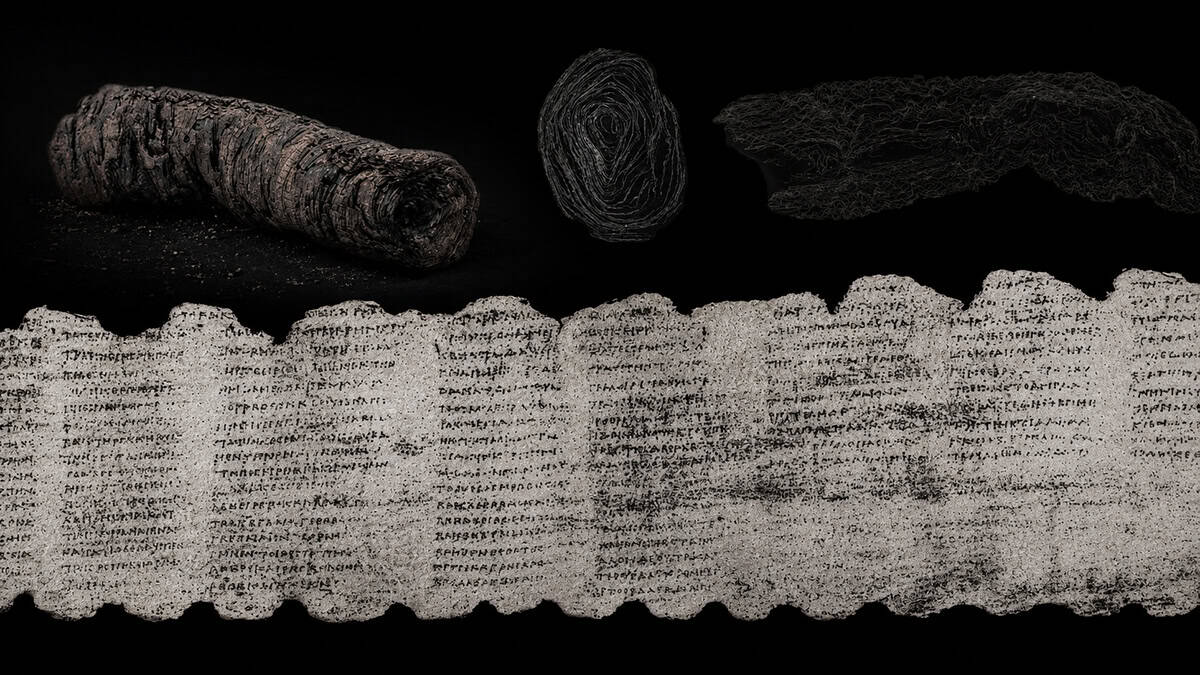
A closed Herculaneum scroll has been read from beginning to end without being opened by hand, after researchers used artificial intelligence, X-ray imaging, and virtual unwrapping to recover ancient Greek text from the carbonized papyrus.
The scroll, known as PHerc. 1667, comes from Herculaneum, the Roman town buried with Pompeii during the eruption of Mount Vesuvius in 79 AD. Researchers announced the results on June 25 in Naples, near the volcano that preserved the scrolls and made them nearly unreadable.
Reuters reported that the work marks the first complete reading of a closed Herculaneum scroll. The Vesuvius Challenge, the research initiative behind the project, described PHerc. 1667 as the first Herculaneum papyrus to be digitally unrolled and read continuously, from end to end.
The scrolls survived in a punishing form. Heat turned them into blackened, brittle rolls of carbon. The ink and the papyrus are both carbon-based, so the writing is difficult to detect even with modern scanning. Physical opening can destroy the text scholars are trying to save.
PHerc. 1667 is not the whole original roll. Earlier attempts to open it by hand, in the nineteenth century, in 1969, and again in the 1980s, damaged the outer layers and left a compact inner core. From that surviving portion, researchers recovered nearly 1.5 meters of Greek text across about 20 columns.
For Greek letters and philosophy, the find has a particular pull. The Herculaneum papyri preserve the only surviving library from the ancient Mediterranean world, and much of it is in Greek. The collection is closely tied to philosophy, especially Epicurean thought and the works of Philodemus of Gadara, the Greek Epicurean philosopher whose texts dominate the library.
This scroll appears to come from another philosophical world. The author and title are still unknown, but the text deals with ethics, art, impulse, reason, and human behavior. The evidence points toward Stoic thought. According to the Vesuvius Challenge announcement, the final preserved column names Aristocreon, the nephew and disciple of Chrysippus, one of Stoicism’s central figures.
That does not make the scroll a confirmed work by Chrysippus. It does make the Stoic reading more than a loose guess. If the attribution moves in that direction, the scroll could bring scholars closer to writing that now survives mostly in fragments and quotations.
The date adds another layer. Researchers say handwriting and internal references suggest PHerc. 1667 dates to the second century BC, possibly even the late third century BC. That would make it one of the oldest scrolls in the Herculaneum collection, older than much of the Philodemus material usually associated with the library.
The reading did not begin with a scholar unfolding papyrus on a table. Researchers scanned the scroll, mapped the hidden layers inside the roll, digitally flattened them, and trained software to detect traces left by ancient ink. The final reading still depends on papyrologists and classicists, but the machine work gives them a surface they can study without sacrificing the object.
Federica Nicolardi, the lead papyrologist for the Vesuvius Challenge, told Reuters that the shift came suddenly. “Literally last night, in front of Mount Vesuvius, something, or I should say everything, changed,” she said.
The announcement also brought new material from Philodemus. The University of Kentucky, whose researchers have played a central role in virtual unwrapping, reported new text from On Vices, Book 1, along with evidence that Philodemus’s On Gods extended to at least eight books. Those finds give scholars enough material to follow arguments across columns, not just identify scattered words.
The technical work reaches beyond one institution. Diamond Light Source and the European Synchrotron Radiation Facility helped provide the high-resolution micro-CT scanning used in the project. The Vesuvius Challenge has also said it will release data, code, and models online.
There is still a long distance between one readable scroll and a recovered library. More than 600 unopened Herculaneum scrolls remain, and each one brings its own problems of damage, distortion, scanning quality, and interpretation. Some may be easier to read than others. Some may resist the current methods.
The project is now trying to speed the work. Reuters reported that the Vesuvius Challenge is offering a $1 million prize to the first person or team to read another scroll in full.
PHerc. 1667 gives scholars something they did not have before: a closed scroll read as a continuous text, without being unrolled and sacrificed.
For nearly 2,000 years, the scroll held Greek words no one could safely reach. Now one fragile papyrus, sealed since antiquity, has been opened without being opened.