
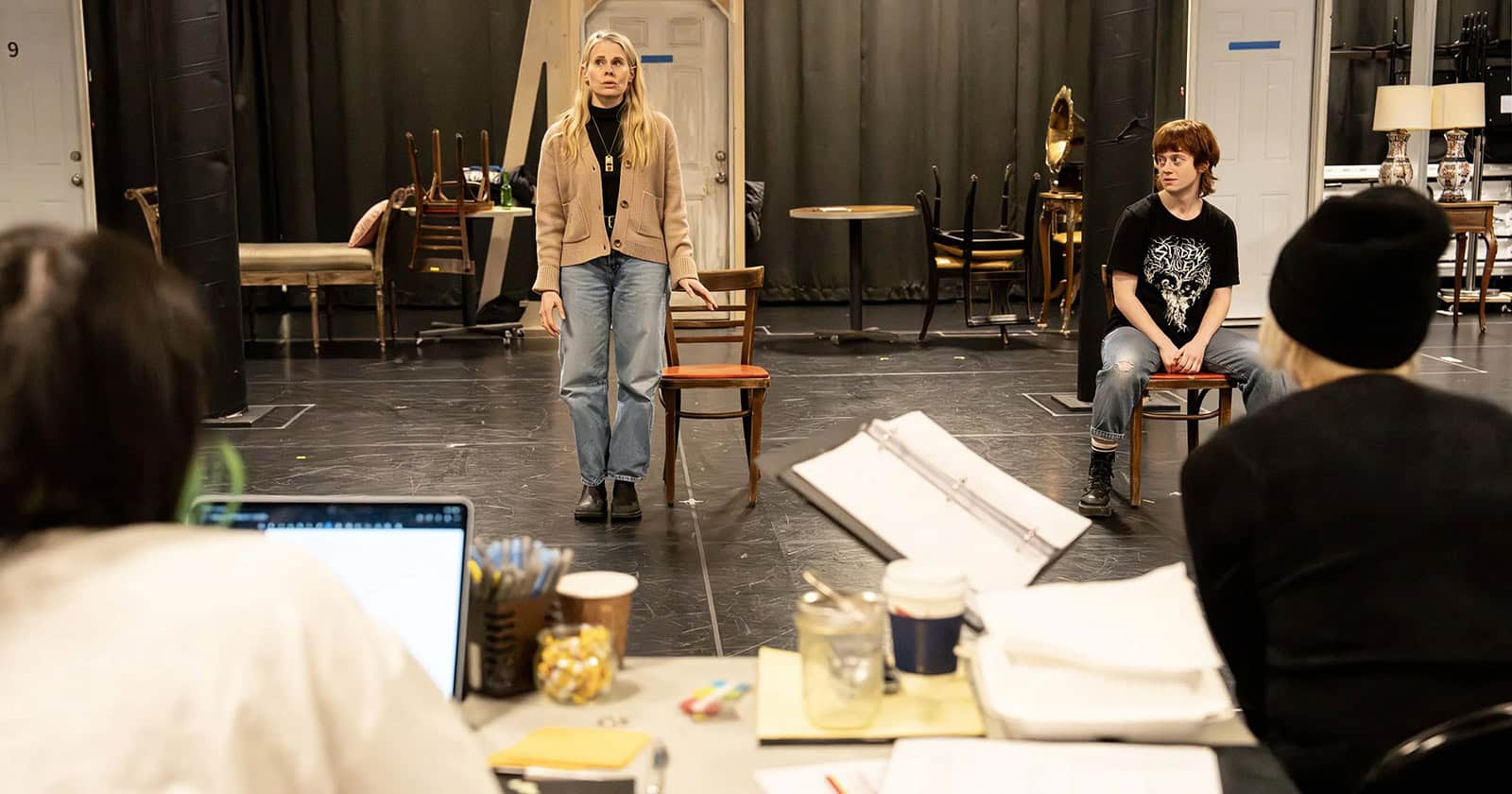
A story most of us first came across in school is back on stage in New York, but this time it lands a little differently.
Anna Ziegler’s Antigone (This Play I Read in High School), set to begin previews February 26 at The Public Theater, takes the familiar outline of Sophocles’ tragedy and shifts its center. The conflict is still there. Antigone still refuses to obey. Creon still holds power. But the question at the heart of it feels closer to today than to ancient Thebes.
For those familiar with the story from school, like many Greeks, it feels like Antigone stays with you. You may not remember every detail, but you remember the feeling of it. Seeing it again like this makes it feel less distant.
The Story Behind It
Before this new version, there is the original.
Written by Sophocles more than two thousand years ago, Antigone tells the story of a young woman who defies the king in order to bury her brother. King Creon has forbidden it, seeing the brother as a traitor. Antigone sees it as a moral obligation she cannot ignore.
What follows is not just a conflict between two people, but between two ways of thinking. One rooted in law and order, the other in personal conscience and duty. Neither side fully gives in, and the outcome is tragic for everyone involved.
It is one of those stories that has been revisited again and again, because the central question never really settles.
A Familiar Story, Told Differently
The structure has not disappeared. Antigone still stands her ground against Creon, and the consequences unfold in ways that feel inevitable.
What changes is the act of defiance itself.
In this version, Antigone is pregnant before her marriage to Haemon, and her decision to end that pregnancy becomes the central conflict. Instead of a dispute over burial rites, the story turns into a question of who has the authority to make deeply personal decisions.
It is a shift that does not try to replace the original so much as sit alongside it. The language moves between ancient and modern. There are moments of humor, moments that feel uncomfortable, and moments that are very direct. Director Tyne Rafaeli has described the production as bridging ancient and modern in a way that functions as a conversation across time, and that is more or less how it plays.
What the production avoids is turning anyone into a simple villain. Antigone is certain. Creon believes he is doing what is right. The tension comes from that gap.
The Cast
Susannah Perkins plays Antigone, and based on rehearsal accounts and her track record in New York theater, she is expected to bring a kind of quiet intensity to the role, leaning less on defiance for its own sake and more on conviction.
Tony Shalhoub has described his Creon not as a distant or purely authoritarian figure but as someone trying to maintain order while failing to understand the cost of that effort until it is too late. It makes the conflict feel more human than symbolic.
Celia Keenan-Bolger takes on the role of the Chorus, here reimagined as a single voice that moves between narrator and contemporary character, helping frame the story without distancing it.
The ensemble, Ethan Dubin, Katie Kreisler, Dave Quay, Calvin Leon Smith, and Haley Wong, supports the tone of the production without pulling focus, keeping the attention where it belongs.
What Early Coverage Points To
This is not a traditional staging, and it does not try to be.
Promotional materials and early features describe a production built around visceral theatricality, humor alongside discomfort, and wit alongside directness, with the production running approximately 2 hours and 15 minutes, including an intermission.
As Playbill notes in its rehearsal coverage, the production blends ancient and contemporary elements in ways that require the cast to hold both registers simultaneously.
What early accounts point to is how familiar the core conflict feels, even in a different setting. The arguments between Antigone and Creon are presented in a way that allows audiences to recognize both sides, without pushing toward a simple conclusion.
Why It Resonates Now
The play opens at a time when these questions are already part of everyday conversation. Ziegler has noted the script’s heightened timeliness in the years since Roe was overturned.
What the production does well, by all early indications, is avoid giving easy answers. Antigone does not soften her position. Creon does not see himself as unjust. The audience is left somewhere in between, which is probably the point.
If You Go
Antigone (This Play I Read in High School) runs at The Public Theater’s Barbaralee Theater, 425 Lafayette Street in New York, through March 29.
Previews began February 26, 2026, with opening night scheduled for March 11.
The production runs approximately 2 hours and 15 minutes with an intermission.
Tickets are available through the Public Theater, with standard and discounted options, and accessibility services offered with advance notice.
Editor’s note: This article was updated on March 5, 2026, to reflect the correct runtime of the production. Antigone (This Play I Read in High School) runs approximately 2 hours and 15 minutes with an intermission.
Please confirm event details with the organizers before attending, as dates, times, locations, and registration information may change.