
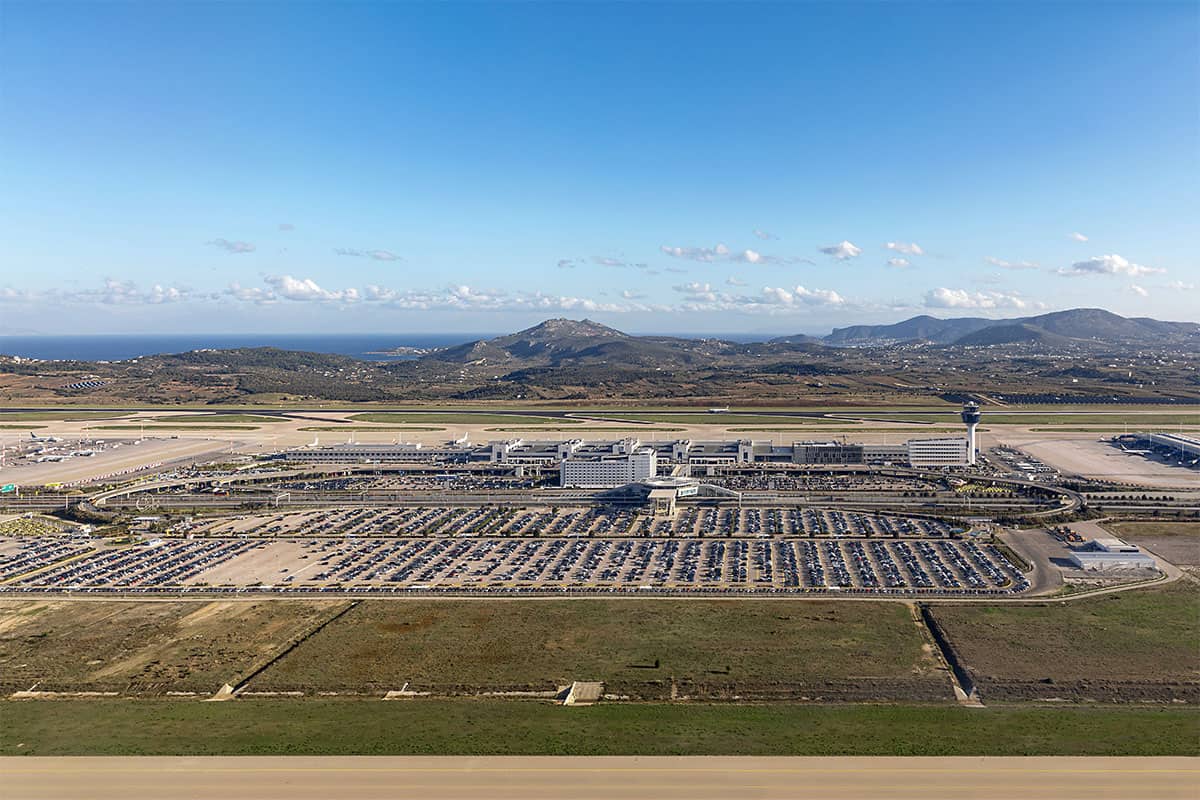
When Greece’s airspace shut down on the morning of January 4, grounding flights nationwide and disrupting travel across southeastern Europe, early explanations focused on a technical failure. Radio communications between air traffic controllers and aircraft were lost. Backup systems struggled to stabilize. Flights were halted, diverted, or delayed.
What has since become clear is that the failure was neither sudden nor inexplicable.
Subsequent investigations and reporting show that the Athens Flight Information Region shutdown unfolded inside a system shaped by years of deferred modernization, staffing strain, and unresolved governance decisions.
What Actually Failed on January 4
A special technical committee of the Hellenic Civil Aviation Authority determined that the disruption was caused by unintentional signal emissions originating from the authority’s own transmitters.
Both the primary and secondary voice communication systems remained technically operational. The failure occurred when multiple transmitters broadcast simultaneously on the same frequencies. The resulting interference saturated the radio spectrum, creating a denial-of-service condition that prevented controllers from communicating with aircraft.
Crucially, officials ruled out any external interference or cyberattack. Michalis Bletsas, commander of Greece’s National Cybersecurity Authority, stated publicly that the system’s own transmitters overtook the spectrum. Backup systems could not function because the frequencies they depended on were already occupied.
“All systems fail at some time,” Bletsas said. “The point is that failures should not have a major impact and the systems should be resilient.”
A Modernization Contract That Never Materialized
That resilience was meant to come from a long-planned upgrade.
In April 2019, the Greek state signed Contract 03/2019, a €4.7 million agreement to modernize the voice communication and recording systems used by air traffic controllers. The project was essential for European Union compliance and interoperability with TopSky ATC One, the air traffic management platform used across much of Europe.
The contract required delivery within 30 months, setting a deadline of September 2021.
Seven years later, the system remains unfinished.
Pandemic disruptions, technical disputes, and coordination failures between overlapping aviation projects stalled implementation. Oversight committees disagreed over specifications. Legal uncertainty surrounded proposed amendments and post-installation support.
At several points, authorities chose not to declare the contractor in default, fearing that restarting the process would cause even longer delays. Instead, the project remained suspended in a state of legal and administrative limbo.
Staffing Shortages and Operational Strain
The January shutdown also occurred amid a broader staffing crisis.
By September 2025, more than one million Ryanair passengers had already experienced delays attributed to air traffic control staffing shortages in Greece. More than 6,200 flights were disrupted in the first nine months of the year alone.
Air traffic controllers repeatedly warned that working conditions were becoming unsustainable. During the summer of 2025, union representatives openly discussed refusing overtime during peak travel periods unless staffing and equipment concerns were addressed.
In October 2025, the authority announced the recruitment of 80 new controllers. The move acknowledged the problem, but it did not resolve it before the January incident.
Budget Choices and Deferred Maintenance
Budget constraints further limited the system’s ability to absorb shocks.
For 2026, the HCAA allocated approximately €350,000 for digital and telecommunications upgrades. Despite being the largest single equipment investment line, aviation sources described the amount as grossly inadequate. Spending on building leases, security, cleaning services, training programs, and public relations collectively exceeded funding for core communications infrastructure.
The consequences of deferred maintenance were already visible months earlier. In August 2025, a data transmission line at Mount Merenda failed. The replacement part had still not been procured more than five months later, and no accountability was assigned.
The January shutdown was not the first warning.
Political Accountability and EU Pressure
Transport Minister Christos Dimas stated publicly that flight safety had not been compromised during the blackout, while acknowledging that Greece’s aviation infrastructure is aging. He also promised accountability, saying that “heads will roll” once investigations are completed.
Earlier in 2025, Dimas and HCAA leadership met in Brussels with DG MOVE, EUROCONTROL, and EASA to coordinate an action plan containing 364 corrective measures.
That urgency reflects mounting European pressure. Greece is facing multiple EU infringement procedures related to aviation compliance. Aircraft identification technology mandated in 2020 remains unimplemented. Performance-Based Navigation procedures, due in December 2020, led to a reasoned opinion from the European Commission in 2024 and referral to the Court of Justice in December 2025, just weeks before the January 4 shutdown.
A Familiar Pattern After Tempe
For many observers, the parallels with the Tempe rail disaster are hard to ignore.
The parliamentary inquiry into Tempe concluded in March 2024, assigning primary responsibility to human error. However, forensic evidence and subsequent investigations that emerged in early 2025 directly contradicted that finding, citing outdated infrastructure, ignored warnings, and fragmented oversight as central contributing factors.
The aviation case reveals a similar pattern: modernization postponed, warnings discounted, and oversight intensified only after crisis.
The Air Traffic Controllers Union described the January shutdown as “years in the making,” citing chronic aging and inadequate maintenance. The union warned that without immediate intervention, the system could face serious difficulties during the upcoming summer season.
What January 4 Ultimately Revealed
By late afternoon on January 4, flights were gradually resuming at Athens International Airport Eleftherios Venizelos and across the country. Operationally, the crisis ended the same day.
Structurally, it did not.
The shutdown exposed not a single point of failure, but a system stretched thin by years of delay, constrained budgets, staffing shortages, and unresolved institutional decisions. What failed that morning was not just a radio frequency. It was a model of risk management that had relied on postponement instead of resolution.