
In the Greek-American community, the Asia Minor Catastrophe (Μικρασιατική Καταστροφή) has become a kind of inherited memory. We grow up hearing fragments of stories. A grandmother who arrived in Piraeus wrapped in someone else’s coat. A grandfather who escaped Smyrna during the Great Fire of 1922 with only a baptismal cross in his pocket. A family name that still carries the echo of a lost village in Cappadocia or Pontos.
What we talk about less, especially in the diaspora, is what happened after these people reached the homeland. Many expected Greece to welcome them with open arms. They were Greek Orthodox Christians fleeing massacre and forced expulsion. They had survived the burning of cities, death marches and the collapse of entire communities that had lived in Asia Minor for generations.
The truth is more complicated. In the 1920s, Greece was overwhelmed by a sudden influx of roughly one and a half million refugees. The country had barely five million people before the disaster. So many traumatized families arriving at once produced a wave of xenophobia inside Greece that is difficult to imagine today. In Athens, one newspaper gave that hostility a name, “Afghanistoupolis,” a mocking term that meant “Athens turned into an Afghan city.”
It was meant as an insult. A way of saying the capital had become foreign, chaotic and unrecognizable because of the people who had just arrived. It remains one of the darkest chapters in modern Greek social history and shows how fear and political division can turn a society against its own.
A Country Already on the Edge
When the refugees arrived between 1922 and 1924, Greece was exhausted. The nation had suffered a military defeat. The monarchy and Venizelists were locked in bitter conflict. The economy had collapsed. There was no real welfare system, no coordinated public health network and no plan for absorbing a refugee population equal to twenty percent of the country.
Most of the refugees were women and children. Many arrived sick, hungry and barefoot. The wounds of Smyrna were still fresh.
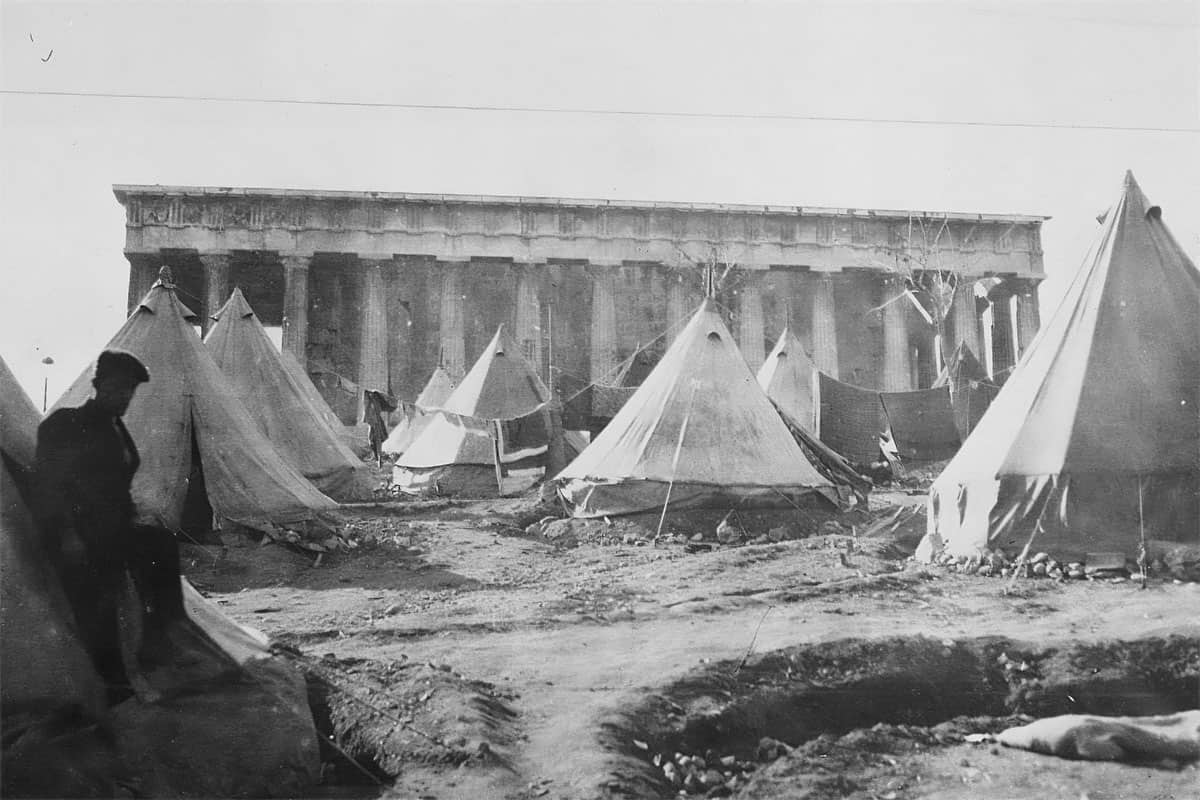
Nearly half of the displaced population settled in Athens and Piraeus. Overnight, schools, churches, warehouses and even theaters became emergency shelters. Families slept on floors covered with rags. Others built makeshift shacks of wood and corrugated metal.
These neighborhoods would later become places like Nea Kokkinia, Nea Smyrni, Vyronas and Kaisariani. In some areas, precarious housing conditions persisted well into the 1970s. As late as 1978, thousands of families were still living in shack settlements.
Diseases spread quickly. Malaria, dysentery, typhus and tuberculosis tore through the camps. In the countryside, ninety five percent of refugees contracted malaria. In the early years, deaths outnumbered births three to one, and in some regions as many as one in five refugees died within their first year in Greece. The government ended up importing one quarter of the world’s quinine supply just to keep people alive.
For Athens, it was not only a health crisis. It was a cultural shock.
A City Transformed Overnight
Imagine the Athens of 1920. Mostly quiet. Mostly small. A city of neoclassical streets, shopkeepers sweeping their stoops in the morning and a population that still lived with rhythms closer to village life than city life.
Then imagine the Athens of 1923.
Makeshift shelters squeezed between old buildings. Street vendors selling halva, boza, baklava and foods many Athenians had never tasted. Women in Anatolian dress washing laundry in public fountains. Children speaking Pontic Greek in the squares. Men roasting animal organs in the city center. Goat herds near Omonoia. Rented rooms overflowing into the streets. Crowds lining up outside charity kitchens for watery soup and bread.
Athens was not prepared for this level of change. And change, especially sudden change, often brings fear.
The Birth of “Turkish Seed” and Other Insults
Although refugees and native Greeks shared the same religion and broader Greek identity, their cultural worlds before 1922 had been different. Many refugees came from cosmopolitan cities like Smyrna and Trebizond. Smyrna was one of the Mediterranean’s great trading ports, and Trebizond was a key hub on the Black Sea.
Others came from rural Anatolia or the Black Sea and spoke distinct Greek dialects. Some communities, especially in Cappadocia and parts of eastern Anatolia, had grown up speaking Turkish as their primary or even sole language. This linguistic reality reflected life in the Ottoman Empire rather than any lack of Greek identity.
Among these groups were the Karamanlides (Καραμανλήδες), Greek Orthodox Christians who spoke Turkish and wrote it with the Greek alphabet. For many such communities, Orthodox faith and shared traditions were the anchors of their Greek identity.
Their clothing, food, music and accents made them stand out the moment they stepped off the ship.
Native Greeks had their own fears. They worried about disease and jobs. They resented that refugee families received redistributed farmland once owned by departing Muslims, land that many local peasants had expected to claim. They also disliked the political influence refugees were gaining as supporters of Eleftherios Venizelos.
In this atmosphere, insults spread quickly. Refugees were called “Turkish seed” (τουρκόσποροι). They were described as “infected” or “cholera-ridden” (χολεριασμένοι). They were accused of ruining neighborhoods, lowering morals, and threatening public order. Politicians fueled the anger and turned refugees into symbols of everything wrong with the country.
When the Press Joined the Attack
In October 1923, after a failed coup by royalist officers, the government shut down all newspapers that opposed Venizelos. Dozens of conservative journalists suddenly found themselves unemployed. They banded together and created a new evening paper called Vradyni (Βραδυνή).
For a time, it was the only right wing publication still operating. It quickly became a central voice of anti refugee anger.
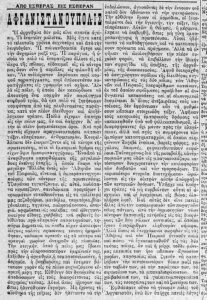
One article in particular, published on December 3, 1923, just weeks after the failed coup, struck a nerve. It ran under the mocking title “Afghanistoupolis.” The anonymous writer described Athens as if it had been invaded. Streets were said to be overflowing with barbarism. Refugee shelters were compared to camels sitting in a home that loved flowers.
From the original Vradyni article (December 3, 1923):
“Disorder, sloppiness, ugliness, and barbarity came and staged a brutal dance in the most respectable parts of the city. Rags flutter, offal is fried in the streets, and makeshift huts crowd the sidewalks. Athens has become a city of Afghanistan.”
The author complained about the noise of refugee women, the sight of refugee children, the food stalls, the smell of frying organs and the appearance of goats and chickens in central neighborhoods.
The punchline was that Athens had stopped being Athens and had turned into some imagined version of Afghanistan. Anyone walking around without a turban, the paper said, should be considered an exception.
The column blamed authorities for letting the city fall into ugliness, but the message to readers was clear. Refugees were a threat. They did not belong.
A Trauma That Cut Both Ways
For the refugees, the rejection was devastating. They had lost everything. They had survived burning cities, deportations and hunger marches. They arrived believing Greece would be their safety and their future.
Instead, many found suspicion and hostility.
For native Greeks, the shock of watching their familiar city transform overnight was also real. Neighborhoods changed, schools overflowed, wages fell and political tensions deepened.
Two populations that should have been one family now faced each other across a line neither had drawn.
A Century Later
Even so, the story did not end with division.
The Greek government, with oversight and financial support from the refugee commissions of the League of Nations, began working on large scale housing projects. Between 1923 and 1925, the Refugee Relief Fund built roughly six thousand five hundred dwellings. By 1930, approximately fifteen thousand refugee residences had been constructed in the Athens and Piraeus area. Across Greece, the state built more than twenty two thousand additional houses of various types. Even with this progress, makeshift shelters continued to stand beside these new homes for decades, some lasting well into the 1970s.
Schools and churches opened. Refugee children who had slept on floors grew up learning the same civic lessons as the children of native Greeks.
By the 1950s and 1960s, the refugee neighborhoods were no longer symbols of misery. They became centers of culture, music, industry and working class life. Refugee families helped industrialize Athens. Refugee women powered the textile mills. Refugee entrepreneurs opened some of the city’s most recognizable shops and workshops.
A century later, the descendants of those families walk through Athens without anyone questioning where they belong. Their neighborhoods, once made of shacks and tin roofs, carry songs, accents, and recipes brought across the Aegean in 1922. What remains is the echo of what their grandparents carried, the pain of losing a homeland, the shock of feeling unwanted in the one place they thought would save them, and the quiet pride of proving that they would not only survive but reshape Greece itself.
Historical Source
Scan of the original “Afghanistoupolis” column published in Vradyni on December 3, 1923.
Click to enlarge