
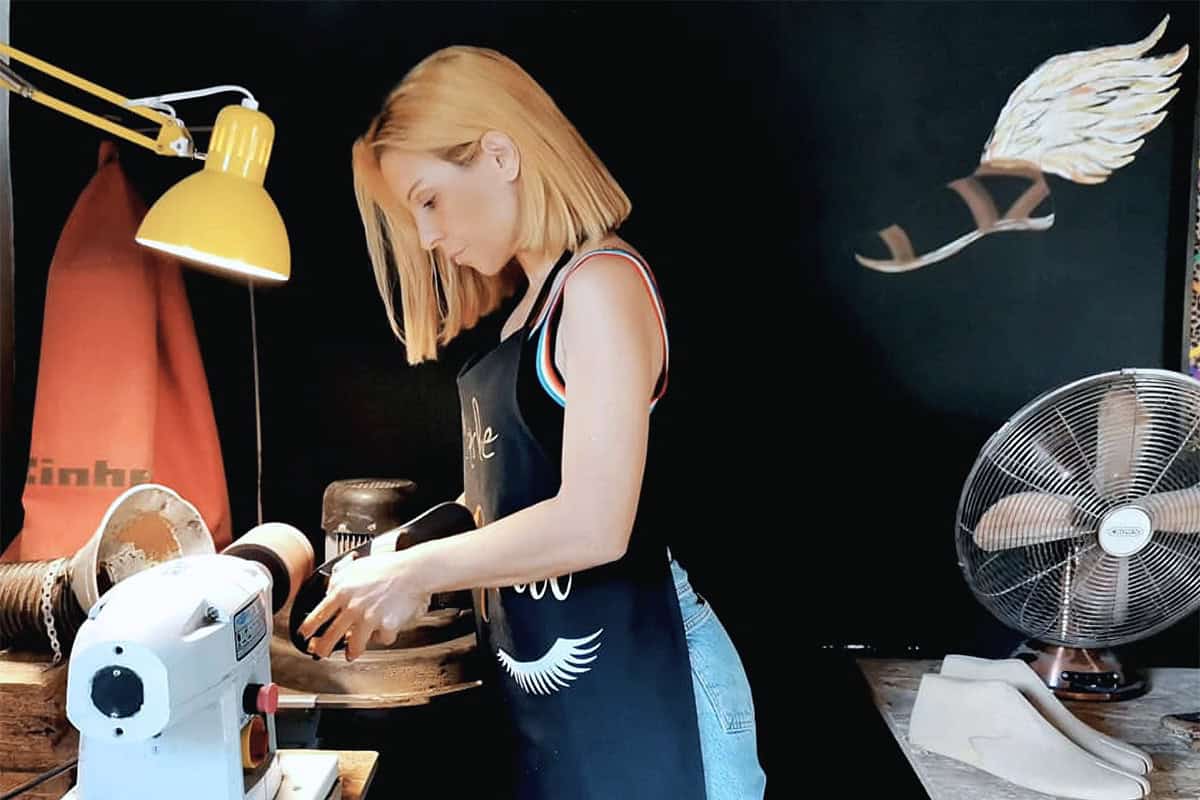
In the quiet southern suburbs of Athens, far from souvenir shops and factory lines, a small workshop continues a tradition that stretches back thousands of years. The smell of leather lingers in the air. The tools are simple. Every pair of sandals is made by hand. The workshop is called Marbe Sandals, and at its center is artisan Marianna Xoulei Matos Bento.
Greek sandal-making is one of the oldest leather crafts in the Mediterranean. In antiquity, sandals were made by tsagarades, skilled leatherworkers whose knowledge passed from one generation to the next. Designs were practical and restrained, shaped by climate, movement, and daily life. Philosophers favored simple forms. Travelers and merchants needed durability. Every pair carried the mark of the hand that made it.
That lineage is what Marbe is quietly preserving.
Marianna, who is half Greek and half Portuguese, grew up between two cultures before settling permanently in Greece. Her background is in fashion design, where she learned precision, structure, and respect for materials. When she encountered traditional Greek sandals, it was their simplicity that drew her in. There were no shortcuts and no trends to chase. Just leather, form, and fit.
She taught herself every step of the process, from cutting and shaping leather to fitting soles and finishing straps. What began as personal exploration became a calling. Today, Marianna is among the very few artisans in Greece who still hand-make every pair herself, using methods that have largely disappeared in an era of mass production.
Marbe is not only a workshop but also a working studio. Alongside her own sandal designs, Marianna welcomes visitors who want to experience the craft firsthand. Small groups spend several hours learning the same process she uses in her own work. They choose natural materials, shape their soles, cut and attach leather straps, and leave with a finished pair of sandals.
Visitors regularly come from abroad, including the United States, Australia, Europe, and Japan, often seeking an experience that goes beyond a souvenir.
For many, the experience is less about the finished product and more about the process itself. The work is slow and physical. It requires attention and a willingness to follow the material rather than force it. There is no assembly line, only repetition and care.
That same approach defines Marbe’s designs. The sandals are understated, built from vegetable-tanned leather and meant to age naturally with wear. Styles reference ancient forms without imitating them outright. Nothing is rushed. Nothing is decorative without purpose.
In a world where Greek craftsmanship is often reduced to imagery and export branding, places like Marbe serve as a reminder that tradition survives only when it is practiced. Not preserved behind glass, but worked, worn, and passed on through use.