
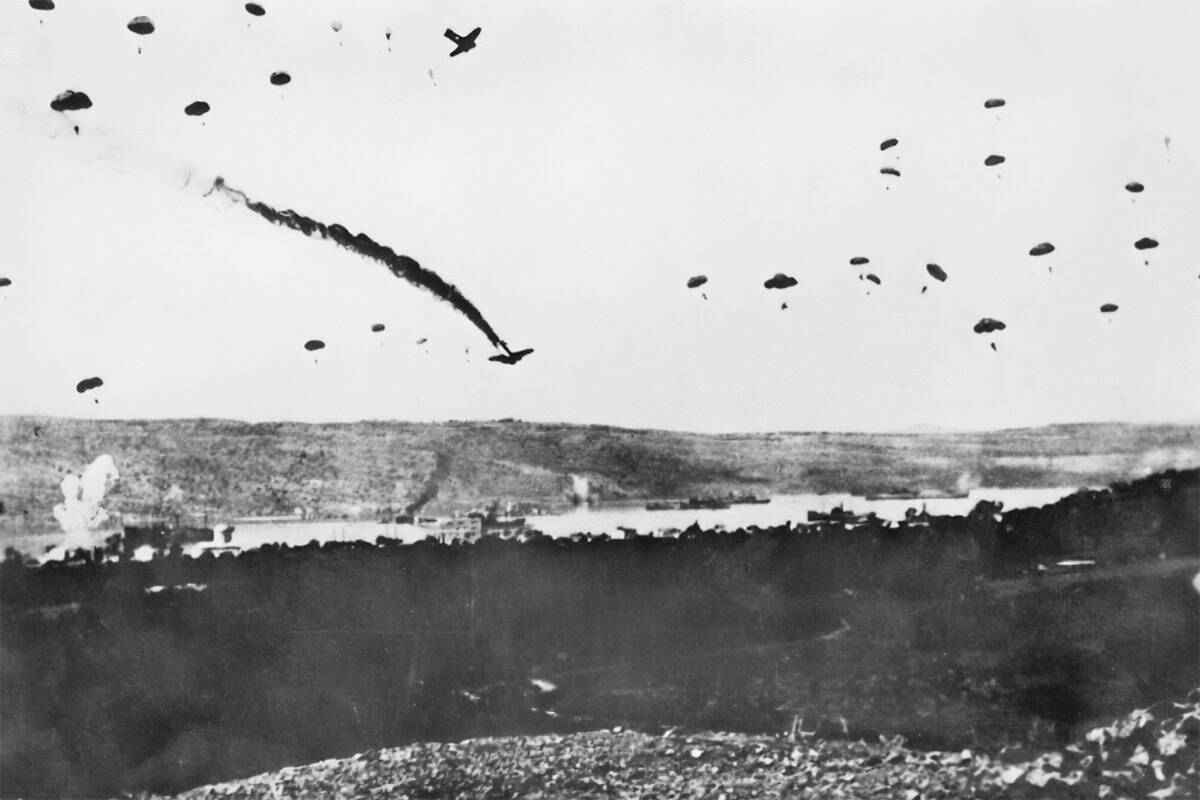
On May 20, 1941, the sky over Crete filled with German aircraft.
What followed was the first large-scale airborne invasion in history, an assault aimed at seizing the island’s airfields, breaking Allied control in the eastern Mediterranean, and turning Crete into a German stronghold. Operation Mercury sent parachute and glider troops toward Maleme, Chania, Rethymno, and Heraklion. The goal was simple and dangerous: capture the airfields quickly enough to fly in reinforcements before the defenders could recover.
But the Battle of Crete became more than a military operation. It became a story of exhausted Allied soldiers, Greek troops, village resistance, German miscalculation, and an island that was taken by force but refused to disappear into silence.
Crete mattered because of where it sat. From the island, Germany could threaten British positions in Egypt, shipping routes in the eastern Mediterranean, and the wider Allied position between Europe, North Africa, and the Middle East. After the fall of mainland Greece in April 1941, Crete became the next target.
The island was defended by British, Australian, New Zealand, and Greek troops, many of them exhausted after the campaign on the mainland. They were short of aircraft, tanks, radios, and heavy equipment. Major-General Bernard Freyberg, the New Zealander commanding the force known as Creforce, had warning that an attack was coming, but Crete was difficult to defend. Its mountains, villages, roads, ravines, and scattered airfields made every decision heavier.
That warning was not vague. British intelligence, including Ultra decrypts, had given Freyberg unusually important information about German intentions. The defenders knew the airfields mattered. Yet Freyberg and his commanders also feared a seaborne landing, and historians have long debated how that concern shaped the Allied dispositions and delayed response around Maleme.
The German plan depended on speed. If the paratroopers could capture the airfields, especially Maleme in western Crete, reinforcements could be flown in. If they failed, the invasion could collapse before it fully began.
On the first day, it nearly did.
German paratroopers landed under fierce fire. Some came down among Allied positions. Others were shot before they could free themselves from their harnesses. At Maleme, Chania, Rethymno, and Heraklion, the fighting was confused, close, and costly. By the end of May 20, the Germans had suffered heavy losses and had failed to secure their main objectives.
For a few hours, Crete still had a chance.
The turning point came at Maleme, and it came through a mixture of German pressure, broken communications, and Allied misjudgment.
The key position was Hill 107, also known as Point 107, which overlooked Maleme airfield. It was held by New Zealand’s 22nd Battalion under Lieutenant-Colonel Leslie Andrew. As the fighting intensified, Andrew believed that two of his companies near the edge of the airfield had been overrun. Communications were broken, the situation was unclear, and support was not arriving as expected.
Andrew attempted a counterattack with two tanks and an infantry platoon, but the effort failed. The tanks broke down, and the position still seemed dangerously exposed. During the night of May 20 to 21, he pulled back from Hill 107, opening the way for German forces to occupy the height the next morning.
The decision has been argued over ever since. It was not simply panic. It came out of uncertainty, pressure, failed communications, and the fear that the battalion could be cut off. But the result was disastrous. Once the Germans realized the airfield and the heights above it had been abandoned, they moved quickly. Maleme became usable for German transport planes, and reinforcements began to arrive.
From that moment, the battle began to turn.
Allied units tried to retake the airfield, but the counterattack came too late and with too little strength. German air power grew stronger by the hour. The more troops and supplies Germany landed at Maleme, the harder it became for the defenders to hold the island.
The fight continued at Galatas, around Chania, near Rethymno, at Heraklion, and along the roads and villages of western Crete. But the initiative had shifted.
By May 27, Freyberg ordered an evacuation. From May 28 to June 1, Allied troops were taken off the island by the Royal Navy, many from the south coast, under punishing German air attack and amid heavy naval losses around Crete. Many men had to retreat south across harsh mountain country toward Sphakia and the southern coast, exhausted, short of food and water, and with little protection from the air. Around 18,000 Commonwealth soldiers were evacuated, while thousands more were killed, wounded, or captured.
Crete fell. But the fall of the airfields was not the end of the fight.
What made the Battle of Crete different was not only the military struggle. It was also the role of ordinary Cretans. Villagers, farmers, older men, women, young people, and priests joined the fight however they could. Some had rifles. Others used knives, axes, farm tools, stones, or whatever could be found nearby.
They knew the ravines, olive groves, mountain paths, and village roads. They were not defending an abstract point on a map. They were defending homes, families, churches, fields, and graves.
For the Germans, this civilian resistance was a shock. For Crete, it came from an older instinct. The island had lived through centuries of occupation, revolt, and sacrifice. In May 1941, that memory became action.
The cost was terrible.
After the battle, the war against Crete’s civilians continued through occupation and reprisal. Villages were burned. Civilians were executed. Resistance continued in the mountains and isolated communities, and the occupation left scars that Crete still remembers.
Kandanos became one of the most infamous examples. The village was destroyed in June 1941 after local resistance during the invasion. Kondomari, Alikianos, Viannos, Anogeia, and other places would also enter the long geography of Cretan suffering under occupation.
These were not footnotes to the battle. They were part of what the battle became once the shooting at the airfields had ended.
Militarily, the island was occupied. Operationally, the German victory was costly enough to change the future use of airborne forces. The National Army Museum describes Crete as a Pyrrhic victory for Germany, with around 4,000 German troops killed or missing. The Imperial War Museums notes that Hitler declared “the day of the parachutist is over,” and Germany never again attempted a major airborne assault on that scale.
It was a victory, but not the kind Germany had expected.
For the Allied soldiers who fought there, Crete became a place of loss, courage, and lasting memory. Australians, New Zealanders, British troops, Greek soldiers, and Cretan civilians fought side by side. The island still carries that shared history in its cemeteries, monuments, and village memorials, from Souda Bay and Maleme to Rethymno and the south coast routes where Allied soldiers tried to escape after the battle was lost. At Rethymno, the Hellenic-Australian Memorial Park, dedicated in 2001, commemorates the 60th anniversary of the Battle of Crete and symbolically represents Greeks and Australians fighting together in 1941.
For Greeks everywhere, including the diaspora, Crete holds a special place in the memory of the Second World War. Its story belongs to the larger Greek wartime arc that began with “Ohi” on October 28, 1940, when Greece rejected Mussolini’s ultimatum and entered the war. It continued through the mountains of Albania, the German invasion of 1941, and the bitter years of occupation, resistance, famine, executions, and village destruction.
But Crete also stands apart.
It reminds us that history is not only shaped by governments and generals. Sometimes it is shaped by people who hear aircraft overhead, see soldiers falling from the sky, and decide that they will not wait for someone else to defend their home.
The Battle of Crete lasted from May 20 to June 1, 1941. The island was taken. Its people were punished. Its villages suffered.
But Crete was never silenced.
More on Greece and WWII
When Hitler Spoke to the Reichstag After Entering Athens — A close look at Hitler’s May 4, 1941, speech after German forces occupied Athens, and how propaganda tried to disguise the conquest.
How Greek North America Kept Greece Alive in WWII — How Greek Americans and Greek Canadians raised money, sent relief, and supported Greece during the war.
December 13, 1943 – The Massacre of Kalavryta — A remembrance of one of the most devastating Nazi reprisals in occupied Greece.