
For generations, they lived in the mountains of Thrace, part of Greece but largely unseen by the state. In 2025, that changed.
In July 2025, Ayşe Kara, a teacher from the village of Roussa in Evros, stood before the Greek Parliament and described what it meant to belong to a community that had never been officially recognized in its own name.
“Today is a historic day,” she told lawmakers. “Together, we are opening a new chapter in the history of our country, Greece, and of our community.”
Her appearance came as Parliament moved to pass legislation recognizing the Bektashi–Alevi Muslims of Thrace as a distinct religious entity. On paper, it was a legal adjustment. In practice, it marked a shift the state had avoided for decades. It meant acknowledging that the Muslim minority in Thrace is not a single, uniform body, and that some communities within it had long existed outside the structures meant to represent them.
For the Bektashi–Alevites themselves, often estimated at around 3,500 people in public reporting at the time of the 2025 law, the change was immediate. Until recently, marriages and funerals were often conducted through Sunni religious authorities, even when families did not identify with those practices. Their places of worship functioned without clear legal standing. Their traditions continued, but without institutional recognition.
As Kara explained in an interview with Kathimerini, it was “as if an Orthodox funeral had to be conducted by a Protestant pastor.”
That gap is what the law set out to close.
A different religious life
Bektashism–Alevism does not sit easily within the categories most people in Greece associate with Islam. It is a Sufi-influenced tradition that emerged in 13th-century Anatolia and spread into the Balkans during the Ottoman period, absorbing elements from Shiʿi Islam, Central Asian traditions, and local Christian practices.
In Thrace, its differences are not abstract. Men and women gather together in worship. Music and ritual movement are part of religious life. Saints and spiritual lineages are central. Worship takes place not in mosques, but in tekkes and cemevi.
Its teachings emphasize inner spirituality over formal religious law, and the boundaries that define everyday religious practice in Sunni Islam are often approached differently. Strict veiling is not central. Alcohol is not treated in the same way. Religious obligation is framed more through personal cultivation than external observance.
These are not minor variations. They define a religious life that developed alongside Sunni Islam, but not within its institutional framework. Locally, that distinction has long been understood. Institutionally, it was not.
The mountains and the state
The Bektashi–Alevi presence in Greece is closely tied to geography. Their communities are concentrated in mountainous areas of Evros and Rhodope, in villages west of Soufli and across the highlands of Western Thrace, an area long known for its layered identities and cultural overlap.
For much of the postwar period, these areas were treated as sensitive border zones. Movement was restricted, and for decades visitors to villages like Roussa were required to present identification to enter. Outside presence was limited. Development lagged behind the rest of the country, and state policy focused more on control than integration.
These restrictions were lifted in the 1990s, but their effects lingered. In villages like Roussa and the nearby Derbent settlements, that period remains part of lived memory. Infrastructure arrived late. Opportunities remained limited. The sense of distance from the state did not disappear with the checkpoints.
Within that environment, identity developed in layered ways. Many Bektashi–Alevites are connected to Pomak-origin communities, Slavic-speaking Muslim populations of the region’s mountains. Over time, Turkish became the dominant public language in many areas, reflecting broader dynamics within the minority. But identity in these villages has never followed a single line. Religious tradition, locality, and inherited practice often carry more weight than external labels.
In practice, this made them a minority within a minority, both within the Muslim population of Thrace and within the structures that represented it. For many within the community, that position shaped everyday behavior. As one local leader put it, “our parents used to hide,” reflecting a long-standing reluctance to openly identify as Bektashi–Alevi.
In recent years, that posture has begun to shift, with community leaders speaking more openly and public events drawing wider attention.
For decades, the state treated the Muslim minority of Thrace as a single administrative category, rooted in the postwar interpretation of minority rights under the Treaty of Lausanne. What existed within it remained largely unexamined.
Roussa and the tekke
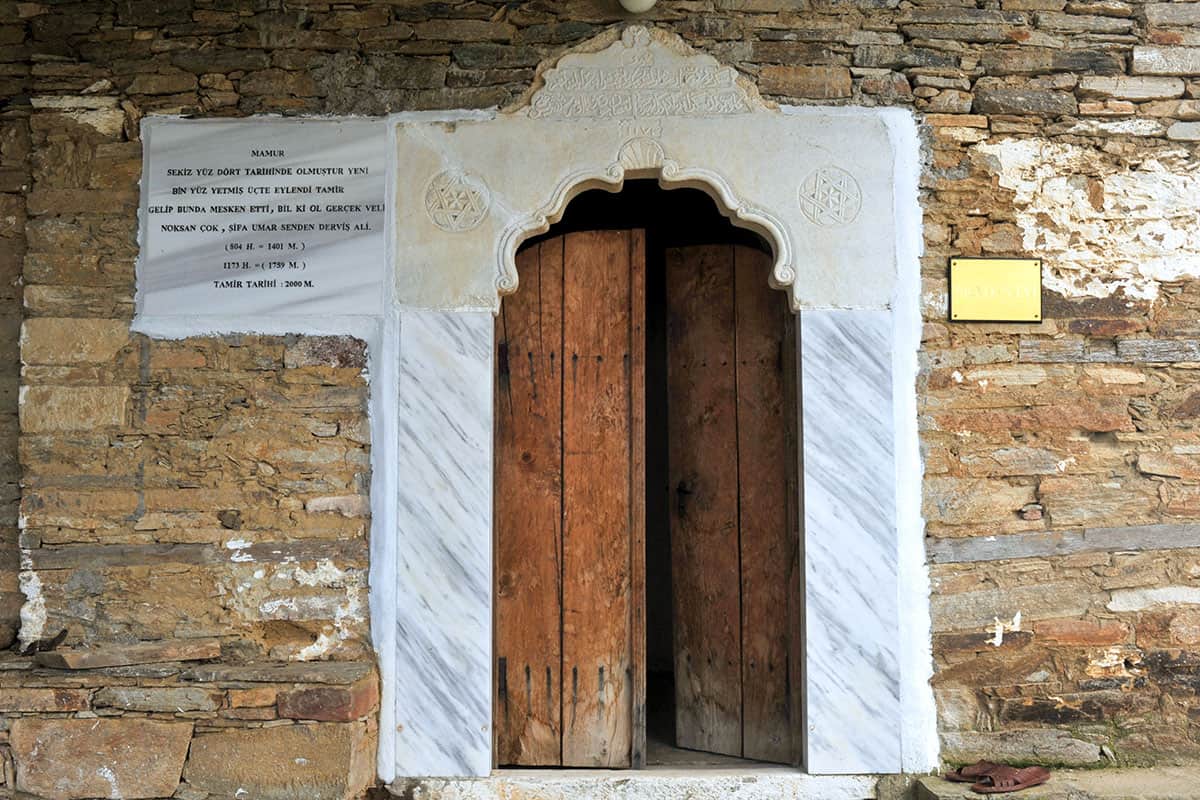
At the center of Bektashi–Alevi life in Greece stands the tekke of Seyyid Ali Sultan, near the village of Roussa. The site is generally associated with the early Ottoman period and is often dated to the early 15th century. Within the Bektashi tradition, it is widely regarded as one of the most important sites in the Balkans and is often described as second in significance only to the shrine of Hacı Bektaş in central Anatolia.
The complex includes a mausoleum, gathering spaces, kitchens, and surrounding grounds used for ceremonies and seasonal gatherings. A centuries-old mulberry tree stands at its center, tied to local tradition and memory.
This is where religious life takes shape. Mixed-gender ceremonies are held. Communal meals follow ritual gatherings. Pilgrimages bring together families from across the region. Festivals tied to the spring calendar draw both religious and cultural participation.
Even in periods when the community had no formal legal standing, this is where continuity was preserved. Rituals continued. Structures were maintained. Identity was carried forward not through institutions recognized by the state, but through places like this.
When Kara spoke in Parliament, she was speaking from that world.
What the law changed and why it is contested
The 2025 legislation gave the Bektashi–Alevites something they had not had before, a legal identity of their own. It allows them to manage their religious property independently, formally recognize their places of worship, and organize religious life outside the Sunni muftiate structure that had previously encompassed them.
It also opens the possibility, under specific conditions, for religious education aligned with their tradition.
For the Greek state, the move reflects a broader shift toward recognizing internal diversity within the Muslim minority, rather than treating it as a single institutional body.
But that shift is not universally accepted.
Some minority organizations argue that recognition does not simply acknowledge difference. It reshapes the political structure of the minority itself. Their concern is that creating separate legal categories risks weakening the framework through which minority rights have historically been negotiated under the Treaty of Lausanne. From that perspective, the issue is not doctrinal but political. Fragmentation could reduce cohesion and bargaining power.
Turkish media and affiliated groups have framed the decision as an attempt to divide what they describe as a unified “Turkish” minority in Thrace. They do not deny that Bektashi–Alevites have distinct practices, but question whether formal separation strengthens the community or isolates it.
Others, including members of the Bektashi–Alevi community itself, see the matter differently. For them, the issue is not division but recognition. A structure that assumes uniformity where it does not exist, they argue, cannot fully represent those within it.
The law does not resolve that tension. It makes it visible.
The Bektashi–Alevites were not new to Thrace in 2025. Their villages, their religious life, and their sacred spaces have been part of the region for centuries.
What changed was recognition. The state began to acknowledge that presence in its own terms.
They are no longer treated as a variation of something else, but as a community in their own right.