
Greece is still too often explained from the outside through a familiar set of words: tourism, shipping, real estate, summer, crisis, recovery.
None of that is false. Tourism fills the islands and city hotels. Shipping remains one of the country’s global strengths. Real estate has changed neighborhoods from Athens to Thessaloniki and beyond. The debt crisis still lives in public debate, family budgets, and political memory. But when those words become the whole frame, they leave out a quieter part of the country’s economy that has been moving in a different direction.
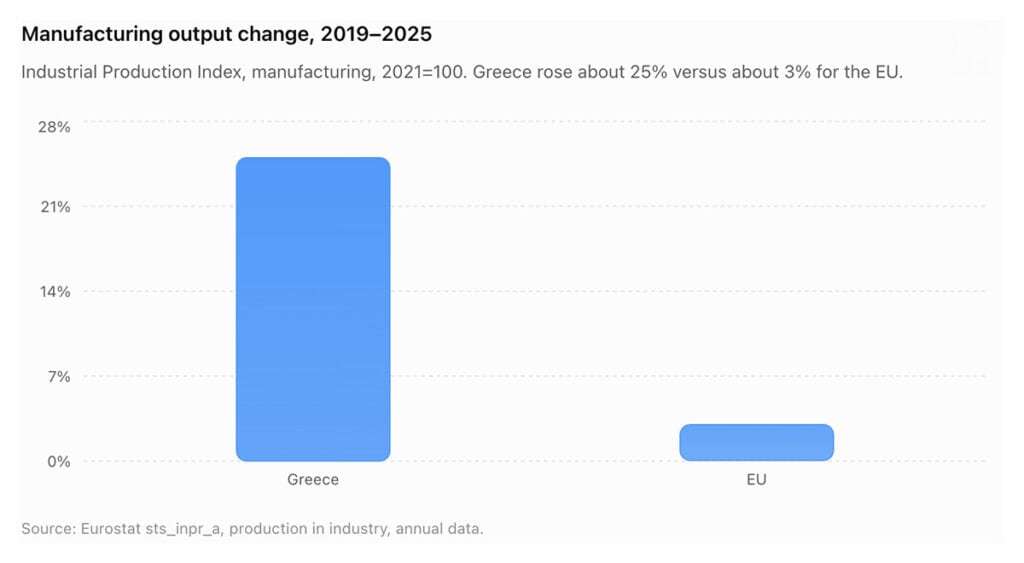
It is the part of Greece that still makes things, and the numbers are no longer easy to brush aside. Eurostat’s annual production-in-industry series, using production volume, manufacturing, calendar-adjusted data, and 2021 as the baseline of 100, shows Greece’s manufacturing index rising from 93 in 2019 to 116 in 2025. Put simply, Greek manufacturing production was about 25 percent higher than before the pandemic. The comparable EU increase over the same period was only about 3 percent.
That figure deserves attention. It does not make Greece an industrial powerhouse, and it does not tell us whether wages, profits, job quality, or every individual firm improved. It measures production volume. Still, it shows that Greece is producing more again, and that fact does not fit neatly into the old habit of describing the country almost entirely through tourism, property, consumption, and services.
The growth is not limited to the most familiar Greek products either. Food production remains important, as it should. But the sharper gains since 2019 appear in less expected places. Computers, electronic and optical products rose by about 124 percent. Other transport equipment rose by about 109 percent. Basic pharmaceuticals rose by about 74 percent. Repair and installation of machinery and equipment rose by about 42 percent.
A small sector can post a large percentage increase without becoming a dominant part of the economy. Even so, the direction is worth noticing. Greece’s manufacturing rebound is not only about olive oil, wine, cheese, cement, or beverages. It also includes medicines, equipment, industrial services, and more technical forms of production.
| Sector | Change, 2019–2025 |
|---|---|
| Manufacturing, Greece | +25% |
| Manufacturing, EU27 | +3% |
| Computers, electronic and optical products | +124% |
| Other transport equipment | +109% |
| Basic pharmaceuticals | +74% |
| Repair and installation of machinery | +42% |
| Wearing apparel | -37% |
| Leather products | -32% |
| Wood products | -15% |
Source: Eurostat sts_inpr_a, Production in industry, annual data. Filters: production volume, NACE Rev. 2 manufacturing sectors, calendar-adjusted data, not seasonally adjusted, index 2021=100, Greece and EU27.
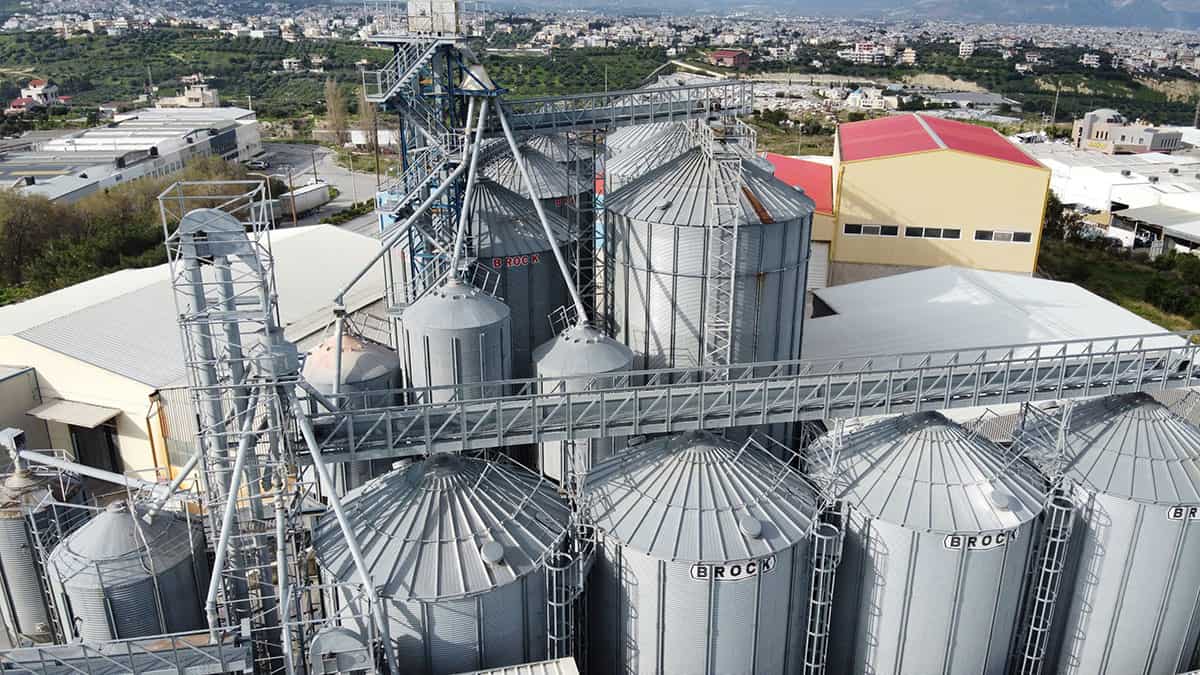
This is not the Greece usually sold to visitors. It is not the ferry dock in August, the island hotel, or the restaurant street filled until midnight. It is the Greece of industrial parks, food plants, pharmaceutical facilities, metalworking firms, repair shops, and small companies trying to become larger ones. It is less photogenic, but it belongs to the working economy, not the postcard economy.
The same table also carries a harder message. Greece has not recovered the industrial world it once had. Some branches were much stronger in 2000 than they are today, and several older manufacturing areas remain under pressure. Since 2019, wearing apparel is down about 37 percent, leather products about 32 percent, and wood products about 15 percent.
For many families in Greece and across the diaspora, that loss is not abstract. People remember workshops, garment work, shoe and leather production, furniture makers, machine shops, and small industrial neighborhoods where making and repairing were part of ordinary life. Some of that world survives. Much of it has been thinned out by cheap imports, changing supply chains, rising costs, weak financing, and the long shock of the crisis years.
The manufacturing map is being redrawn, not restored.
That is the honest reading of the data. A restoration would mean the old base has returned. A redrawn map means new strengths, old losses, uneven gains, and no guarantee that today’s progress will become tomorrow’s transformation.
Greece still has serious structural weaknesses, and they should not be pushed aside because one index looks encouraging. Many firms remain too small to scale easily. Energy costs weigh heavily on industry. Skills shortages are real. Research and development capacity remains behind stronger European economies. Export depth is still limited. The European Commission’s 2026 Country Report for Greece points to the same unfinished work around productivity, innovation, firm size, and competitiveness.
There are encouraging signs beyond the 2025 table. A Bank of Greece note on the Greek economy pointed to continued growth and positive manufacturing signals entering 2026. But a few good years in an index do not answer the deeper question of what kind of economy Greece wants to build.
That question deserves more seriousness than it usually gets. Tourism will remain central to Greece, and pretending otherwise would be foolish. But a country cannot lean forever on visitors, property, and seasonal consumption. It needs productive depth. It needs firms that make, repair, process, package, design, export, and improve. It needs young people who can imagine a future outside hospitality, public-sector exams, or leaving the country.
For the diaspora, this should change the way we talk about Greece. Too often, Greece is seen from abroad through memory or mood: the village, the island, the family apartment, the summer return, the political complaint, the crisis headline. Those attachments are real, but they can also flatten the country. They can make Greece seem trapped between beauty and dysfunction, as if it exists only as a place to visit, worry about, or remember.
The manufacturing data offers a less dramatic picture, but maybe a more useful one. Greece is still carrying old weaknesses. Nobody who knows the country should pretend otherwise. At the same time, something is happening in parts of the economy that do not photograph easily and do not travel well on social media.
The diaspora does not need to romanticize this. It should pay attention to it.
That means looking beyond resorts, marinas, and renovated apartments when talking about investment. It means taking Greek firms seriously when they are doing serious work. It means understanding that the country’s future will not be built only in the places where visitors spend August.
Greece is not only a destination, a memory, a crisis story, or a summer economy. It is also a country still trying to make things. The rebound is incomplete, uneven, and easy to overlook, but it asks something practical from those who care about Greece from afar: look closer, speak more carefully, and take the country’s productive economy seriously.