
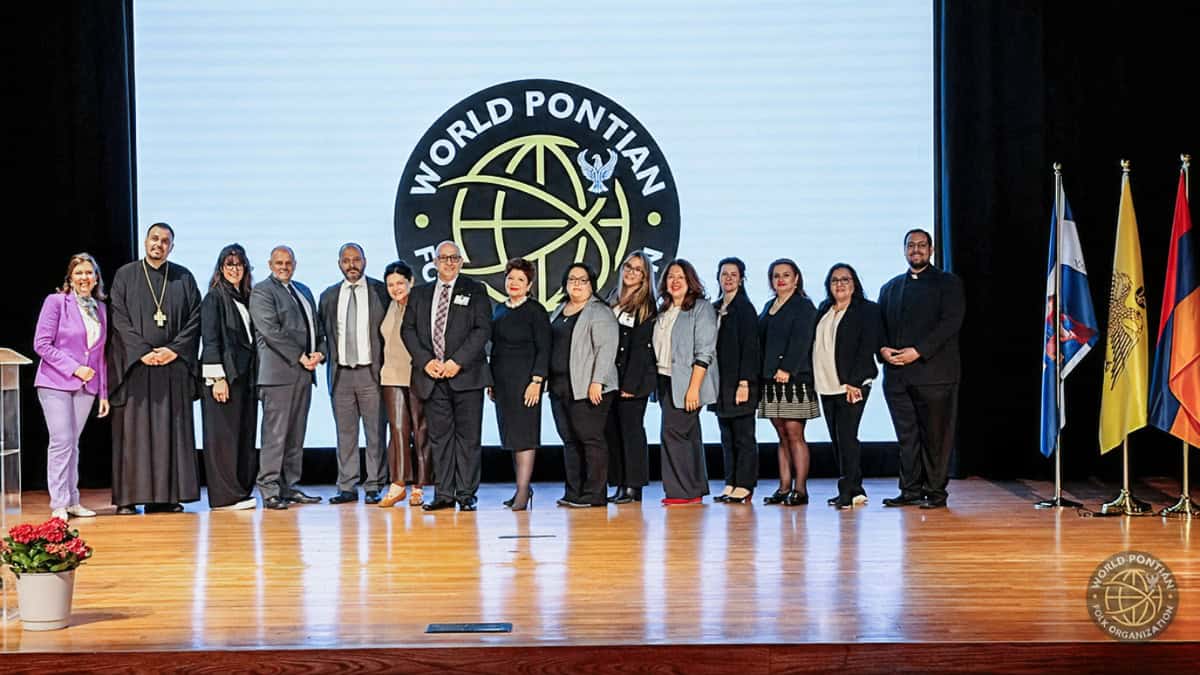
Pontian history often survives in family memory, church life, song, and community commemoration more than in wider public conversation.
A symposium held April 18 at the Maliotis Cultural Center in Brookline brought that history into a broader public discussion, gathering scholars, clergy, and community members around the Christian heritage of Anatolia and the histories of Greek, Armenian, and Assyrian-Chaldean communities. The event was organized by the World Pontian Folk Organization.
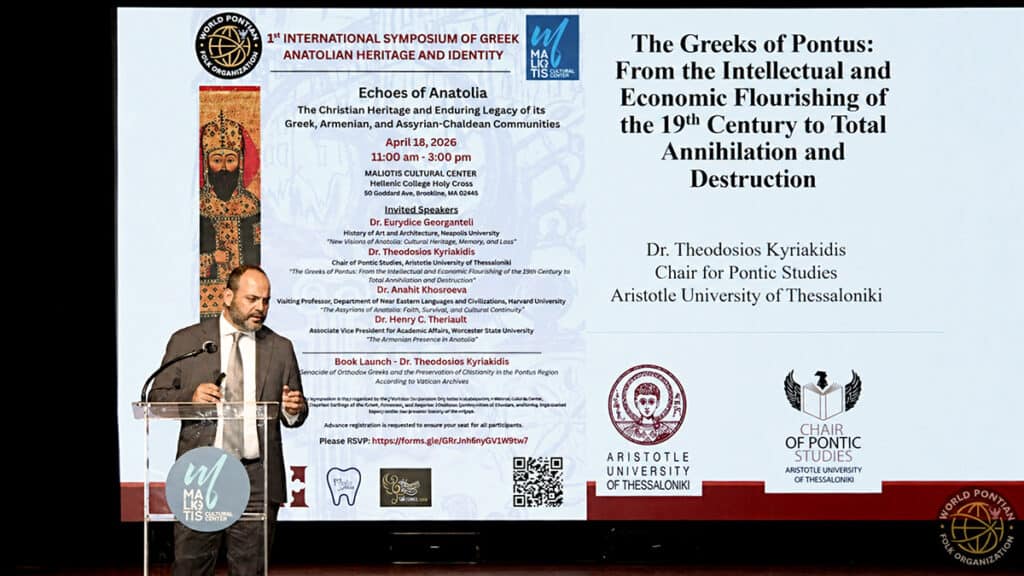
Held at Hellenic College Holy Cross under the title Echoes of Anatolia: The Christian Heritage and Enduring Legacy of its Greek, Armenian, and Assyrian-Chaldean Communities, the event moved beyond a single-community heritage program. Its focus was not only Pontian Greek memory, but the wider question of how Christian communities of Anatolia are studied, remembered, and discussed across generations and across diasporas.
The speaker list gave the symposium real academic weight. Dr. Evridiki Georganteli of Harvard University addressed cultural heritage, memory, and loss in Anatolia. Dr. Theodosios Kyriakidis of the Chair of Pontic Studies at Aristotle University of Thessaloniki traced the history of the Greeks of Pontus from the 19th-century flourishing to destruction. Dr. Anahit Khosroeva of Harvard focused on the Assyrians of Anatolia, while Dr. Henry C. Theriault of Worcester State University spoke on the Armenian presence in the region.
That range mattered. Rather than treating Pontian history in isolation, the program placed it alongside Armenian and Assyrian-Chaldean experience, giving the day a wider historical frame. The result was a symposium shaped not only by remembrance but by comparison, scholarship, and the recognition that these histories remain connected.
One of the day’s clearest focal points was the presentation of Kyriakidis’s book, The Genocide of Orthodox Greeks and the Persecution of Christians in the Pontus Region According to Vatican Archives. The book was presented as part of the symposium program and described by organizers as drawing on Vatican archival material concerning the persecution of Orthodox Greeks and other Christian populations in Pontus during the early 20th century.
The program was not limited to academic papers. It also included opening remarks, church participation, and a presentation of Parthen I Romania, a well-known Pontian piece associated with memory and loss. In that setting, it connected the historical discussion to the emotional language through which Pontian memory has often been carried.
Among those noted in the press material were V. Rev. Fr. Bartholomew Mercado, Rev. Fr. Alexandros Pretorian of St. Nektarios Church in Roslindale on behalf of the Greek Orthodox Metropolis of Boston, and a message delivered on behalf of Archimandrite Petros of the Monastery of Dionysiou on Mount Athos. Their presence gave the gathering a church dimension that matched the symposium’s attention to faith, endurance, and communal memory.
For the World Pontian Folk Organization, founded in 2024 and publicly launched this year, the symposium served as a first substantial public statement of what the group wants to be: a place where Pontian and Anatolian Greek heritage is not only commemorated, but studied, interpreted, and placed in dialogue with related histories.
In that sense, the event was less a ceremonial debut than an effort to claim public space for a subject that is often carried privately, within families and communities, rather than treated as part of a larger historical conversation.