
Chios, Greece’s fifth-largest island, a stone’s throw from Turkey, is known for its physical beauty, its unique product, mastic, which grows only in the island’s south, and for its nautical prowess. Together with the diminutive neighboring island of Oinousses, Chiots own about ten percent of global shipping.
Yes, ten percent, which means that they own fifty percent of the total Greek figure. Greeks own twenty percent of the global total. Few people today, however, know about the Chios merchants, who played a central role in eighteenth and especially nineteenth-century trade. Even in Chios, their legacy is often misunderstood.
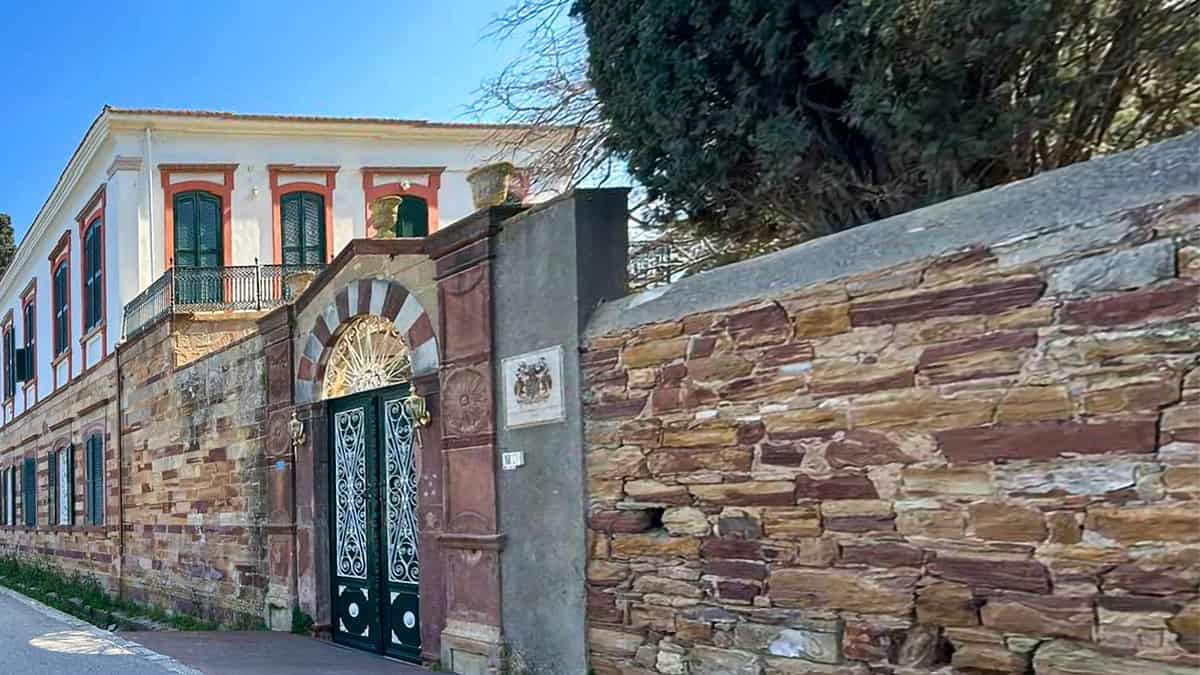
Just a few minutes’ drive south of Chios’ Chora, the capital, and its airport, lies the Kambos, which I call, perhaps inappropriately, a suburb. Here, drowned in citrus trees and ringed by long walls, stand a series of palazzi in local red stone, stylistically Genoese, with large architectural infusions of Byzantine and Ottoman, where dozens of merchant dynasties, often with roots in Genoese and Byzantine nobility, built their large estates.
These families, heavily intermarried to hold fortunes close, expanded heavily in the eighteenth and nineteenth centuries, as the Industrial Revolution began, sending people abroad to establish merchant offices and return periodically, or to retire to large, elegant estates, in a pre-industrial version of today’s diaspora repatriations.
Visitors marveled at the exquisite taste of these mansions, with priceless fixtures and paintings, and even technological innovations, such as telescopes, to view nearby Asia Minor and Samos from silk-canopied verandas, often enough in pebble mosaics that are a fixture of the island.
In 1822, during the Greek War of Independence, these same mansions’ spyglasses beheld Turkish hordes disembarking from Asia, as the island was put to fire and sword, permanently disfiguring fair Chios. The cruel hammer of the Chios Massacre fell most heavily on the Kambos residents, due to their wealth and the Turks’ wish to make an example of their cosmopolitan, successful owners. To this day, Chios has never fully recovered demographically.
Fortunately for Kambos families, scores of their kin were either already abroad, such as the Ralli family, or they escaped via Psara just to the west, and therefrom, quite literally, to the four winds. These merchants, with operations from Odessa to Marseilles, Trieste, London, Liverpool, New York, Alexandria, New Orleans, and Bombay, absorbed these traumatized refugees.
These families, bolstered by massacre exiles, played low-key but central roles in the grain, jute, and most importantly, the cotton trades. Though Chios remained stricken and many of the Kambos estates never recovered, others were revived as fortunes abroad were tentatively reinvested at home, though Chios was to remain under Turkish rule until liberated via an amphibious landing in the First Balkan War in 1912.
Chios and its Kambos families, together with other upwardly mobile Chiots, had created a “Chios in exile” via a vibrant economic ecosystem that was a discreet driver of the nineteenth-century global economy.
Today, the Kambos remains an architectural time capsule of the story of a global commercial elite, whose high walls of red stone, with sentinels of citrus trees, stand guard over their elegant Italianate mansions. They range from active homes renovated either by descendants or new buyers, to decaying edifices, celebrating a past traumatized by a singular horror and punctuated by earthquakes.
When I visited Chios in March 2025, I had the singular honor of visiting Kambos with Lorenzo Argenti, a descendant of the famous Chiot Argenti family, whose name is contemporaneous with centuries of Greek and global history.
We met at the Koraes Library, which houses the Argenti Museum containing artifacts and thousands of books donated by Lorenzo and his late father, Philip, a Greek diplomat and prolific author who chronicled the Kambos merchant diaspora.
His ancestral mansion, the Argentikon, is now owned by the Tomazos shipping family, but Lorenzo walked me through the estate, encircled by walls at least nine feet high with an imposing gate characteristic of all Kambos estates.
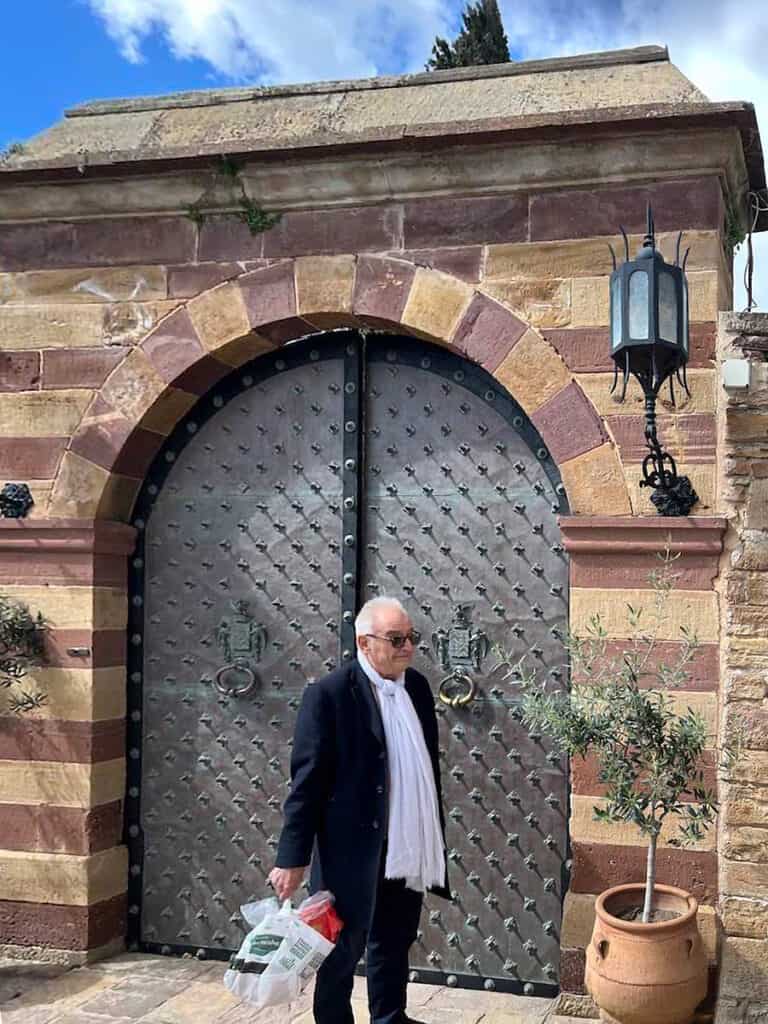
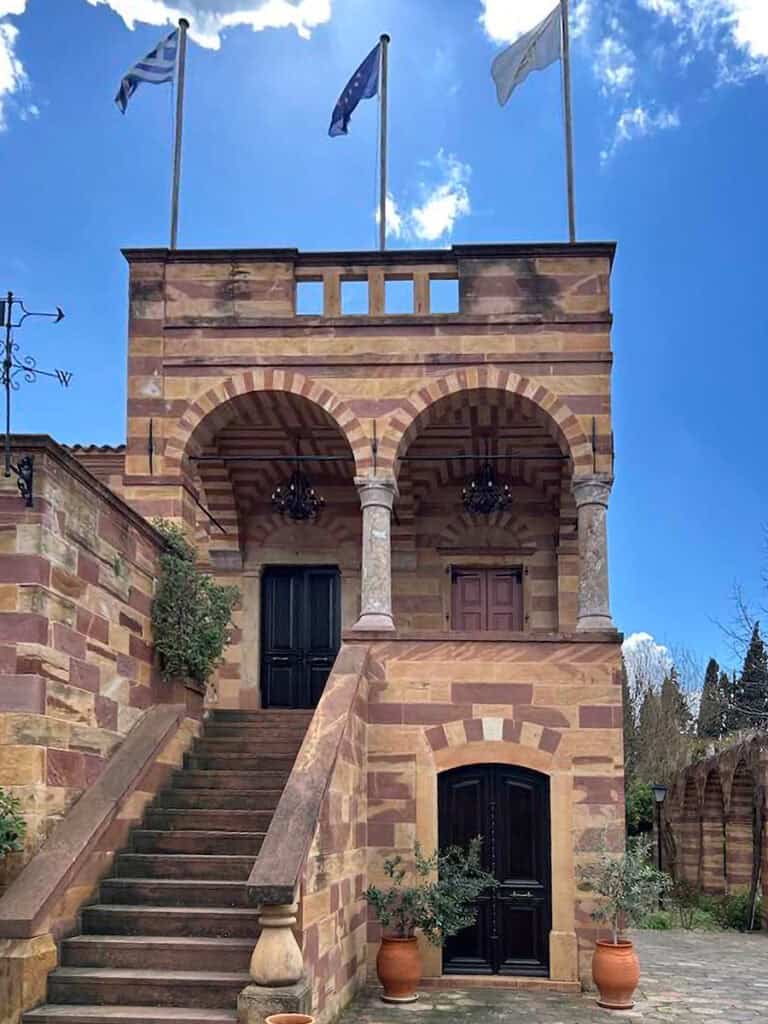
Inside, there were rows of carefully tended lemon and orange trees, their thirst slacked by a now automated water wheel typical of the region, which yields the best citrus in Greece, and that is an impossibly high bar.
He walked me through the mansion, whose caretaker welcomed us effusively and guided us through several buildings. The mansion’s current state is largely the work of Lorenzo’s father, Philip, who infused both cash and taste into the estate.
Many mansions are similarly well-maintained, yet others have fallen to recent or earlier ruin as years, fortunes, and fates, seismic, economic, and political, have taken their toll.
A few minutes’ walk from the Argentikon, the Citrus Museum provides further exhibits and information on remarkable journeys, both of the orange ubiquitous to the region, as well as of the wide reach of the Kambos merchants’ global network, where maps show communities from Calcutta to New Orleans with dozens of points between.
Then there are the gates, dozens of them, all keystoned with heraldic family symbols often enough in marble. Some are well-maintained, while others either show their age or trauma in structure.
With the right guide, you will learn the story of each, which often takes you across continents and the currents of commerce and war. These family names were headlines in the financial pages of New York, London, and Marseilles, not to mention Greece, though now their descendants are likely as not comfortable denizens of the smarter districts of Paris, London, New York, or Athens.
Often, they make the trip to Chios, and it inevitably includes a pilgrimage to the Kambos, an ancestral home, whether renovated or ruined, that reminds them of their quiet legacy hidden in plain sight.