
National Geographic has named Crete one of the world’s top food destinations for 2026. But the real story isn’t discovery; it’s whether the island can keep its food culture rooted in producers, villages, and place as tourism and climate pressures grow.
Crete did not suddenly become a food destination in 2026.
When National Geographic named Crete one of its Best of the World food destinations for 2026, and Euronews amplified the news for travel readers, the story could easily have flattened into another pleasant headline about Greek food, olive oil, and summer. But Crete’s food moment is more interesting than that.
The island is also the officially awarded European Region of Gastronomy 2026, a title granted through the International Institute of Gastronomy, Culture, Arts and Tourism, known as IGCAT. That distinction places Crete inside a broader European effort to connect food with local economies, heritage, sustainable tourism, and community life. In other words, this is not only about where travelers should eat. It is about how a region uses food to tell the truth about itself.
For anyone who knows Crete, the recognition feels less like a discovery than a confirmation. Cretan food has always carried more than flavor. It carries landscape, memory, season, work, hospitality, and a particular understanding of abundance, not as excess but as knowing what the land gives, when it gives it, and how little needs to be done when the ingredients are honest.
Crete’s food predates every modern travel list. National Geographic points readers back to Knossos and the island’s ancient food culture, with evidence of storage, wine drinking, and organized agricultural life in the Minoan world, where food, farming, oil, wine, and ritual were already deeply woven together.
That long history matters because it keeps the modern story from becoming a marketing slogan. Crete is not selling generic “Mediterranean cuisine”; it is drawing on one of the oldest food cultures in Europe, shaped by olives, grains, legumes, vines, and livestock, and by the hard intelligence of people who learned to live with mountains, sea, drought, and distance.
The modern reputation of the Cretan diet also has a scientific layer. Crete became central to twentieth-century research on the Mediterranean diet, especially through the Seven Countries Study, which brought global attention to the link between traditional eating patterns and heart health. But the older Cretan diet was not a wellness brand and was never built around isolated “superfoods.” It was a way of life.
Olive oil was not a garnish. Wild greens were not a trend. Legumes were not a vegetarian option for special menus. Bread, rusks, pulses, herbs, cheese, honey, wine, and seasonal vegetables formed a daily grammar of eating. Meat had its place, but it did not dominate the table in the way outsiders sometimes imagine Greek food.
That may be one of the most useful parts of the picture for Greek Americans. In the United States, “Greek food” is often understood through a narrow set of familiar dishes: gyro, souvlaki, Greek salad, spanakopita, feta, and baklava. Those foods have their place in diaspora life; they belong to church festivals, diners, family restaurants, and American memories of Greekness. But Crete reminds us that Greek food is not one cuisine. It is regional, local, seasonal, and sometimes intensely specific.
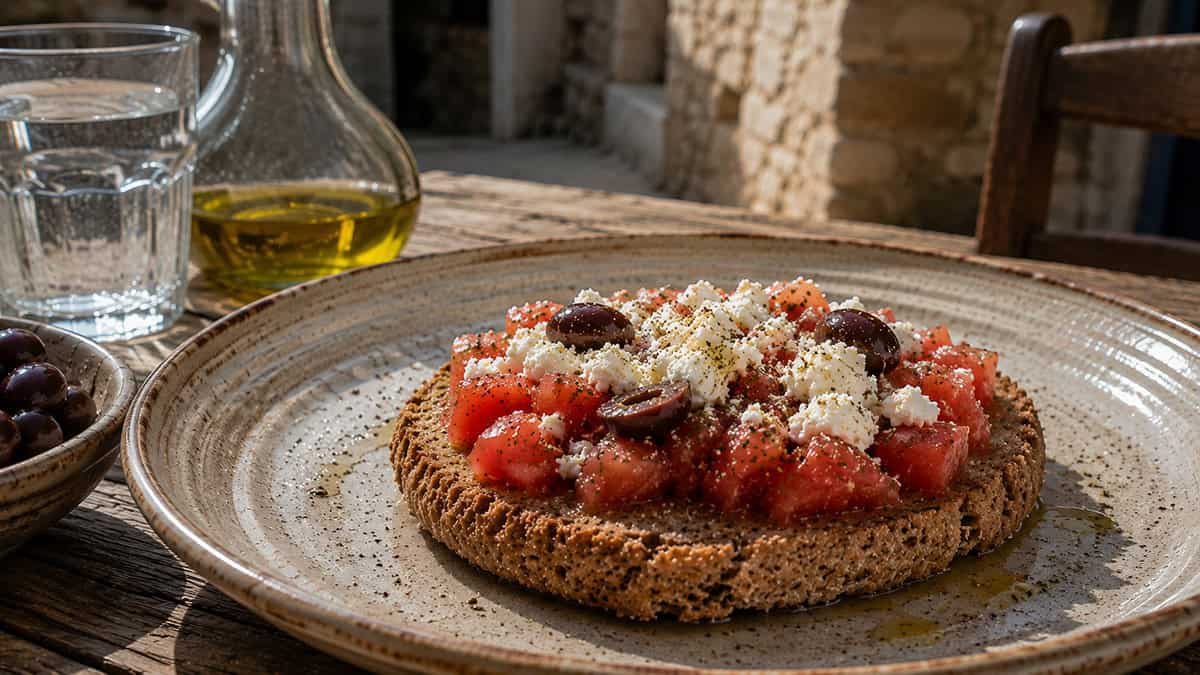
Cretan food is dakos with barley rusk, tomato, olive oil, and cheese. It is horta gathered by people who know which greens are edible and when they are at their best. It is graviera, xynomyzithra, pichtogalo from Chania, xygalo from Sitia, honey from thyme and pine landscapes, snails cooked with rosemary and vinegar, lamb and goat when the occasion calls for them, and tsikoudia poured not as a cocktail but as a gesture of welcome.
The official Taste Crete platform presents this food culture as living heritage, not a museum piece, and that difference is the whole point. A cuisine can be old and still alive, traditional and still open to careful interpretation. The best Cretan cooking does not survive because it is frozen in the past. It survives because families, shepherds, cooks, and small producers keep carrying it forward.
The island’s protected products make that concrete. Crete has major olive oil designations, including Kolymvari Chanion Kritis, Peza Irakliou Kritis, and Sitia Lasithiou Kritis, alongside the broader “Kriti” extra-virgin olive oil registered as a protected geographical indication. Its cheeses include Graviera Kritis, Xynomyzithra Kritis, Pichtogalo Chanion, and Xygalo Siteias. Its honey, wines, and tsikoudia give the table even more regional identity.
These designations can sound technical, but they do real work. They show that Cretan food is not just a feeling; it is tied to real places, real methods, and real producers. They also keep names from being emptied of meaning, anchoring a claim in geography and practice rather than adjectives.
That is where the 2026 title stops being symbolic. The Region of Crete has invited restaurants, hotels, and hospitality businesses to join a Cretan Gastronomy Supporter 2026 program, which encourages them to put Cretan dishes and themed menus in front of visitors, give local products visible space, use Cretan olive oil in declared Cretan dishes, and connect hospitality more directly with producers.
That may sound like an administrative detail, but it is one of the most revealing parts of the whole effort. Crete is trying to make sure the award changes what visitors actually encounter. A tourist should not come to the European Region of Gastronomy and find a generic hotel buffet that could be anywhere in the Mediterranean. The promise of the title is that more visitors will meet Crete through Crete itself.
The challenge is whether that promise can hold.
Crete is already one of Greece’s tourism giants. Millions of international visitors arrive each year, and tourism is a major economic engine for the island. Food tourism can help spread attention beyond beaches and peak season, bringing visitors into inland villages, wineries, olive mills, farms, markets, and family-run tavernas, lengthening the season and giving small producers a stronger place in the economy.
But it can also become another layer of pressure if handled carelessly. Chania and other popular areas already face concerns about overtourism, housing costs, short-term rentals, and the tension between visitor demand and local life. Climate stress compounds the risk: wildfires, heat, drought, and labor shortages all fall on the same olive groves, vineyards, farms, and villages that tourism campaigns celebrate.
That is the hidden question behind Crete’s 2026 food moment: will gastronomy strengthen the island’s local food system, or simply package it for outsiders?
The answer will depend less on headlines and more on where the money flows. If the recognition brings more business to local olive growers, cheesemakers, beekeepers, winemakers, small tavernas, village guesthouses, and younger Cretans trying to stay close to the land, it could become a meaningful model. If it turns into another decorative label for mass tourism, it will lose most of its value.
For travelers, the lesson is simple. Crete should not be eaten only from the edge of the sea.
The island’s food is in the cities, in the markets of Chania and Heraklion, the bakeries, restaurants, and wine bars. But it is also inland, where the pace changes and the food becomes harder to separate from place: mountain villages, family farms, olive mills, the vineyards around Archanes and Peza, cheese tastings, honey producers, and the small rituals that rarely appear on a menu. Spring and autumn may be the best seasons to find this side of the island without the full weight of summer crowds. Spring brings greens, artichokes, and herbs; autumn brings grapes, wine, raki-making, and the first movements toward the olive harvest.
For us, this carries an added layer. Food is one of the main ways diaspora communities remember Greece, and the memory is physical before it is anything else. It is bread on the table, olive oil poured without ceremony, tomatoes that taste like summer, a glass raised before anyone has looked at a menu. Recipes travel when people do, and so do the unspoken manners around them: how guests are received, and how no one is in a hurry to leave the table.
But Crete asks for a more precise kind of memory. It reminds us that homeland is not abstract. It has regions, dialects, villages, soils, cheeses, oils, herbs, and ways of feeding people. To say “Greek food” is only the beginning. To say Cretan food is to enter a more specific world.
A meal in Crete can hold 4,000 years of history without announcing it. It begins with olive oil and bread, moves through greens, cheese, honey, wine, and something cooked slowly, and ends with tsikoudia and conversation that outlasts the food. It feels simple because the complexity is not on the plate as decoration. It is behind the plate, in the land, the season, the producer, the village, the memory.
That is what Crete’s 2026 recognition is really about, and what its harder test will measure: not the title itself, but whether food can still belong somewhere.