
There are moments in politics where the language sounds decisive, but the reality underneath hasn’t moved at all.
Last week, President Nikos Christodoulides said that Cyprus will move forward on the issue of the British bases with a “specific plan and design,” adding that preparations had already begun even before his public statements.
It’s the kind of phrasing that suggests direction and intent, but it leaves one question hanging in the air: what does “having a plan” actually mean when the power imbalance is this clear?
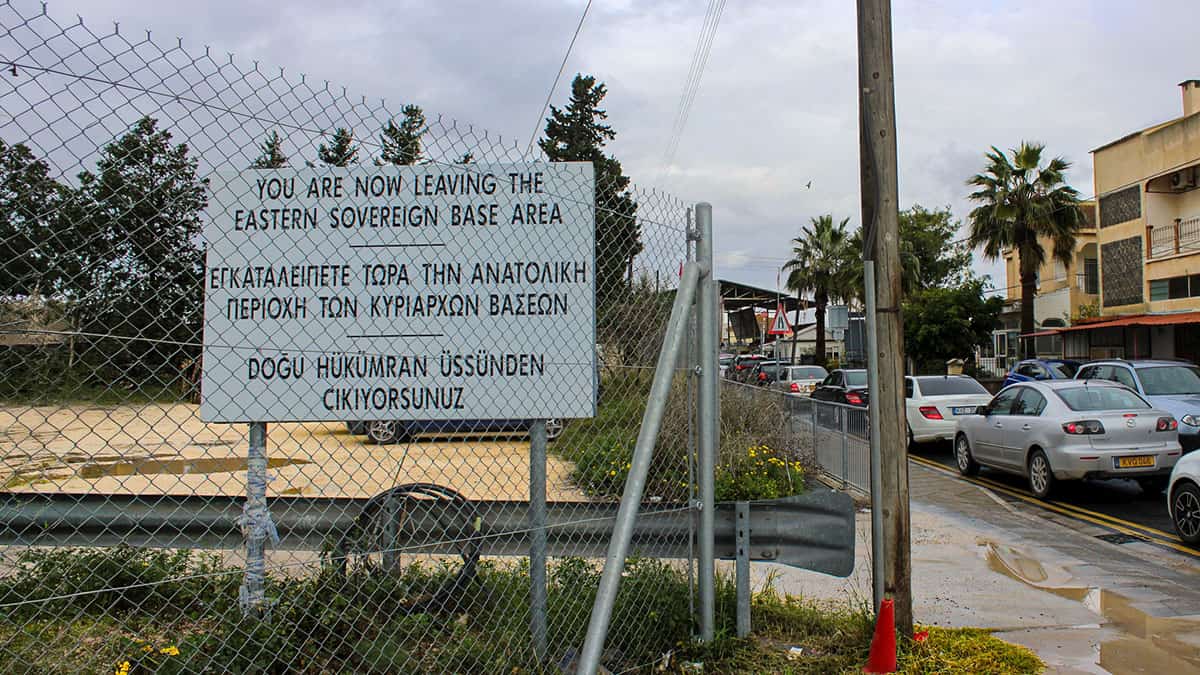
The British bases in Cyprus are not the kind of gray area the term implies. Their status was defined decades ago, written into the agreements that accompanied Cyprus’ independence in 1960, and they remain central to the United Kingdom’s military presence in the region.
These are not symbolic outposts. They are active infrastructure, tied into operations that extend well beyond the island, positioned at the edge of the Middle East for surveillance, logistics, and rapid deployment.
That reality became visible again recently, when a drone linked to Hezbollah was reported near RAF Akrotiri, drawing attention not only from the United Kingdom but from other countries monitoring the broader security environment. In moments like that, the bases are not an abstract question of sovereignty. They function as part of a wider military network, and the reaction they trigger makes clear why their status is treated as fixed.
This is why the response from the British Ministry of Defense matters as much as anything said in Nicosia. That position has been consistent. There is no intention to negotiate the status of the bases.
Cyprus is left in a familiar position, speaking the language of sovereignty while operating within limits set long ago. That conversation unfolds in a country where questions of sovereignty are already layered, most notably by the continued division of the island following Turkey’s 1974 invasion and the ongoing Turkish occupation in the north.
Christodoulides has pointed to recent European Council conclusions as a form of political acknowledgment that, in diplomatic terms, carries some weight. But recognition is not the same as backing. The European Union did not commit to action, outline consequences, or suggest pressure. It noted the position and moved on.
Without leverage, even a clearly defined approach begins to take on a different function. It becomes a signal to domestic audiences, a way of showing that the issue remains active, that it has not been set aside, even if the boundaries themselves have not shifted. That does not make the issue any less real. If anything, it explains why it persists.
The presence of the bases has always sat slightly outside the story Cyprus tells about itself as a fully sovereign European state. It is a reminder that independence came with constraints that were never fully removed.
A plan suggests the ability to act, to change terms, to move from one position to another. But when one side has already made clear that there is nothing to discuss, and the other has no mechanism to compel that discussion, the meaning of that claim begins to shift.
There are examples where long-standing arrangements have changed, but they follow a different pattern. The handover of Hong Kong in 1997 came through years of negotiation between the United Kingdom and China, with both sides holding leverage. It did not begin with one side announcing a strategy. It moved when the balance of power made it unavoidable.
That does not mean stated positions are without effect; over time, even statements without immediate leverage can shift how an issue is framed. But in Cyprus, that balance has not shifted. The country remains in the same position, asserting sovereignty within constraints it cannot alter; instead, what changes is the way the issue is framed, moving away from concrete outcomes and toward positioning.
So when we hear that there is a plan, it’s worth listening carefully.
Because sometimes the clearest part of a political statement is not the plan itself, but the limits it quietly reveals.