
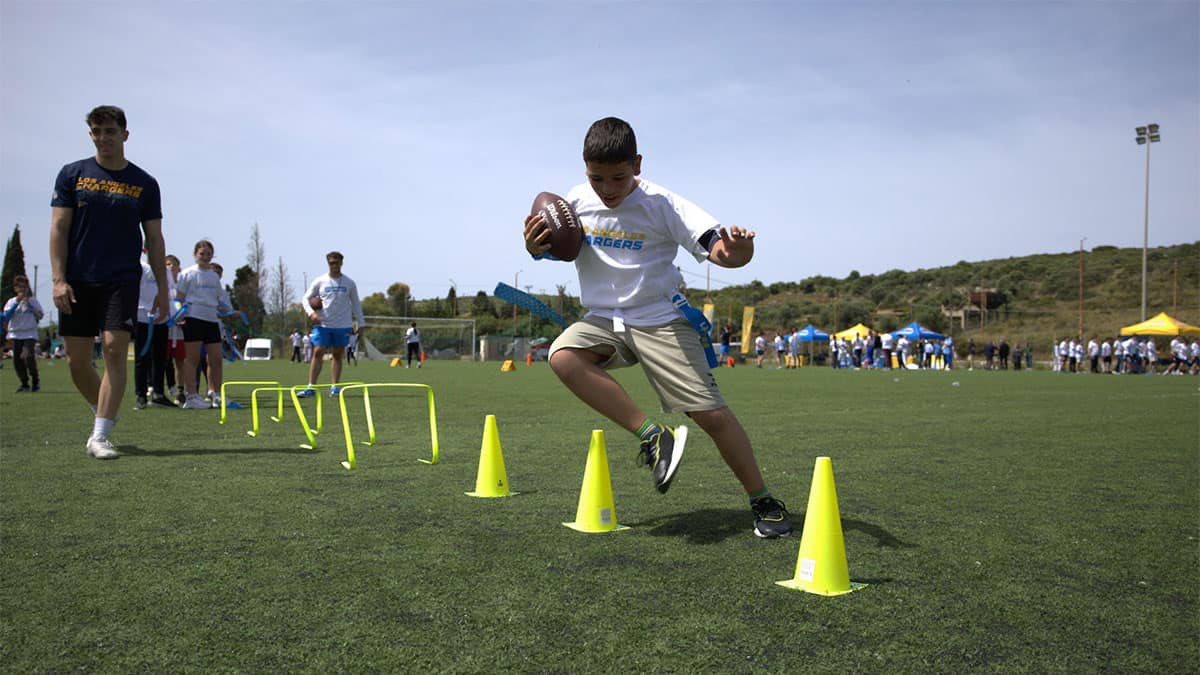
Hundreds of children took part in an NFL flag football camp in Methoni, while the Los Angeles Chargers owner traveled to Eva, the Messinian village his grandfather left for the United States.
The Los Angeles Chargers brought NFL flag football to Messinia, introducing hundreds of children to a non-contact version of American football that will make its Olympic debut at the Los Angeles 2028 Games.
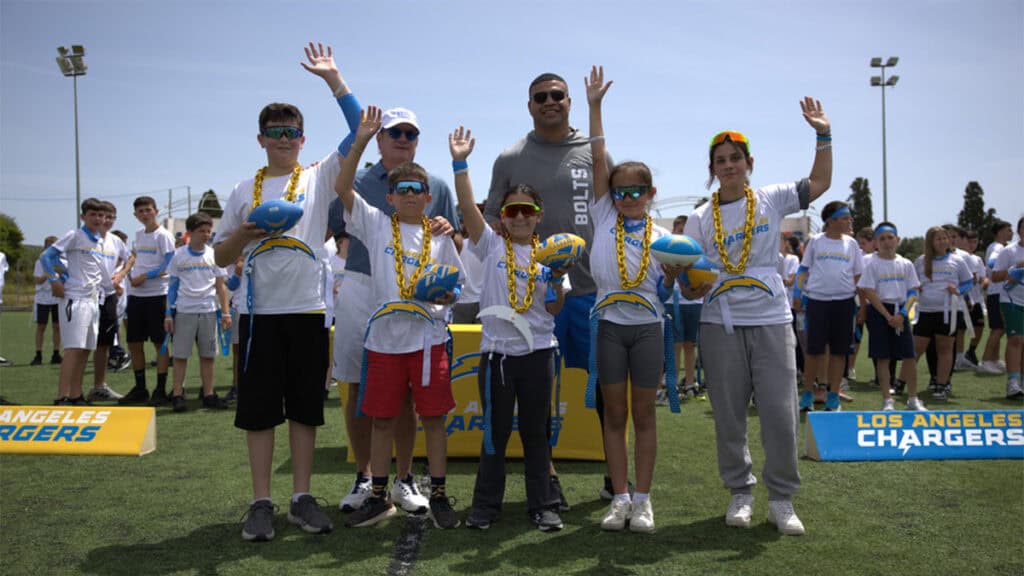
Held in Methoni as part of the Messinia Challenge 2026, the camp drew young participants from across the region for drills and introductory sessions led by Chargers coaches and staff. Former Chargers linebacker Shawne Merriman joined them on the field, encouraging the children and walking them through the fundamentals of the game. It was the fourth NFL flag football camp held in Greece, after earlier stops in Santorini, Thessaloniki, and Athens.
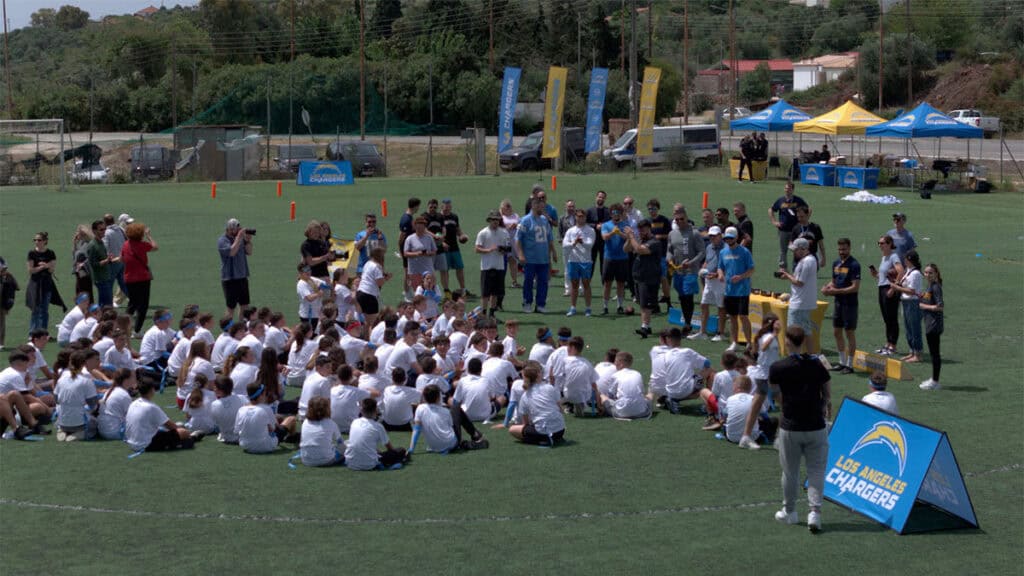
For Chargers owner and chairman Dean Spanos, the trip carried a personal weight that set it apart from the organization’s other international work. His grandfather was born and raised in Eva, a village in Messinia, before emigrating to the United States, making the visit as much a return to family roots as a sports initiative.
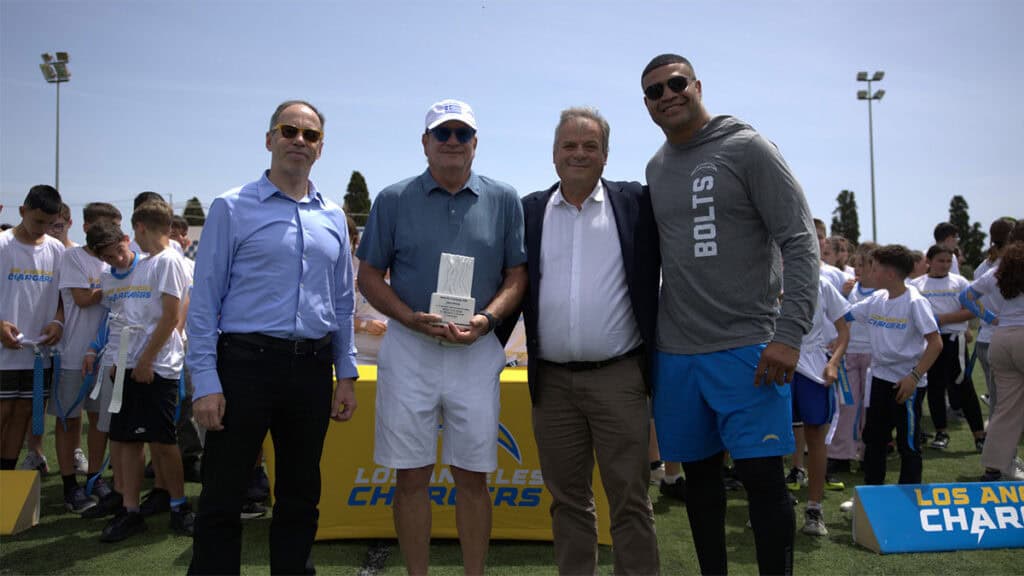
The camp also drew Greek sports and local officials. George Mavrotas, Greece’s General Secretary of Sports, tied the event to a broader push to introduce young people to new Olympic sports and to link athletics with education and community life. Spanos met separately with Isidoros Kouvelos, president of the Hellenic Olympic Committee, and Achilleas Constantakopoulos, chairman and CEO of TEMES. Panagiotis Karvelas, mayor of Pylos-Nestor, presented him with a commemorative award for his contribution to sport and youth development and his enduring ties to the region. Representatives of the U.S. Embassy in Greece also attended.
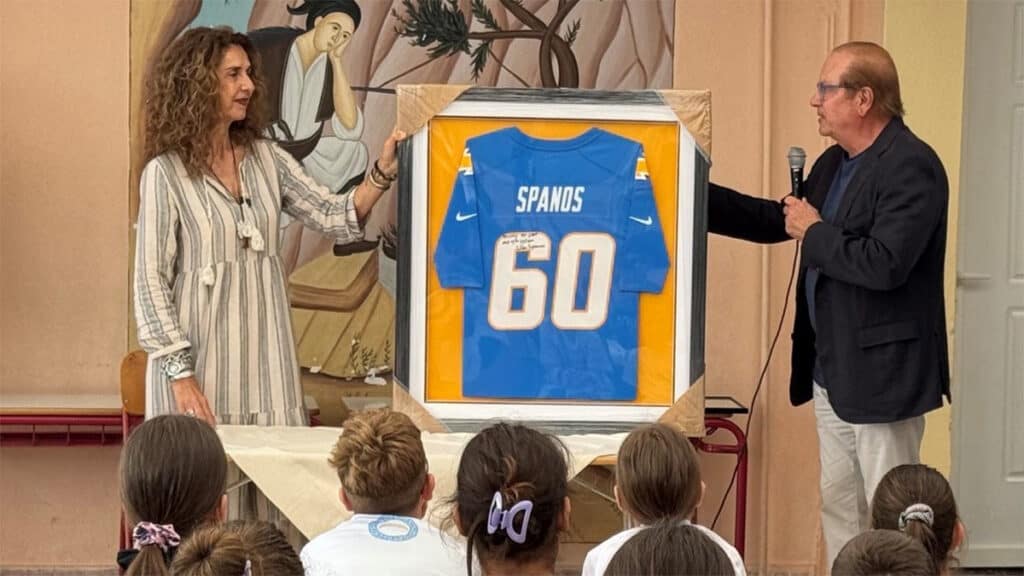
The warmest reception came from a school in Methoni, where children and teachers gave Spanos handmade gifts and mementos. For families in a part of Greece where American football is still unfamiliar, the camp was a rare brush with an NFL program.
The following day, Spanos traveled to Eva itself. He and Chargers representatives visited the village’s only elementary school, meeting students, teachers, and residents. The team donated an autographed jersey and other signed memorabilia, Spanos left a personal letter for the school, and the organization provided new air-conditioning units for the classrooms. He also stopped at the local church, which his grandparents had helped fund, a building that, for the Spanos family, marks the older story of departure and return.
“Being here in Messinia and visiting the village where my family comes from is incredibly meaningful to me,” Spanos said. “Seeing so many children take part in the camp and embrace flag football makes me proud and optimistic for the future of the sport in Greece. My family has always had a deep connection with this country, and it is special to continue building that relationship through sports and community.”
For the Chargers, the visit was another step in flag football’s international growth. For the children of Messinia, it was a first taste of a sport now headed to the Olympic stage. For Spanos, it was a homecoming to a village, a school, and a church his family never entirely left behind.