
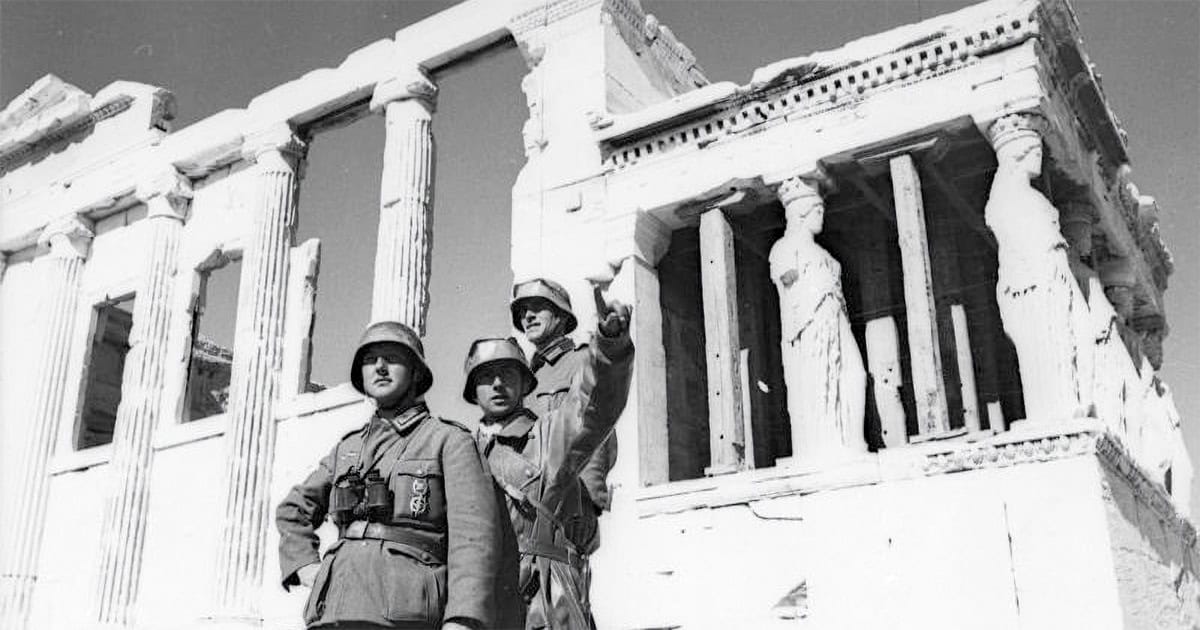
If you ask someone in our community what Germans thought of Greece during the war, you’ll probably hear about the occupation, the hunger, or the reprisals. What you probably won’t hear is the name Erhart Kästner. And yet, for many Germans, he shaped what Greece meant.
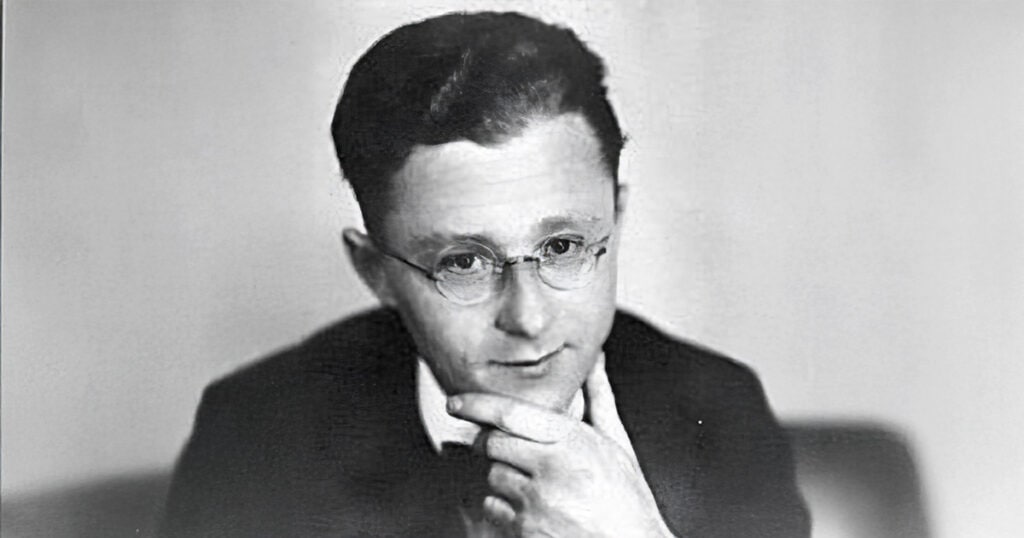
Kästner was a German writer and librarian who came to Greece in 1941 as a Luftwaffe officer. He had a background in classical studies, which he used to secure a post in Athens as a military interpreter and cultural liaison. He arrived just weeks after the occupation began and soon received permission to travel extensively. His task was to prepare a book that would help German soldiers understand the cultural landscape of the country they were occupying.
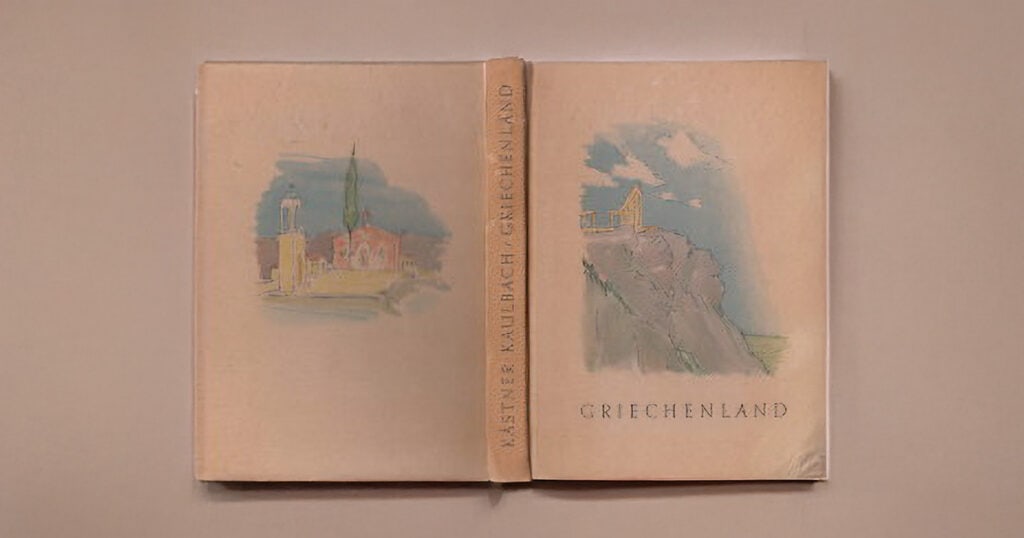
That book, Griechenland. Ein Buch aus dem Kriege, appeared in a special soldiers’ edition in December 1942. The first shipment of 5,000 copies reached Athens by January. It was stocked in Wehrmacht unit libraries across Greece and the Balkans. Kästner’s writing stood out. It was literary, filled with references to Homer, Herakles, and the ruins of Delphi and Olympia. In one scene at the foot of Mount Olympus, he compared German paratroopers to “the blond Achaeans of Homer.”
But the Greece Kästner described was frozen in time. His book focused on ancient landscapes and spiritual reflections, not on the realities of the occupation. Spyros Moskovou of Deutsche Welle put it plainly: it was “a book about classical Greece, as if the modern country, suffering under occupation, simply didn’t exist.”
This was not an oversight. The Wehrmacht’s cultural branch had a specific purpose: to provide “cultural welfare” to soldiers through books, lectures, and films. Kästner’s book fit that brief perfectly. It reassured troops that they were not merely occupiers, but temporary stewards of a higher European tradition. A deeper analysis of Kästner’s wartime commission is available here.
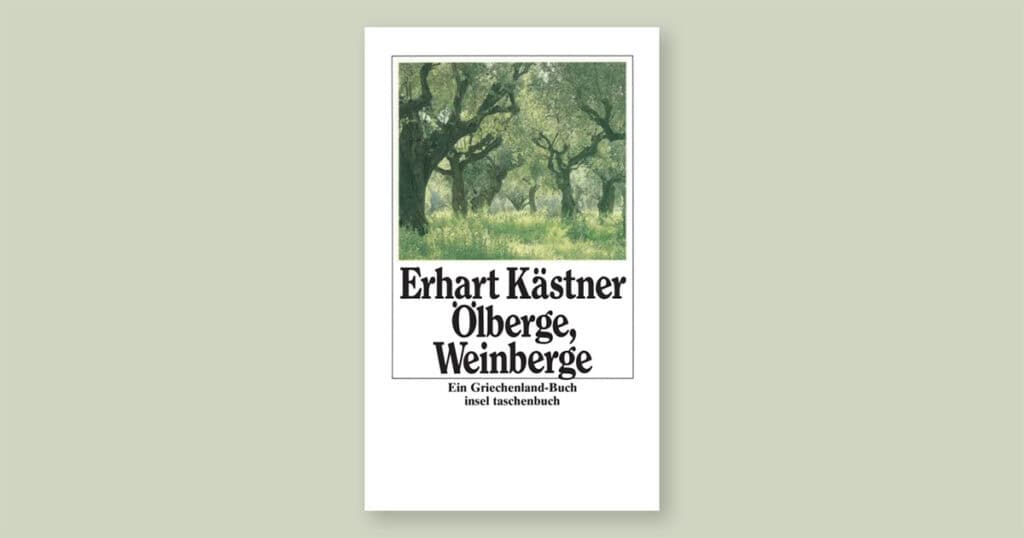
After the war, Kästner was arrested on Rhodes in May 1945, then held by the British in Egypt until late 1947. When he returned to Germany in early 1948, he began revising his wartime writings. In 1953, he published a new version of his Greek reflections under the title Ölberge, Weinberge (Olive Hills, Vine Slopes). The overt Nazi language was gone. So were the racial metaphors. What remained was the lyrical style, the shepherd imagery, and the calm, pastoral Greece that Kästner had always preferred to describe.
The book became a commercial success. Suhrkamp’s Insel imprint reprinted it more than twenty times. By the early 1970s, it had reached over 200,000 copies in circulation. For many German readers and early tourists, Kästner’s Greece became a guidebook of sorts—a literary map of sacred spaces and timeless virtues, untouched by recent history.
Kästner continued to write about Greece in the decades that followed. His later books, such as Kreta, Die Lerchenschule (on Delos), and Die Stundentrommel vom Athos, carried the same tone. They portrayed Greece as a spiritual refuge, a place of renewal and moral simplicity. What they rarely acknowledged was the historical context in which Kästner had first encountered these places. The war remained in the background, if present at all.
There is one exception. In the revised Ölberge, Weinberge, Kästner briefly mentioned the 1944 massacre at Distomo, where 218 civilians were killed by German troops. He devoted just eight lines to the event and admitted that he had avoided entering the village out of fear of being recognized as a German. It was a rare moment of acknowledgement, but one that came late and remained carefully restrained.
This silence has become one of the defining aspects of Kästner’s legacy. He offered readers a Greece they could admire, but only by removing its present and its pain. Historians now view his work as part of a larger pattern of post-war cultural displacement, in which German engagement with Greece was framed around aesthetics, not accountability.
That tension is not just academic. It matters to those of us whose families lived through the occupation. In Athens alone, tens of thousands died during the 1941–42 famine. In villages like Kalavryta and Distomo, entire communities were wiped out in reprisals. These were not isolated incidents, but part of a larger pattern of violence carried out across occupied Greece. They remain among the best-documented wartime atrocities in modern Greek history. Our grandparents did not experience the peaceful, eternal Greece that Kästner described. They lived through the real one. Kästner saw those things. He chose to say very little.
The DW article captures this duality well. Kästner was “probably both,” Moskovou writes, “a literary opportunist and fellow traveler, but also a sensitive writer, a man out of step with his time, a lover of ancient Greece still worth reading today.” That sentence reflects the lasting ambivalence. Kästner was more than a propagandist. He had real literary skill and real admiration. But sincerity is not the same as honesty.
Kästner’s books are still read in Germany. Tourists still walk the landscapes he described, sometimes with his words in hand. But for those of us who carry different memories of that time, it is worth looking closely at what he left out.
He gave readers a Greece they could admire, as long as they didn’t look too closely. Ours is the task of remembering what the pages left out.