
When Emily in Paris first aired, much of the reaction in France focused on one thing: the city didn’t feel entirely real.
Paris looked cleaner. Quieter. More arranged than it actually is. Cafés were always available, streets always picturesque, interactions always moving the story forward. For many viewers, especially locals, it felt less like Paris and more like a version designed to be immediately understood.
That approach wasn’t accidental. The series, created by Darren Star, follows a familiar formula. Place is introduced quickly and clearly, then shaped around the character rather than shaping them. The setting becomes part of the tone, not the subject.
It’s a model that travels well. Audiences don’t need context to understand where they are or what it’s supposed to feel like. Paris becomes shorthand for a certain kind of life, and when the story briefly shifts to Rome, the same logic applies. What emerges is a kind of visual system, where places are reduced to elements that can be recognized instantly.
Greece already exists within that system.
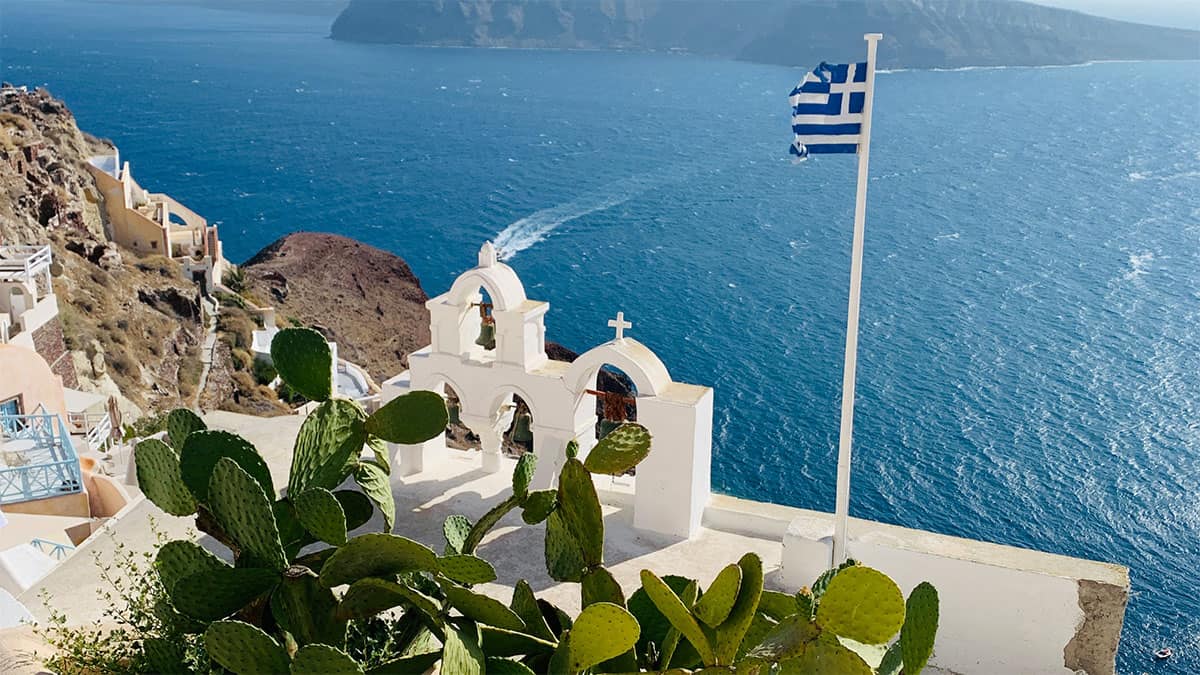
You see it in travel campaigns and widely circulated imagery, where places like Santorini are reduced to a handful of recurring views. The same terraces, the same blue domes, the same vantage points appear again and again, carrying the weight of the whole. These images aren’t inaccurate, but they are selective. Over time, they become a default way of seeing the country.
In Emily in Paris, daily life rarely sets the pace. Scenes move quickly. Spaces are introduced and left behind just as fast. Background activity exists, but it doesn’t shape what happens.
A Greek summer works differently. The day slows in the heat. Plans shift. People return to the same places because they’re familiar, not because they’re curated. Conversations continue across evenings rather than resolving in a single scene.
And behind that rhythm are the people who keep it running, often working long seasonal hours that rarely appear in the image itself, as young seasonal workers across Greece take on the bulk of that work each summer. Greece may be marketed as a place of leisure, but in reality, it also has some of the longest average working hours in the EU.
That kind of continuity, built on repetition and shared routine, is harder to capture in a format designed around movement.
This isn’t about inaccuracy, but about structure. When places are presented through a visual system designed for global audiences, clarity comes first, and complexity is reduced.
If Greece appears more often in this kind of storytelling, it will likely follow that same pattern. The image will be recognizable, and the feeling familiar, but it will still only be part of the place.