
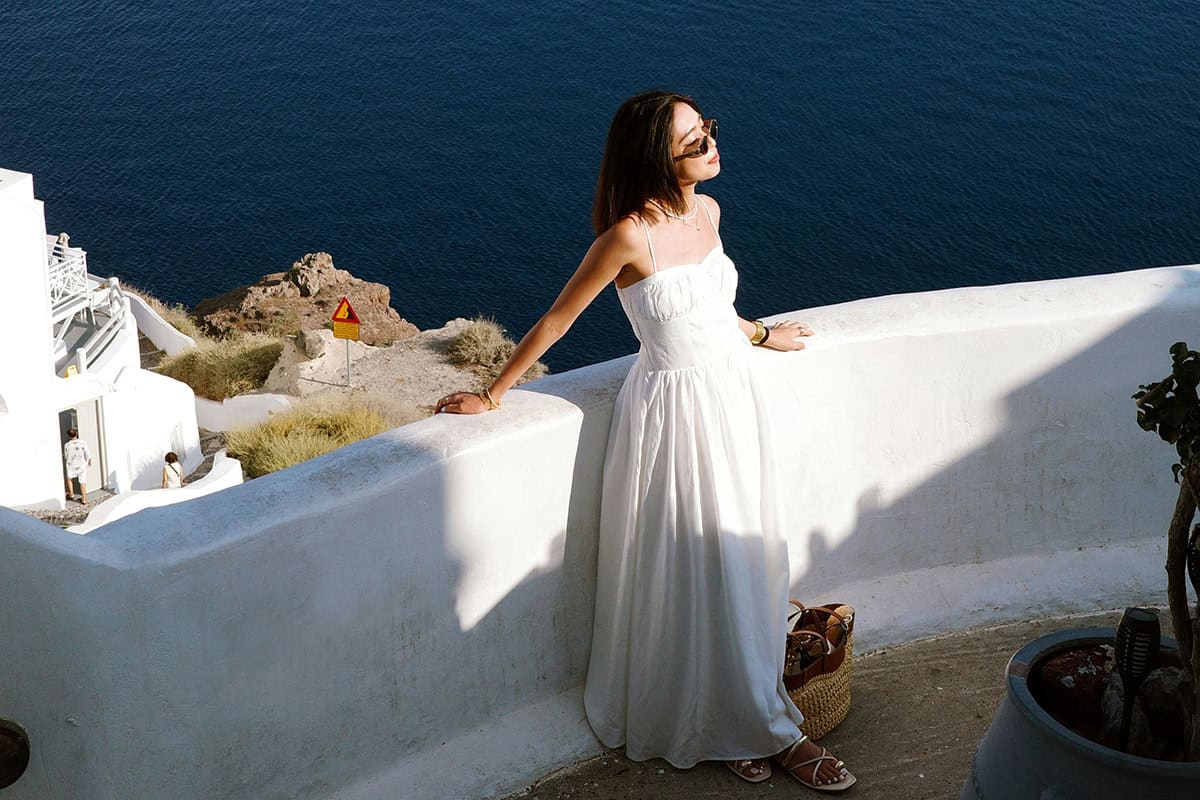
A wedding in Greece begins with a couple, but it rarely stays that small.
Parents come. Cousins come. Friends turn the invitation into a trip. A ceremony becomes four days of hotel rooms, dinners, buses, flowers, music, photographs, boat rides, late nights, and long tables where people who may have never met before begin to feel like family.
For the Greek diaspora, the pull can be even stronger. Greece is not only a beautiful place to marry. It may be the island a grandparent left, the village a family still talks about, the church where relatives were baptized, or the summer place that has lived for years in stories. That emotional weight is now part of a serious conversation in tourism.
According to a Focus Bari study reported by GTP Headlines, destination weddings in Greece could generate up to €2.43 billion annually under an optimistic market scenario. The study estimates an average wedding budget of €157,300 excluding VAT, with about 130 guests staying roughly four nights.
The figures are sometimes rounded in coverage, but the Focus Bari presentation uses €157.3k for the average budget and €2.43 billion for the optimistic scenario.
The estimate needs care. It is not an official government total. It is an industry-based estimate, built from research and extrapolation. Greece does not yet have a separate national figure showing exactly how much foreign weddings bring into the economy.
The study still captures a shift already visible in Greek tourism. Greece already has global demand. The country welcomed more than 40 million inbound travelers in 2024 and collected more than €21.5 billion in travel receipts, according to the Bank of Greece. The same release reported that average expenditure per trip declined by 7 percent, while the average length of stay fell to 5.9 overnight stays.
Weddings offer a different pattern.
Wedding guests rarely pass through quickly; they stay for several nights. They attend welcome dinners, beach days, church services, receptions, brunches, excursions, and family gatherings. They spend money in more than one place, often with local businesses that depend on this kind of work: planners, venues, florists, drivers, musicians, makeup artists, caterers, tavernas, wineries, photographers, and small hotels.
A single wedding can spread spending across a local economy in ways ordinary tourism often does not. It can also move beyond the places that already carry so much of Greece’s tourism weight.
Santorini, Mykonos, Athens, and the Cyclades will always attract couples. They have the views, the venues, the planners, and the name recognition. They also have the crowds, the costs, and the strain that come with being world-famous. The larger opportunity may be outside the best-known destinations.
The Peloponnese, Epirus, Halkidiki, lesser-known parts of Crete, the Ionian islands, wine regions, mountain villages, historic estates, and smaller Aegean islands all have the raw material for memorable weddings. They have food, landscape, churches, family hotels, beaches, vineyards, village squares, and a pace that can feel more personal than polished.
Many still need coordination. Couples abroad need clear information, reliable local contacts, easier paperwork, professional planning support, and confidence that a wedding outside the obvious destinations will not become a logistical gamble.
The Focus Bari findings point to demand for privacy, design, dining, and local experience. The study points to strong interest in authentic local experiences, customized design, privacy, and fine dining, which are all areas where Greece can compete without turning every wedding into a luxury package.
The strongest Greek wedding settings are often the ones that feel lived-in: a courtyard after the liturgy, a harbor at dusk, a vineyard dinner, a family-run hotel, a taverna table under trees, a village square where children run between chairs and older relatives sit quietly at the edge of the music. For the diaspora, those details are not decoration. They are often the reason to come.
A Greek wedding in Greece can bring together people who usually live on opposite sides of the world. Relatives from abroad meet relatives in Greece. Older guests return to places they left decades ago. Younger guests see names, foods, churches, beaches, and villages that had only existed as family references.
Advertising alone cannot create that value. Greece has what many destinations try to manufacture: memory, belonging, ritual, and return.
The source markets named in the Focus Bari material include the United States, the United Kingdom, Australia, Canada, and Israel. For Greece, that mix matters. The United States, Australia, Canada, and the United Kingdom all have established Greek diaspora communities, while Israel highlights Greece’s broader appeal as a nearby Mediterranean wedding destination. Together, they show that the market is not only about ancestry or scenery. It sits at the crossing point of family ties, regional travel, and international demand for Greek settings.
Legal recognition also matters for some couples choosing where to marry. Greece legalized same-sex civil marriage in 2024, becoming the first Orthodox Christian country to do so, according to the Associated Press. That does not make every social, family, or religious setting simple. Still, it gives Greece a broader place in the international wedding market, especially for couples seeking a Mediterranean civil wedding in a country where their marriage is legally recognized.
The practical work is less glamorous than the photographs. The Focus Bari presentation points to the need for a targeted international campaign, better access to iconic locations for experiences and photo shoots, investment in premium venues across the regions, season extension, promotion of new destinations, and stronger coordination between the industry, the Greek National Tourism Organization, and the Ministry of Tourism.
Those choices will shape the market. If wedding tourism adds more luxury events to already crowded islands, the benefit will be limited. If it brings work to more regions, more months, and more local suppliers, it could become one of the healthier parts of Greek tourism.
A destination wedding begins as a personal decision. In Greece, it can become something larger: a family return, a regional business opportunity, and a reason for guests to stay, gather, spend, and come back.