
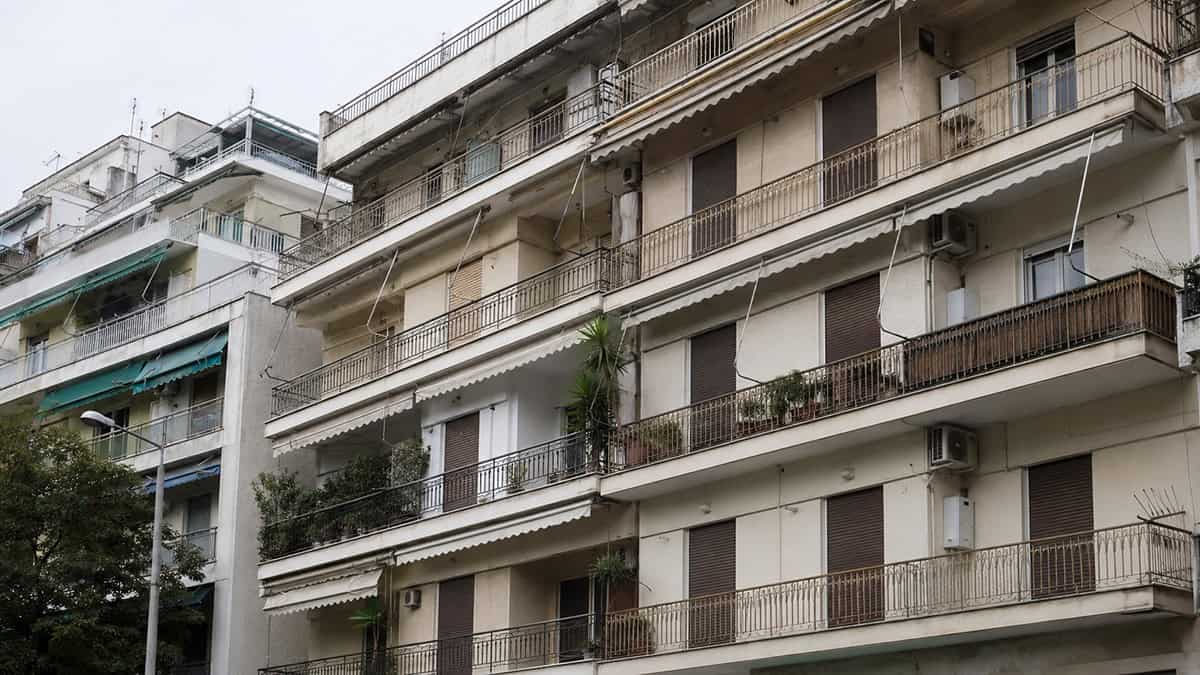
Greece’s housing crisis begins with a contradiction.
The country has a large number of empty homes, yet many Greeks cannot find a place they can afford to rent or buy. Greece’s draft National Housing Strategy says ELSTAT counted 2.2 million vacant homes in the 2021 census. Once secondary and vacation homes are set aside, the government puts the stock more relevant to housing policy at about 800,000 units.
A closed apartment in a village does not help a young couple searching for a one-bedroom in Thessaloniki. An inherited flat with several owners and no agreement between them does not help someone trying to rent near work, school, or family support. An old property that needs major repairs is not real supply for a household already stretched by rent, electricity, food, and transportation.
This is the point often lost in Greece’s housing debate. An empty home is not the same as an available home. It has to be legally clear, habitable, in a place where people need to live, offered for long-term use, and priced within reach of Greek incomes. Without those conditions, the home exists in statistics but not in the life of a renter, a student, a young worker, or a family trying to move.
A new policy paper by KEFIM, written by Ioannis Navrozidis, Christos Loukas, and Nikos Rompapas, gives that contradiction a wider frame. The study argues that Greece is facing a growing gap between demand for housing and the supply of homes people can actually live in, rent, buy, or afford. Airbnb, the Golden Visa, tourism, foreign buyers, low wages, bureaucracy, and the long damage left behind by the financial crisis all matter. None of them explains the whole problem on its own.
The KEFIM study traces much of today’s pressure back to the collapse of residential construction during the crisis years. According to the report, housing investment fell by 95 percent between 2007 and 2017, while residential building permits fell by 84 percent between 2007 and 2016. Greece did not simply pause construction for a year or two. It lost a decade of housing production, along with builders, skilled labor, financing habits, and confidence in the sector.
Construction has returned, but not evenly and not always where ordinary households need it most. Recovery has been more visible in places where projects can command higher prices: expensive neighborhoods, tourist zones, coastal areas, renovated apartments for higher-income buyers, and properties aimed at foreign capital. That activity can make a city look alive again. It can bring cranes, fresh facades, and investment. But it does not automatically create modest rentals or affordable apartments for people earning Greek salaries.
Greece is left with an uncomfortable kind of recovery. Real estate values rise, neighborhoods are renovated, and international interest grows, while many Greeks feel that the market has moved past them.
One strength of the KEFIM report is that it refuses to treat all housing as interchangeable. Greece’s strongest need is often for smaller, livable, reasonably priced apartments in cities, university areas, job centers, and tourist regions where local workers are being squeezed. Students need them. Young adults need them. Separated parents need them. Older people living alone need them. Couples trying to leave the family home need them. But high land prices, construction costs, and limited financing often push new development toward the upper end of the market, where returns are stronger.
The market can produce property value without producing housing relief. That is the difference between a real estate recovery and a housing recovery.
There is also a quieter demographic story behind the numbers. Greece’s population has fallen, but the number of households has grown. Families are smaller. More people live alone. Older people remain in their own homes. Young adults marry later. Some couples separate. Fewer people in the country can still mean more demand for homes when one large household becomes two or three smaller ones. KEFIM also notes that limited access to housing, not only strong family ties, is a main reason many young Greeks remain in the family home.
Airbnb and the Golden Visa fit into this picture as local accelerants. The KEFIM paper does not dismiss their effect. It places it where it belongs. Short-term rentals and foreign investment can matter deeply in specific neighborhoods, especially in central Athens, on islands, in coastal towns, and in areas where tourism dominates the local economy. They can remove apartments from long-term rental use, push prices beyond local wages, and change the character of a building or street.
The broader problem is that these pressures landed on a housing system already weakened by years of underbuilding, costly renovation, slow permitting, legal complications, limited lending, and a damaged construction sector. When demand came back, it came from many directions at once: local households, foreign buyers, tourism, investors, families helping children buy, and people with cash in a market where ordinary mortgage access remained limited.
That is where the politics of housing gets harder than the slogans. Helping people borrow more money may help some families, but if supply remains tight, more credit can simply send more buyers after the same limited number of homes. The KEFIM report warns that easier mortgage access without more supply can add pressure to prices instead of easing the problem.
The pressure is visible in the wider data. According to Eurostat’s 2024 housing figures, Greece had the highest housing cost overburden rate in the European Union. Nearly 29 percent of people in Greece lived in households spending at least 40 percent of disposable income on housing, compared with just over 8 percent across the EU.
Prices have also continued to rise. Bank of Greece data for the first quarter of 2026 showed apartment prices up 5.7 percent nationally from a year earlier, with Athens rising 5.2 percent and Thessaloniki 6.4 percent. A slower increase may be better than a faster one, but it does not feel like relief to people already priced out.
The diaspora is not outside this story, but it is only one part of it. Many Greeks abroad inherit homes, renovate family properties, buy apartments for summers, rent them out, or imagine returning one day. These decisions are often emotional, not purely financial. A house in Greece may be tied to parents, grandparents, village summers, or a sense of belonging that does not fit neatly into market language.
The same is true, in different ways, for owners inside Greece and for foreign buyers who enter the market with stronger purchasing power than local households. Homes stay closed for reasons that are personal, legal, financial, and practical.
At the same time, outside money can change a local market. A property that feels affordable to someone earning in dollars, pounds, or euros earned in northern Europe can be unreachable for someone earning a Greek salary. That does not make any single group the cause of the crisis. It does mean diaspora ownership, foreign buying, local ownership, tourism, inheritance, and investment all sit inside the same housing reality. The question now is how much of Greece’s unused housing stock can realistically return to everyday residential life.
In Attica, the numbers are especially hard to ignore. More than half a million homes were recorded as vacant or closed in the 2021 data, and central Athens alone had more than 117,000 vacant homes, according to Kathimerini reporting based on ELSTAT figures. Those numbers do not mean all these apartments can return to the market quickly. They do show why the debate has shifted from building alone to the harder work of making unused homes usable again.
The government has begun reacting in that direction. Through “Ανακαινίζω Νοικιάζω”, or “Renovate and Rent,” Greece subsidizes renovation or repair costs for vacant homes that are then committed to long-term rental use.
The wider housing strategy now places that kind of program alongside other tools, including tax incentives, new rental-housing models, a proposed national index for property and rent prices, and a possible unified housing policy agency. The consultation text says the housing policy portal gathers 48 existing measures with a total budget of €6.5 billion, while the strategy also discusses additional proposals.
That is more substantial than a single subsidy, but it remains a reaction rather than a solution. A grant can help an owner repair an apartment, but it cannot solve every reason a home stays closed. Some properties are in the wrong place. Some are tied up in inheritance disputes. Some need more work than the subsidy covers. Some owners may still prefer short-term rental income, seasonal use, or simply keeping the property in the family.
Property owners’ groups also argue that the state cannot unlock the stock through pressure alone. ΠΟΜΙΔΑ, the national federation of property owners, has pushed for stronger incentives, including income-tax relief for owners who move closed homes into long-term rental use. Finance Minister Kyriakos Pierrakakis made a similar point at a ΠΟΜΙΔΑ congress, saying the housing crisis cannot be addressed without property owners.
Greece’s housing policy should be judged by that test. Not by how many measures are announced, how large the budget sounds, or how much real estate activity returns to the market. The question is whether inactive properties become long-term homes in the places where people actually need to live.
A vacant apartment is not useful simply because it exists. A strong real estate market does not mean a healthy housing market.
The question is not whether Greece has houses. It is whether people who live and work there can still find a home.