
The renewed Greece-France partnership is one of the most important security developments for Greece in years. It strengthens deterrence, gives Athens a powerful European partner, and places Greece more firmly inside the debate over Europe’s future defense architecture.
But the harder question is not whether the alliance matters. It does. The harder question is what Greece makes of it.
France and Greece have extended their 2021 defense pact while broadening cooperation into defense technology, energy, education, nuclear technology, missile support, research, and military innovation. During his visit to Athens, French President Emmanuel Macron and Greek Prime Minister Kyriakos Mitsotakis framed European defense investment as a complement to NATO, not a replacement, while calling for stronger European defense collaboration and more European-made defense products.
That sounds attractive in Athens. It also deserves scrutiny.
For France, “European preference” often means strengthening Europe’s major defense champions, including Naval Group, Dassault, MBDA, and Thales. For Greece, the same phrase should mean more Greek maintenance capacity, more Greek engineering work, more domestic research, and more participation in European defense supply chains.
Those interests overlap, but they are not identical. France wants a stronger European defense industry with France near the center. Greece wants deterrence, but it also needs industrial depth. A serious alliance has to make room for both.
Greece’s need for modern weapons is not in doubt. The Aegean remains sensitive, Cyprus is exposed to wider regional instability, the Red Sea and the Strait of Hormuz affect Greek shipping, and the war in Ukraine, combined with renewed doubts about long-term American reliability, has pushed Europe into a new era of defense planning. Macron and Mitsotakis also referenced Cyprus during the Athens visit, underscoring how quickly Greek, French, British, Israeli, Turkish, Iranian, and Russian calculations can overlap in the Eastern Mediterranean.
That is why Greece’s modernization program matters. Athens plans to spend about €25 billion on defense as part of a multi-year plan. The program includes new submarines, drones, satellites, fighter jets, and an anti-aircraft and anti-drone shield called Achilles Shield. A later description of the Achilles Shield described it as a multilayer air and drone defense system expected to cost around €3 billion.
But this comes with fiscal limits. Greece already spends heavily on defense, while still needing to protect growth, social cohesion, public investment, and debt reduction. Athens cannot attach industrial demands to every procurement decision.
Athens has to choose where domestic capacity matters most.
The first priority should be in-country sustainment. Greece does not need to build every major platform from scratch. That would be unrealistic. But it should insist that maintenance, repair, upgrades, software support, and integration work for key systems increasingly take place in Greece.
The French-built FDI frigates are the obvious test. Naval Group says its Hellenic Industrial Participation program already involves more than 70 Greek companies and is designed to integrate Greek firms into Naval Group’s supply chain for current and future French and export programs.
That should become the floor, not the ceiling.
If Greece buys additional French naval systems, whether frigates, submarines, missile upgrades, or support packages, Athens should make the industrial condition explicit: Greek yards and Greek technical teams must be part of the maintenance chain. Skaramangas, Elefsis, Salamis, and the wider naval repair ecosystem should not remain spectators while Greece becomes one of France’s best naval customers.
The second priority should be drones, counter-drone systems, electronic warfare, and software-heavy defense. These are areas where Greece has a better chance of building real capability than in trying to replicate the industrial base of much larger countries.
The Centauros anti-drone system is a useful example. The Greek-made system, developed by Hellenic Aerospace Industry, was used successfully during a European Union patrol in the Red Sea and has become part of Greece’s effort to build a homegrown defense industry centered on drones and counter-drone technology.
That points to what HAI can realistically become. Not a Greek Dassault. Not a miniature Israel Aerospace Industries. A better model is a small-state specialist, closer in spirit to Norway’s Kongsberg or parts of Sweden’s Saab ecosystem: focused niches, export discipline, strong integration with allied platforms, and a few technologies where Greece can become genuinely useful.
For HAI, that means counter-drone systems, electronic warfare, autonomous systems, software integration, maintenance, and selected co-production. The test is not whether HAI can do everything. It is whether it can become excellent enough in a few fields that foreign primes need Greek participation, not merely tolerate it.
France is the immediate case. It is not the only one.
This logic applies beyond France. Greece is buying F-35s from the United States, has signed a declaration of intent with Italy for 2+2 Bergamini/FREMM frigates, and is working with Israel on missiles, rocket artillery, drones, and air-defense systems. French dominance is not the only structural risk. The broader danger is that Greece becomes a high-spending defense customer across several alliances without building enough domestic depth in any of them.
Layered security should also mean layered industrial policy. With the United States, Greece should push for maintenance, software, and sustainment roles where possible. With Italy, any naval acquisition should connect to shipyard work and naval support. With Israel, the emphasis should be on co-development in drones, sensors, air defense, and unmanned maritime systems. With France, Greece should use the political closeness to demand more than a favorable language about European sovereignty.
European financing matters here. SAFE, the European Defense Fund, and related EU programs are not background details. They are the rails through which Greek companies, universities, and research centers can enter collaborative defense projects. Recent European Defense Fund selections cover areas including artificial intelligence, cyber defense, drones, and counter-drone systems, while the 2026 EDF work program carries a €1 billion budget for defense research and development.
Energy should also be treated as part of strategic resilience. Macron’s visit included a French investment push in Greece, with Akuo signing a joint-development contract for seven wind projects in central Greece. Le Monde valued the contract at €215 million, while Greek reporting identified the project as seven wind parks in Atalanti with a total capacity of 166 MW.
That is not just a green-energy footnote. A country that wants a stronger deterrent posture must also be harder to disrupt. Ports, electricity, fuel, grids, islands, and emergency systems are part of national security.
The nuclear debate adds the most sensitive layer.
Macron’s doctrine of “dissuasion avancée,” or forward deterrence, is not a simple French nuclear umbrella for Greece. The official French line is more careful. France keeps sovereign control over the nuclear threshold, while allowing partners to participate in deterrence exercises and possibly allowing temporary deployment of strategic-force elements on allied territory.
Greece should not treat this as an all-or-nothing choice. Full participation, including routine basing of French nuclear-capable aircraft, would expose Greece to risks that go far beyond the Aegean. Staying entirely outside the framework would also be short-sighted, because Greece would lose influence over a European deterrence debate that is already moving ahead.
The sensible Greek posture is selective participation: join the political consultations, participate in strategic signaling and exercises, build crisis-communication habits with France, and study escalation scenarios. But Athens should avoid any peacetime basing role for French nuclear-capable aircraft unless there is a clear national debate, parliamentary scrutiny, and an explicit assessment of Russian, Turkish, NATO, and domestic implications.
That middle position gives Greece the benefits of being inside the European deterrence conversation without automatically becoming a forward nuclear platform.
Russia has already warned that European countries hosting French nuclear-capable strategic aircraft would become targets in a conflict. Turkish media has read the issue through its own lens, often presenting it as Greece moving under a French nuclear umbrella against Turkey.
The French position is more careful than that, but perception matters in deterrence. What Athens calls consultation, Ankara may call escalation, and Moscow may call targeting logic.
France itself is not a permanent political constant. Macron is term-limited, French politics are volatile, and a future government, including a possible Rassemblement National presidency in 2027, could hold meaningfully different views on Russia, NATO, the European defense industry, and France’s Mediterranean posture. Greece and France are aligned today, especially in the Eastern Mediterranean, but their interests are not identical everywhere. Libya, North Africa, the Sahel, Middle East policy, and relations with Turkey can all produce divergences.
That does not weaken the case for the alliance. It strengthens the case for making the alliance productive while the window is open.
The best outcome is not a Greece that becomes a loyal customer of French defense power. It is a Greece that uses French cooperation and its other partnerships to strengthen capacity in areas where it can realistically make a difference: naval support, drones, counter-drone systems, electronic warfare, cyber defense, software, energy resilience, and European-funded industrial projects.
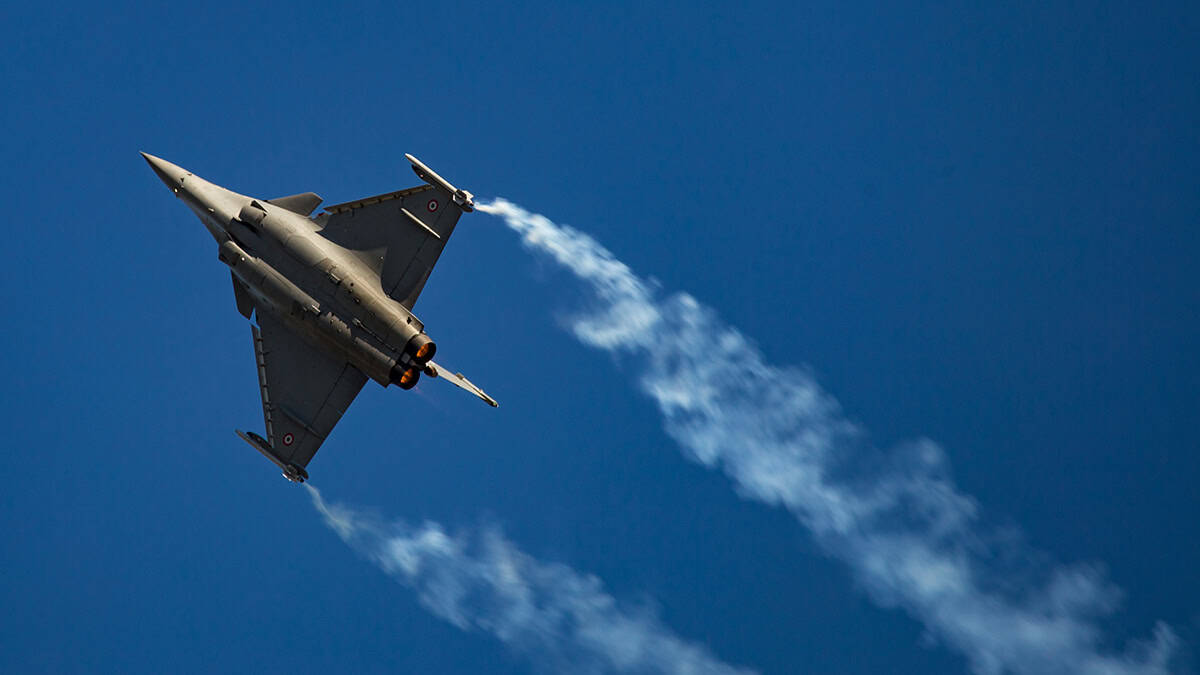
Greece benefits from France. The immediate deterrent value of Rafales, FDI frigates, missiles, and joint exercises is real. But the ultimate measure of this relationship will not only be the number of aircraft, frigates, or missiles purchased. It will be whether, ten years from now, Greece can maintain more of what it operates, develop more of what it needs, and contribute more to Europe than another procurement order.
That is what a serious alliance should produce.