
Greece is entering another wildfire season with more firefighters, more aircraft, more drones, and a larger ambition than simply being better equipped. The promise is speed.
Speed in seeing smoke before it becomes a front. Speed in deciding whether a fire needs local crews, forest commandos, aircraft, evacuation warnings, or all of them at once. Speed in moving information from a drone, satellite, emergency call, or firefighter in the field into a command chain before wind and terrain take over.
Viewed this way, Greece’s 2026 wildfire plan is not just a seasonal readiness package. It is an attempt to build a national wildfire nervous system for a country where summer fires are no longer exceptional events, but part of the annual risk calendar.
At a May 22 meeting at the Maximos Mansion chaired by Prime Minister Kyriakos Mitsotakis, officials reviewed this year’s fire-season readiness. According to the prime minister’s office, the Hellenic Fire Service begins the season with 17,727 permanent and seasonal firefighters, a figure expected to rise to 18,804 by the end of the period. The service has 4,299 vehicles, while Greece’s forest commando units, known as EMODE, now number 21 units with 1,450 members. Greece will also again receive pre-positioned firefighters from four European countries.
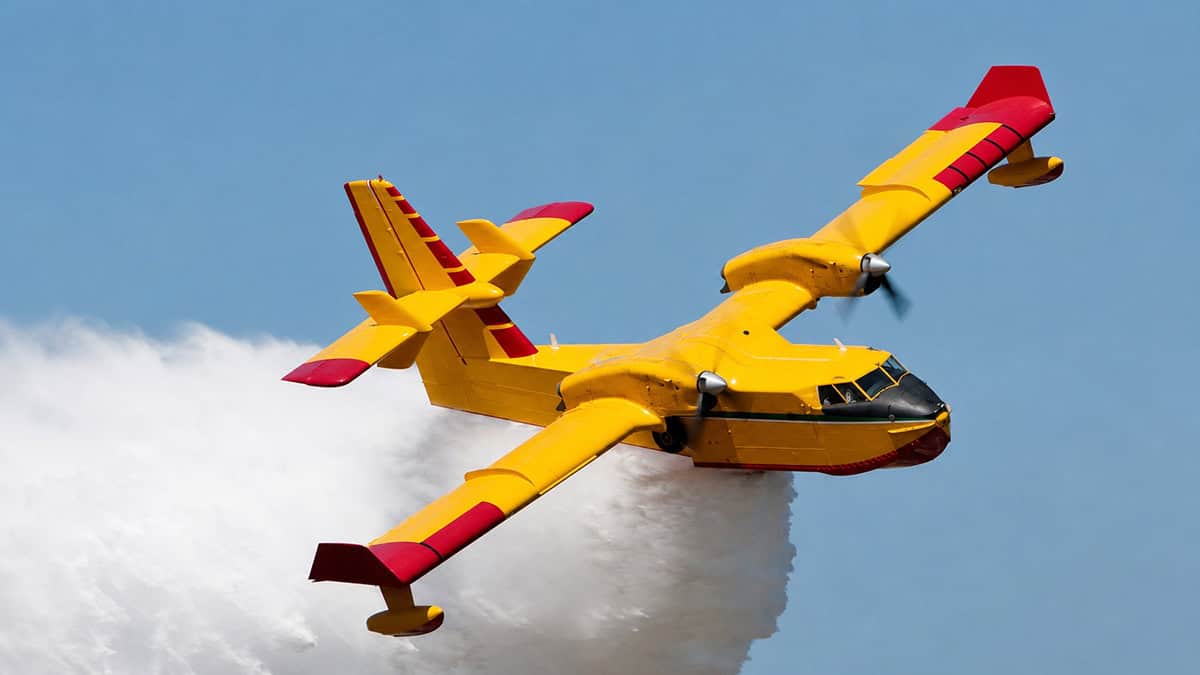
The aerial side remains central. Officials described 33 national aerial assets and 51 leased assets, with about 80 to 85 aircraft and helicopters expected to be available on a daily basis, depending on readiness.
That last phrase carries weight. Fleet size is not the same as daily capacity. Aircraft need maintenance, crews need rotation, weather can ground assets, and several fires at once can stretch availability quickly.
The most visible change this year is the drone network. Greece says it will operate more than 100 drone bases, along with three mobile drone operations centers. The drones carry thermal cameras and are intended to help authorities identify fire starts earlier, including in difficult weather.
The drone count is the easiest part to report. The harder question is what those drones feed into.
The public record points to several overlapping layers: seasonal surveillance bases, mobile drone operations centers, drones tied to command and coordination, and broader procurement under the AIGIS civil protection modernization program. AIGIS was presented in 2024 as a 2.1 billion euro program that includes firefighting aircraft, helicopters, fire service vehicles, drones, mobile operations centers, air-surveillance aircraft, fire-detection tools, meteorological stations, radar, and an upgraded 112 emergency-warning structure.
Not every drone has the same role. Some are eyes over high-risk forests. Some support command posts. Some help build a clearer field picture when smoke, terrain, distance, and conflicting reports make the first minutes uncertain. The strongest version of the network is one in which drone imagery moves quickly into dispatch, air operations, ground crews, and evacuation decisions.
This is where Greece’s digital upgrades become as important as the aircraft.
The upgraded ENGAGE incident-management platform was delivered in April 2026. Information Society S.A. described it as a modern digital tool for the Fire Brigade, designed to support incident management and the visualization of operational planning. The same announcement described ENGAGE as an interoperable platform supporting crisis management from prevention to recovery.
The Next Generation 112 project adds another layer. The project has a budget of about 21.7 million euros, is designed for 400 users, and is intended to support voice, video, real-time text, SMS, eCall data, GIS, and geo-tracking functions for civil protection users.
In plain language, Greece is trying to connect detection, warning, dispatch, and field command. The public descriptions point in that direction, but they do not yet answer the operational question: whether drone feeds, 112 data, satellite monitoring, field reports, and command decisions can move through the same chain quickly enough during a fast-moving fire.
The plan has to be judged by performance, not architecture.
The same caution applies to Greece’s new satellite layer. On May 3, four Hellenic Fire System CubeSats were launched for Greece aboard a SpaceX Falcon 9 mission from Vandenberg Space Force Base in California. The European Space Agency described the mission as a world first for a national satellite capability dedicated to wildfire detection and tracking. The satellites carry infrared imagers designed to detect active fires, identify thermal anomalies, and assess fire intensity over Greece and other areas of interest.
Greece is trying to create its own thermal-monitoring layer rather than relying only on aircraft, lookout points, citizen reports, and European fire-mapping systems. But ESA said the satellites would need a commissioning period of a few months before becoming ready for service. For the 2026 season, the Hellenic Fire System is best understood as a strategic addition whose full value will phase in, not as a fully mature backbone from the opening days of summer.
The least dramatic part of the plan may be the most important.
The government says the Antinero forest-protection program includes about 82 million euros in 2026 projects, bringing prevention actions for 2022 through 2026 to roughly 667 million euros. The work includes clearing forest vegetation, maintaining forest roads, creating mixed and shaded firebreaks, building forest infrastructure, adding water tanks, and protecting archaeological sites and high-risk suburban forest ecosystems.
These are not the images that lead television coverage. A cleared forest road is less dramatic than a water drop. A shaded firebreak is less visible than a drone. A water tank does not look like a technological breakthrough. But these measures can decide whether crews reach a fire early, whether aircraft have support on the ground, and whether a small ignition point becomes a dangerous front.
The government specifically cited high-risk peri-urban areas such as Hymettus, Aigaleo-Poikilo, and Seich Sou, the forest above Thessaloniki. Wildfire risk is not limited to remote forests. It is also about the edge where forest, city, monastery, archaeological site, village, power line, summer home, and road meet.
Once fire enters that edge, the problem becomes urban, cultural, economic, and human.
Wildfire season in Greece is now followed from far away, through phone calls, family chats, and maps refreshed late into the night. A fire may be near a village, an island road, a cemetery, a monastery, an olive grove, a summer house, or the home of relatives who cannot leave quickly. The danger may be distant, but the worry is not.
This is where official optimism runs into Greece’s recent record. In 2025, Greece also entered the season with record firefighting resources, 18,000 personnel, 85 aircraft, and a drone fleet that had grown to 82, according to AP reporting at the time. Fire officials then framed the season around climate-driven risk, rapid mobilization, drone surveillance, and mobile command centers, much as they are doing again now.
The record before that was harsher. In 2023, wildfire damage in Greece reached more than 1,745 square kilometers, roughly three times the 2011 to 2020 average, according to European Forest Fire Information System data cited by AP. The Alexandroupoli and Evros fire became the largest wildfire recorded in the European Union since EU records began in 2000, and AP reported that the fires in that region accounted for 20 of Greece’s 21 wildfire-related deaths that year.
In 2024, a major fire that began near Varnavas in northeastern Attica moved rapidly toward the Athens suburbs, forced evacuations, destroyed homes and vehicles, and killed one woman in Vrillisia. More than 670 firefighters, volunteers, forest commandos, planes, and helicopters were deployed, but strong winds pushed the fire toward the capital’s northern edge.
Those episodes do not mean the new investments are meaningless. They explain why the burden of proof is high. Greece has repeatedly increased personnel, aircraft, drones, and technology. The question is why larger forces have not always translated into control during the hardest fire days.
Independent voices have pointed to gaps that hardware alone cannot solve. In 2025, WWF Greece’s Nicos Georgiadis told Le Monde that drones can help, but the human factor remains more important, especially foot patrols in forests during critical evening hours. He also argued that forest-service hiring remained insufficient and that privately contracted clearing work needed stronger supervision by the forest services. Wildfire researcher Theodoros Giannaros of the National Observatory of Athens pointed to another weakness: poor data collection on fire causes, including infrastructure-related ignitions such as power lines.
An EU spending watchdog raised a related concern in 2025. The European Court of Auditors said EU-funded forest-fire prevention projects were not always directed where they could make the greatest difference. The Guardian’s report on the audit noted a particularly striking Greek example: authorities were using a fire-risk map drawn up in 1980 to assess forest-fire risk.
The 2026 government briefing says Greece is now moving toward active forest management using scientific data, modern mapping tools, and updated fire-prevention and management studies across the country. It does not, however, say whether the specific risk-mapping weakness identified by the auditors has been fully resolved.
That is the right place to locate the tension. Greece is not standing still. The official plan includes new tools, new data systems, and a larger prevention budget. But the country is also trying to modernize after years in which outdated maps, understaffed forest services, weak cause data, and uneven prevention oversight left gaps that aircraft and drones could not close by themselves.
The 2026 plan also places Greece inside a broader European fire reality. The country is building a larger national network while drawing on seasonal support from other European countries. Mediterranean fire risk is increasingly shared. When Greece, Spain, Italy, France, Cyprus, Portugal, and the Balkans face overlapping heat and wind events, no country can assume help will always be available exactly when needed.
The strongest reading of Greece’s plan is that the country has learned an uncomfortable lesson: firefighting begins long before the flames.
It begins with forest management. It begins with access roads, water points, patrols, thermal cameras, satellite monitoring, reliable communications, trained crews, local coordination, and public warnings that people trust enough to follow. Aircraft matter, but aircraft enter a story that has already begun on the ground.
The weakness is also clear. Greece now has many pieces: drones, satellites, aircraft, digital platforms, EMODE units, prevention works, local authorities, volunteers, and European support. The hard part is making them work as one civil-protection apparatus during real conditions.
That test should be measurable. How long does it take a drone or satellite alert to become a verified incident? How quickly can aircraft or EMODE units be assigned once the first signal appears? How often are alerts false alarms? How many fires are contained in the first attack? Are prevention works in places such as Seich Sou, Hymettus, and Aigaleo-Poikilo maintained after the first funding cycle? Are fire causes tracked well enough to show whether power infrastructure, negligence, illegal burning, or arson are driving local risk?
Without answers to those questions, Greece will be able to count equipment more easily than performance.
The country is moving toward a model in which wildfire management becomes a year-round responsibility, not a summer emergency. That is the right direction. But accountability has to become year-round too. It will not be enough to count drones in May and burned hectares in September.
The 2026 season will show whether Greece’s new wildfire architecture can do what it is designed to do: see earlier, decide faster, and act while there is still time.