
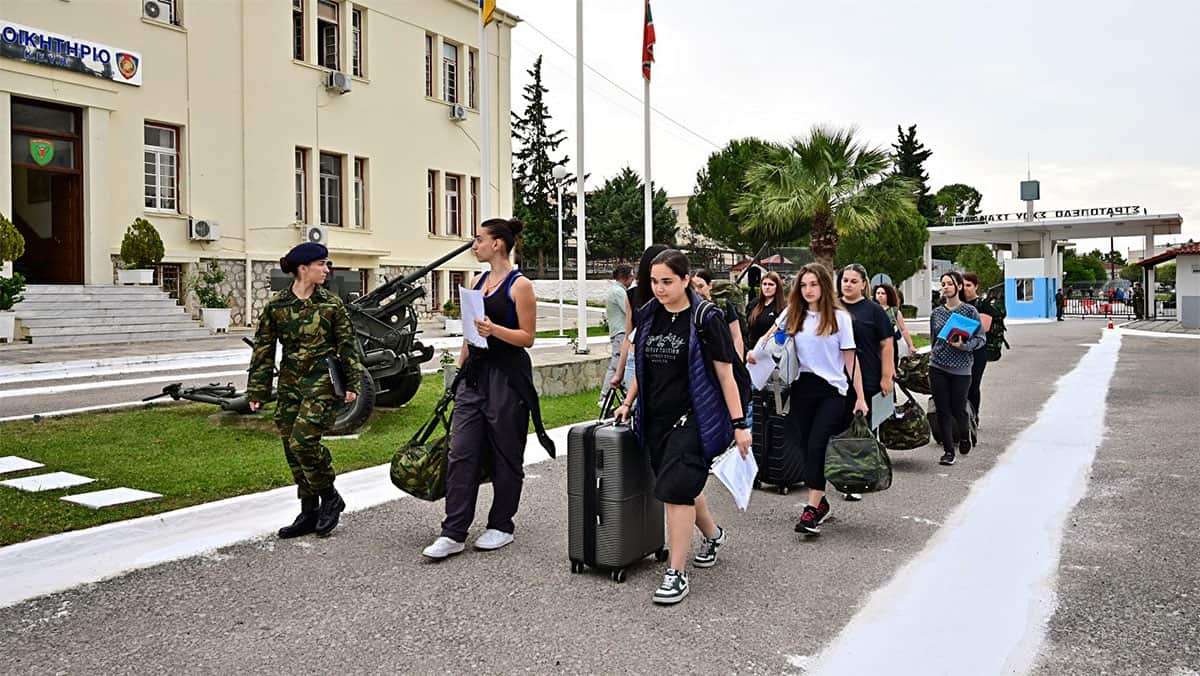
When the first women reported for voluntary military service in Greece on June 4, the moment was treated as historic. In one sense, it was. A military system long shaped by compulsory service for men had opened a new route for women who chose to serve.
But the first days in Lamia showed that a symbolic opening is not the same as a system that has been fully explained and prepared.
According to ERT News, 72 women presented at the recruit training center in Lamia, as voluntary military service for women began in practice in the Hellenic Army. Some spoke with emotion and anxiety. Some said they wanted to test themselves. Others saw service as a possible step toward a future in the armed forces.
That choice deserves to be taken seriously. These women were not simply appearing in first-day photographs. They were entering an institution that carries decades of social weight in Greece, and they were doing so as the first visible test of a new framework.
Within days, the picture became more complicated. Ta Nea reported that although 72 women had been expected, 51 ultimately enlisted, and that some had already left with postponements or expressed a wish to do so. Defense Minister Nikos Dendias visited Lamia and asked the volunteers to speak honestly with their officers about what was not working.
That visit is the real story.
The first withdrawals should not be used to mock the women who volunteered. They should be used to ask whether the state was clear enough with them before they arrived.
Greece has not introduced female conscription. The legal possibility of voluntary service for women is not entirely new, as a 1977 law had already addressed the issue. What changed in 2026 is that Law 5265/2026 replaced that long-dormant framework with a more specific route for Greek women aged 20 to 26 to volunteer for 12 months of service in the Hellenic Army. A legal summary by Nomiki Bibliothiki Daily notes that women who serve acquire military status similar to male conscripts during their service and are registered in the reserve after discharge.
That is a serious commitment. It is not a patriotic photo opportunity or a low-risk experiment. It is military service, with discipline and consequences.
That is why the question of benefits matters. Public reporting and discussion around the new service have included references to professional opportunities, points, and future recruitment. But the clearest legal framing ties the points specifically to competitions for professional soldiers, known as EPOP. That is different from a broad advantage across public-sector hiring.
If any volunteers arrived believing the service would open wider employment doors than the law actually provides, disappointment should not surprise anyone. A year of service is a large decision. The difference between “this helps you compete for professional military roles” and “this helps you generally in public employment” is not a technical footnote. It changes how a young woman weighs the choice.
The state should have made that distinction unmistakable from the beginning.
There are other questions that should have been answered just as plainly. What would the first weeks look like? What conditions should volunteers expect? What standards would apply? What would happen after basic training? What options would remain after discharge?
None of these questions weakens the army. They are the normal questions of people being asked to make a serious commitment.
Dendias was right to say that the army is not a hotel or a vacation. But the army is also not exempt from its own obligations. If it asks citizens to serve, even voluntarily, it owes them honesty before they enter the gate, not only after problems appear.
The early postponements do not prove that women cannot serve. That is the laziest conclusion and probably the most unfair one. Men have also struggled with military service, requested postponements, complained about conditions, or entered with unrealistic expectations. No one treats that as proof that men as a whole do not belong in uniform.
Women should not be judged by a harsher standard simply because they are first.
The more useful question is whether the first implementation was handled with enough care. Greece was not just adding women to an existing routine. It was inviting them into a military culture built over decades around male conscription. That required preparation, clear communication, suitable facilities, trained leadership, and a sober understanding that the first group would carry more pressure than ordinary recruits.
There is still a chance for the new framework to work. Voluntary service can give women a real path into military life and help the armed forces reach candidates who already want to serve. It can also make the idea of service less narrowly male without turning the issue into a debate over compulsory conscription for women.
But the first days in Lamia should be read honestly. They were neither a clean triumph nor a collapse. They were a warning that opening the door is only the easiest part.
The women who walked through it deserved a system ready to receive them.