
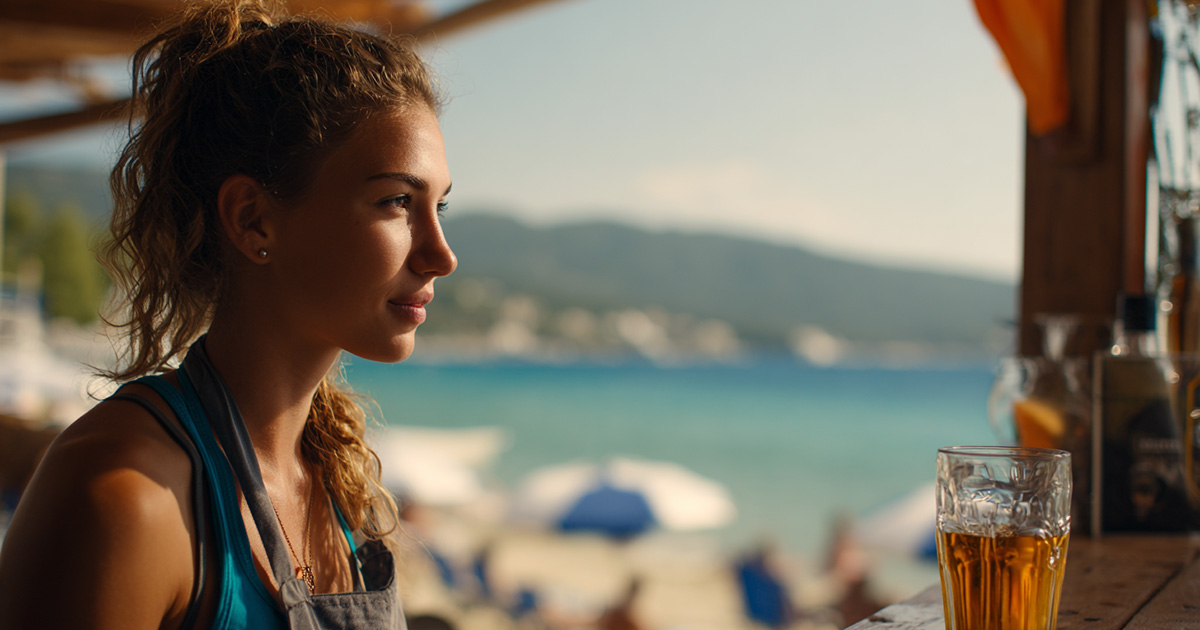
If you’ve spent a summer in Greece lately, you’ve seen them.
Maybe it was the kid who carried your suitcase up the hill in Santorini. Or the girl who took your order at a beachfront taverna, balancing three plates with the kind of ease you only get after weeks of doing it twelve hours a day. Or the guy at the hotel front desk, greeting tourists in four languages, even though his shift started before sunrise and won’t end until long after midnight.
We talk a lot about the forty million tourists who visited Greece last year. What doesn’t get talked about enough is who keeps that machine running.
It’s mostly the young.
Greece now has the highest share of tourism workers in the European Union. More than one in four people in the country work in tourism, mostly in hospitality. For young people especially, it’s the dominant job market. And during the summer months, that number feels even higher.
For the generation that grew up during the financial crisis, tourism isn’t just a career option. For many, it’s the only one that feels within reach. This is a generation that saw youth unemployment hit nearly sixty percent in 2013. Many of them watched their parents lose jobs or close businesses. Now they are trying to build something for themselves in an economy that still isn’t easy.
Tourism became the lifeline, but not without cost.
The summer season starts in May and runs until October. Six months of nonstop work. Days off are rare. Contracts are often temporary or, in some cases, don’t exist at all. Wages range from modest to downright low. Some jobs pay as little as six hundred euros a month, especially in entry-level roles like dishwashing or cleaning rooms. And while a few employers provide decent staff housing, plenty don’t. There are workers who cram into shared rooms, sleep eight to a space, sometimes without air conditioning. Some end up sleeping in their cars.
Still, every year, they do it again.
Last summer we met Ariadni, a twenty-three-year-old from Nafplio. She was working in a small hotel on Ammouliani, the tiny island off Halkidiki where the locals say the sea is always calmer than anywhere else. Ariadni was running breakfast service in the morning and bartending at night. We sat for a few minutes after her shift, just before midnight, when the last table finally cleared out. She told us she had done three seasons back-to-back. The first two summers helped her cover rent and living expenses during the winter. This year, she was saving up to move to Athens for a master’s program in marketing. Her feet hurt, and she had not had a day off in two weeks, but she smiled when she said it. At least she had a plan. At least she was getting somewhere.
Stories like Ariadni’s are everywhere in Greece right now. Some workers feel stuck. Others, like her, see it as a way forward. Either way, it’s hard work, and there is no easy path through it.
This story might sound familiar if you grew up in the Greek-American community here in Philly. It’s not so different from the path many of our parents and grandparents took when they got here. They started in diners, bakeries, and pizza shops. Long hours. Small paychecks. Big dreams.
Back then, the hustle was about building a life in a new country. Now, for a lot of young Greeks, it’s about holding on to the one they’ve got.
There is another layer to this. Despite all the hard work and long shifts, Greece still faces a labor shortage in tourism. This past season, tens of thousands of positions went unfilled. Employers had trouble finding staff, not because there aren’t workers, but because fewer people are willing to put up with the conditions. Some hotels and restaurants now recruit workers from countries outside the EU to fill the gaps.
That is the paradox of modern Greek tourism. The industry is booming. Tourists are spending record amounts. But behind the scenes, it is becoming harder to staff the very jobs that keep the engine running.
When we go back to Greece for the summer, we visit the islands, eat the seafood, and check into the hotels. But it’s worth remembering who is making those vacations possible. It’s the young people pouring coffees at seven in the morning and mixing cocktails at two in the morning. It’s the ones folding linens, clearing tables, and chasing after tourists who forgot their phone chargers in the lobby. It’s the ones working two jobs because they don’t have the luxury of doing just one.
They are not just part of the scenery. They are the backbone of Greece’s summer economy. And in a way, they are part of our story too.
So next time you are there, take a moment. Tip well. Ask their names. Find out where they are from. You might hear that their village is near yours. Or maybe their cousin lives in Upper Darby. That happens more often than you’d think.
Because the truth is, the line between here and there has always been thinner than we like to admit.
Watch: Sun, Sea and Sweat
If you want to see this story from the inside, the documentary Sun, Sea and Sweat by Arte follows Greece’s young seasonal workers through a real summer season.
For those of us in the Greek-American community, this is not just someone else’s reality. It is part of the same long story.
The documentary is available to watch online until June 26, 2026.
Here’s the video: