
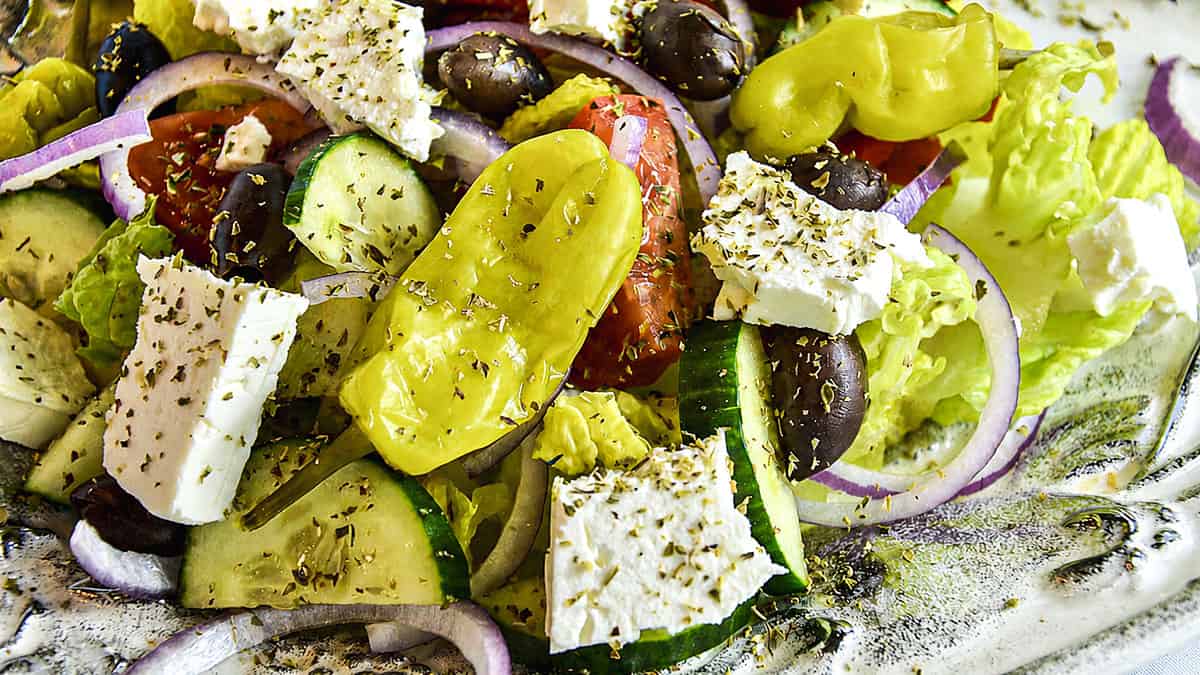
Thank goodness spring has sprung… I think?
With the first day of spring behind us, everyone seems ready for sunshine, the outdoors, and cool, crisp salads. I get more requests for my classic Greek salad and creamy Greek yogurt dressing than almost any other salad I make.
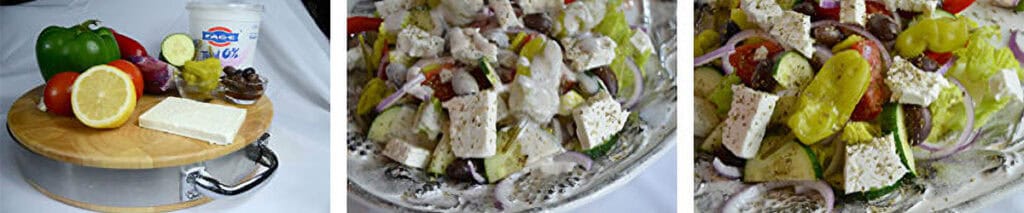
As popular as Greek salad is around the world, I still get many questions about what actually belongs in an authentic Greek salad. Many Greek and non-Greek restaurants serve Greek salads, but most of them are American-style Greek salads. A traditional Greek salad dressing does not include Greek yogurt. It is usually extra virgin Greek olive oil, red wine vinegar, oregano, salt, and pepper.
My love of Greek yogurt, especially Fage, is what helped this dressing become so creamy and delicious. When we were young, Fage was not available, so we made our own yogurt. But my mom never put yogurt in her Greek salad dressing. Even today, in many Greek households, dressing is not made in advance. It is not pre-measured or poured into a jar. The olive oil and vinegar are added freehand, the spices are tossed in, and everything is mixed right in the bowl.
I never saw my mom measure. Never.
With that said, there are also many variations of Greek salad, even in Greece. It changes depending on the island, village, or family table, and many of those versions are authentic in their own way. Still, the horiatiki Greek salad is the one most people think of as the true salad of Greece.
And it does not include lettuce.
In North America, the term “Greek salad” almost always means lettuce is involved. Unless you go to a very authentic Greek restaurant, you may not even find a horiatiki, or no-lettuce Greek salad, on the menu.
Horiatiki means something close to “in the peasant manner,” and it is often called a country salad, village salad, or peasant salad. A true horiatiki salad must have certain ingredients to earn the name. First, no lettuce. Always a green bell pepper, not red or yellow. No croutons, parsley, mint, fresh oregano, yellow onion, black olives, or crumbled feta cheese.
I know what you are thinking.
A Greek salad without feta cheese, olives, onion, and oregano?
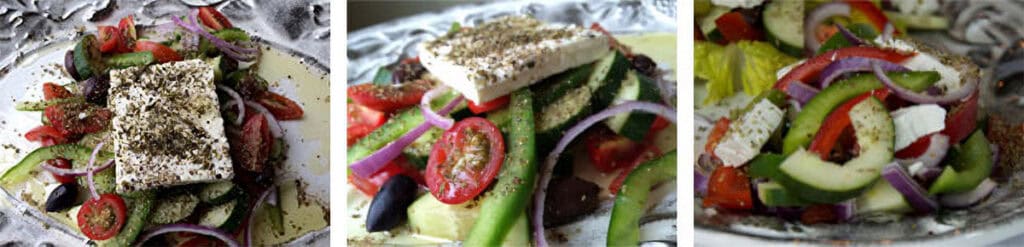
Don’t worry. Of course a horiatiki Greek salad includes feta, olives, onion, and oregano. But the oregano should be dried Greek oregano, not fresh. The onion should be red, not yellow. The olives should be plump Kalamata brined olives, not those little black things from a can with holes in them. And the feta should be one large piece of that delicious salty, firm, creamy cheese.
The lettuce-style Greek salad is still the most popular version here in the United States, and the variations are endless. Some people add radishes, anchovies, or sardines. In Tampa Bay, Florida, it is common to find potato salad on your Greek salad. In Detroit, beets are served on many Greek salads. Even cold vegetarian dolmades have been known to show up on some Greek salads.
No matter your preference, one thing almost everyone agrees on is that Greek salad is one of the best and most popular salads in the world. That combination of crisp vegetables, salty feta, briny olives, oregano, olive oil, and vinegar just tastes like the Greek islands.
The only thing that could make the experience better is a big loaf of crusty bread.
If you have a Greek market or bakery nearby, go in and grab a loaf. If you get there in the morning, you may be lucky enough to get one hot from the oven. Unbelievable.
When we were young, one of my favorite memories was going downtown to the Greek store with my sisters and my mom on a Saturday morning. The smell alone, as soon as you walked into a Greek or Mediterranean market, made you want to eat your way through all the delicacies around you.
As much as we loved the smells and samples, we could not wait for the shopping trip to be over. Not because we didn’t love being there. Not because my mother was picky about her purchases. Definitely not because the market was huge and took forever to get through. Most of those specialty markets were tiny little stores tucked into row homes.
What made us restless was the full hour my mom spent talking to the store owner after our purchases were done. Her shopping and tasting took about 15 minutes. Then came the real business: catching up on all the news around town.
But as soon as we got in the car with our bag of goodies, my mom would pull out the warm crusty bread, unwrap cheeses, open containers of olives, and we would dig in. Yes, she was driving, and yes, the crumbs from the warm bread were flying everywhere as we filled our bellies with Greek delights.
I guess the ride home was worth the wait. No matter how much we tugged on her to get going, we could not wait to do it all again the following week.
American-Style Greek Salad
Ingredients
1 head iceberg lettuce, cut into small pieces
2 vine-ripe tomatoes, cut into small wedges
1 large cucumber, seeded, peeled, and sliced into 1/4-inch pieces
1 green pepper, seeded and sliced thin
1 red onion, halved and sliced thin
6 to 8 pepperoncini
10 to 12 Kalamata olives, pitted or with pits
1 to 2 cups good-quality feta cheese, crumbled or cut into pieces
I also like a blend of romaine or arugula with mine.
Cut the lettuce, tomatoes, cucumber, green pepper, and red onion. Add the pepperoncini and olives, and toss everything together. Add the feta and dressing, then toss again.
I like to save a little feta to sprinkle on top. You can also build the salad without mixing it first. If you want that ooh-ahh presentation, place all the ingredients on top of the lettuce for a beautiful display. Most restaurants serve it this way and let you mix it yourself. The dressing is usually served on the side.
Greek Yogurt Salad Dressing
Ingredients
1 cup Greek yogurt, preferably homemade or Fage
1/4 cup red wine vinegar
1/4 cup fresh lemon juice, about half a large lemon
2 tbsp. dried Greek oregano
2 tsp. black pepper, freshly ground if possible
2 tsp. granulated garlic
2 tsp. sea salt
3/4 cup extra virgin olive oil
If you have a container of homemade Greek yogurt or Fage and you think there is about one cup left, you are in luck. You can use the same container to make and store the dressing if you have an immersion blender, or a strong arm and a wire whisk.
If not, measure out one cup of yogurt and use a blender or food processor.
Add the yogurt, vinegar, lemon juice, oregano, pepper, garlic, and salt to whatever you are using to blend. Mix very well until everything is incorporated. Slowly add the olive oil and continue blending until you have a creamy, smooth dressing.
Adjust the salt and pepper to taste. I like extra pepper.
The dressing will not be very thick. If you like a thicker dressing, add a little more yogurt and adjust the spices. You can double the recipe and keep it in the refrigerator for several days.
Horiatiki Salad
Now for the classic no-lettuce horiatiki salad.
When I was in Greece, I noticed that the tomatoes and cucumbers were cut into big chunks, while the green pepper and red onion were sliced paper thin. The waiter told me the flavor of the sweet tomatoes and crisp cucumber should not be lost under the stronger flavors of the green pepper and red onion. It is all about balance, and that balance gives this salad its beautiful flavor.
I was also never served pitted Kalamata olives in Greece. They were big and plump and absolutely worth eating around the seed to get every last bit.
And here is a little legal advice, if you have ever bitten down on a Kalamata olive pit in a Greek salad. I once saw a Judge Judy case involving a customer who sued a Greek restaurant after breaking a tooth on an olive pit. Judge Judy asked whether the customer knew what went into a Greek salad before reading the menu. The customer said yes, she had eaten many Greek salads. Judge Judy told her the pit in the olive was to be expected and ruled in favor of the Greek restaurant.
Go Judge Judy, haha.
Now, about tomatoes. In winter, it can be hard to find great ones. I have found that vine tomatoes or grape tomatoes can be sweet enough during the colder months and make a decent substitute. If you knew my mom, she would tell you there is no tomato better than a Jersey tomato. She was raised in Philly, and a trip to the Jersey Shore to get tomatoes was never a problem. Of course, that is just one more thing she missed when we moved to Baltimore.
Jersey tomatoes or not, pitted Kalamata olives or not, here is a great horiatiki salad.
Ingredients
6 vine-ripe sweet tomatoes, cut into thick chunks or wedges
1 large cucumber, cut into chunks
1 medium red onion, sliced paper thin
1 large green pepper, seeded and sliced paper thin
10 Kalamata olives
1 large 1/4-inch slice of good Greek feta
1 to 2 tbsp. dried Greek oregano, be generous
Salt and freshly ground black pepper, to taste
1/2 to 3/4 cup Greek olive oil
About 1/8 cup red wine vinegar
I like English cucumbers because their skin is thin and there is no need to peel them.
Place all the ingredients except the feta in a bowl. Sprinkle half the oregano over the top, then add salt and pepper. Drizzle with Greek olive oil and red wine vinegar. Toss well, but gently.
Top with the feta, the remaining oregano, and one more quick drizzle of olive oil.
You are all set. Just don’t forget the bread, because this salad makes the most amazing juice at the bottom of the bowl, and you will want to dip your bread into every drop.
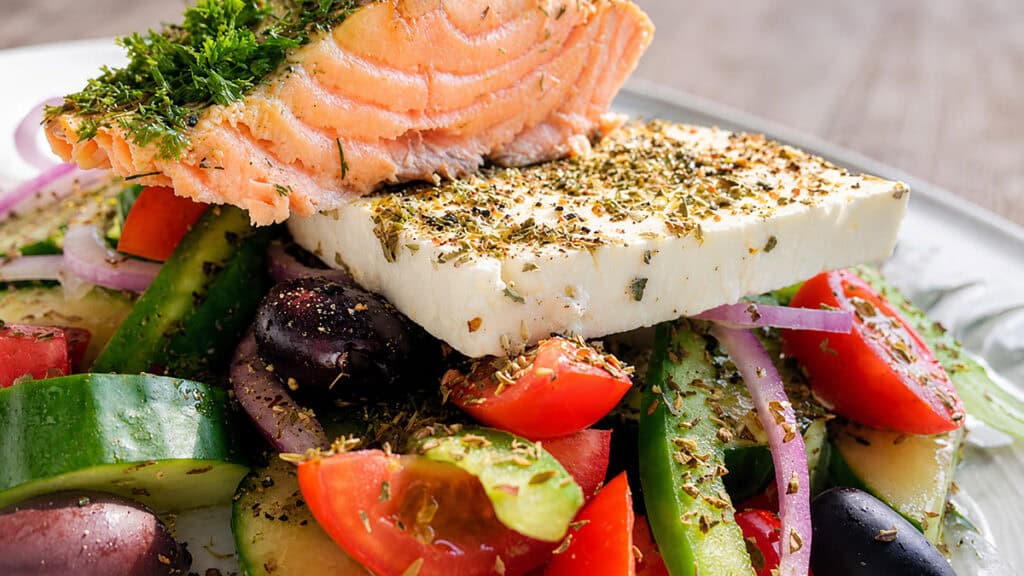
For Lent, top either of these salads with a nice piece of broiled salmon or another fish finished with fresh parsley and dill. Perfect.
Hope you enjoy!
Chef Steff