
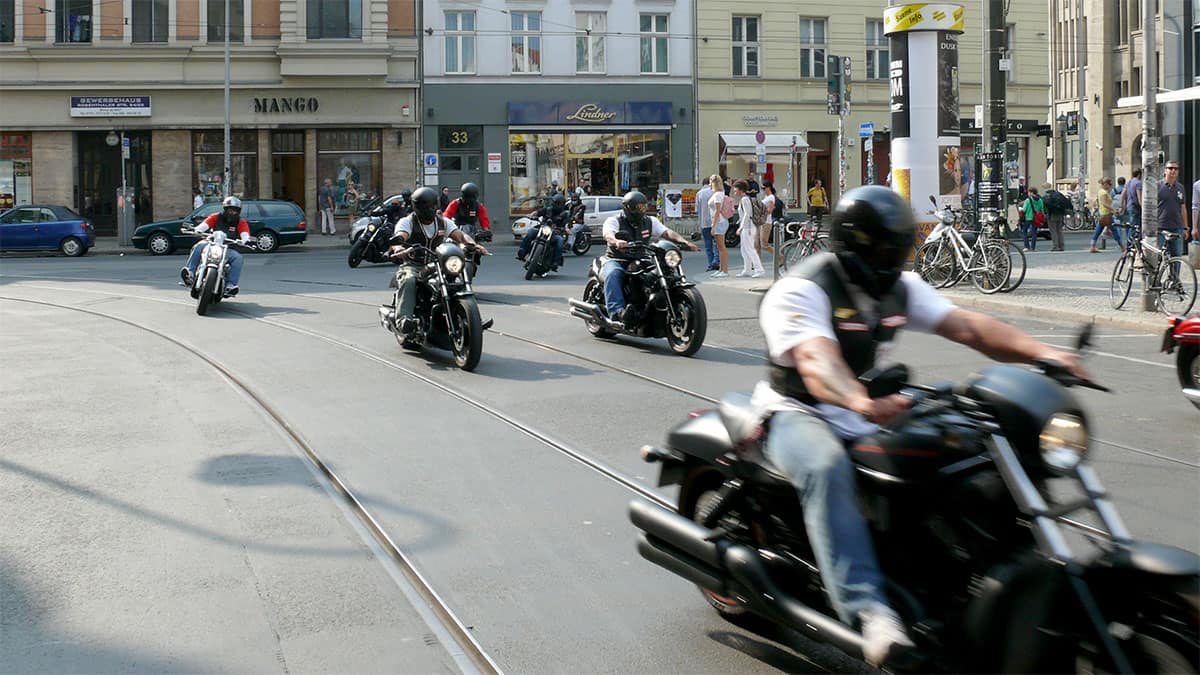
From June 5 to 7, Drepano near Igoumenitsa looked like a stage set for two different stories.
In one, the Hells Angels gathering was an unusual tourism event. Local reports spoke of around 5,000 riders and more than 2,000 motorcycles arriving in the area. Expensive machines moved through Epirus. Hotels and tavernas filled. Riders crossed by ferry from Italy, came by road through northern Greece, or arrived from farther afield. Some pushed on toward Parga, Preveza, and Corfu.
Business owners described the visitors as courteous and as people who spent real money. Restaurants did brisk trade, especially the grills and casual tavernas. A Cypriot rider even married at sunset on Drepano beach.
In the other story, Greek authorities were watching closely from the first hour.
Greek outlets reported a heavier police presence, tighter border checks, port inspections, and arrests connected to the gathering. Seven German riders were detained at the port of Igoumenitsa, including one man found to have an outstanding arrest warrant from Poland, who later suffered a stroke in custody. At Promachonas, border officers found knives, batons, and brass knuckles in riders’ luggage; five Hells Angels-linked bikers were subsequently convicted on weapons charges and received suspended sentences.
Other reports described a dedicated police plan and the presence of organized crime units on the ground. Kathimerini, LiFO, Ta Nea, Proto Thema, SKAI, ERT, and EfSyn did not treat the gathering only as motorcycle culture. They treated it as a public event with a security dimension.
The story begins in that gap: not with the motorcycles alone, nor with fear alone, but with the distance between how the gathering looked locally and how the Greek state understood the name attached to it.
A rally with structure
The Drepano gathering was no informal stopover. Greek reporting described a marked-off event space, a broad “welcome brothers” banner, controlled entry, and the club’s own internal security. Riders came in formation, grouped by country and chapter. Their vests and jackets carried place names, patches, and symbols that signaled chapter and rank within the international club.
EfSyn reported that the Greek chapter based in Patras organized the meeting. That detail matters: it positions the Greek structure not simply as a local host but as an organizer within the international Hells Angels world.
It also helps explain why the event could be two things at once. A rally can fill hotel rooms and still matter to police. It can bring business to a seaside area and still gather people whom the authorities want to identify, screen, and track. The same public event can be good for tavernas, meaningful to riders, and relevant to organized crime units.
The Hells Angels have long operated in that tension. Their public image is built around brotherhood, motorcycles, symbols, travel, and loyalty. But in country after country, the club’s name has also surfaced in investigations involving violence, weapons, drugs, extortion, and money laundering.
A Greek footprint
The club’s presence in Greece is usually traced to the mid-1990s, when the first Greek chapter was reportedly established in Attica.
Greek reporting links that early structure to Koropi and to Yiannis Rossikopoulos, known as “Chief,” whom the press describes as one of its founding figures. In the years since, reports have placed chapters in Athens and Attica, Thessaloniki, Patras, Crete, Rhodes, Kos, and elsewhere.
More recent coverage cites intelligence assessments that put the number of Greek Hells Angels chapters at eight. Earlier reporting tended to say six.
The precise status of each is hard to verify from the outside, but the direction is clear enough: the Greek footprint is no longer a single clubhouse or a passing foreign presence.
The Patras chapter’s role in organizing the 2026 Drepano gathering underlines that point. Greek chapters are not just names on a map. They can host, organize, and connect to the international club.
That is why the rally mattered beyond its size. It showed the Greek presence functioning in public, not merely existing in the background.
The record behind the concern
Greek police interest in the Hells Angels did not begin with this rally.
Over the years, Greek and international reporting has linked individual members, affiliates, or foreign visitors to a series of serious cases. The record includes a bombing at a tattoo studio in Glyfada in 2011, a murder case in eastern Attica in 2012 involving a Greek-Canadian with alleged ties to cocaine-trafficking networks, a cocaine arrest in 2013, and a dynamite attack on the clubhouse in Koropi in 2014.
The most serious case tied to a previous Greek gathering came in 2015, after another major Hells Angels meeting in the Drepano area. Giorgos Ginargyros, a 41-year-old yacht captain from Corfu, was killed after an altercation in Kontokali. The convicted men were tied to the Hells Angels scene in Alberta, Canada; Dustin Swanson, a prospect at the time, received a 15-year sentence for the killing.
That case gives the Greek story its clearest shape. The place was Greek. The victim was Greek. The men involved came from abroad. Greek authorities were not dealing only with a domestic motorcycle subculture, but with a club world that travels.
One case often mentioned in this wider context, but needs to be separated. The 2019 car bombing in Glyfada targeted Amad “Jay” Malkoun, an Australian outlaw-biker figure who had previously led the Victorian chapter of the Comancheros. The bombing shows how foreign outlaw-biker figures can surface on Greek ground, but it should not be counted as a Hells Angels incident.
Greek reporting on outlaw motorcycle clubs can blur the lines between names, rivalries, and allegiances. Hells Angels, Comancheros, Bandidos, and other groups are not interchangeable. The Greek case is serious enough without adding incidents that belong elsewhere.
The legal line also matters. Reporting has connected individuals and affiliates to serious crimes. That is not the same as a Greek court convicting the Hells Angels as an organization. Greece has not followed the Dutch path, where a court in Utrecht moved against the club itself in 2019, banning both the Dutch arm and the international mother organization.
The Greek posture appears more operational: surveillance, border checks, event policing, cooperation with foreign authorities, and arrests made one case at a time.
Why Greece counts now
The question is not whether Greece has a “biker war.” No public evidence points to a sustained conflict between rival outlaw clubs on Greek territory.
The sharper question is whether Greece is becoming a stable operating environment for Hells Angels influence: through its chapters, its events, and its ability to connect foreign members with Greek locations. So far, the evidence leans that way.
Greece is not the center of the Hells Angels world. It is not Quebec, where biker violence became a long-running public crisis. It is not the Netherlands, where courts eventually moved against the club itself. It is not Australia, where outlaw motorcycle clubs have been part of organized crime policing and public debate for years.
But a country does not have to sit at the center to be significant.
Greece is strategically located at the intersection of the Balkan corridor, the Eastern Mediterranean, Turkey, the Adriatic route, and Europe’s southern sea lanes. It has major ports, islands, busy border crossings, a vast tourism economy, and deep social ties to Canada, Australia, the United States, and Western Europe.
That combination creates room for movement, meetings, visibility, and reputation-building. It does not prove a single criminal structure. It does explain why a large Hells Angels gathering in western Greece would draw more than local curiosity.
To the club, Greece offers a destination, a meeting ground, and a public stage. To Greek authorities, it offers the same thing from the other side: a place where international members can gather openly, connect with Greek chapters, and create relationships that may last beyond the weekend.
That is why the gathering near Igoumenitsa became a security story.
Not because every motorcycle on the road was a threat. Because the event brought together scale, structure, history, and geography in one place.