
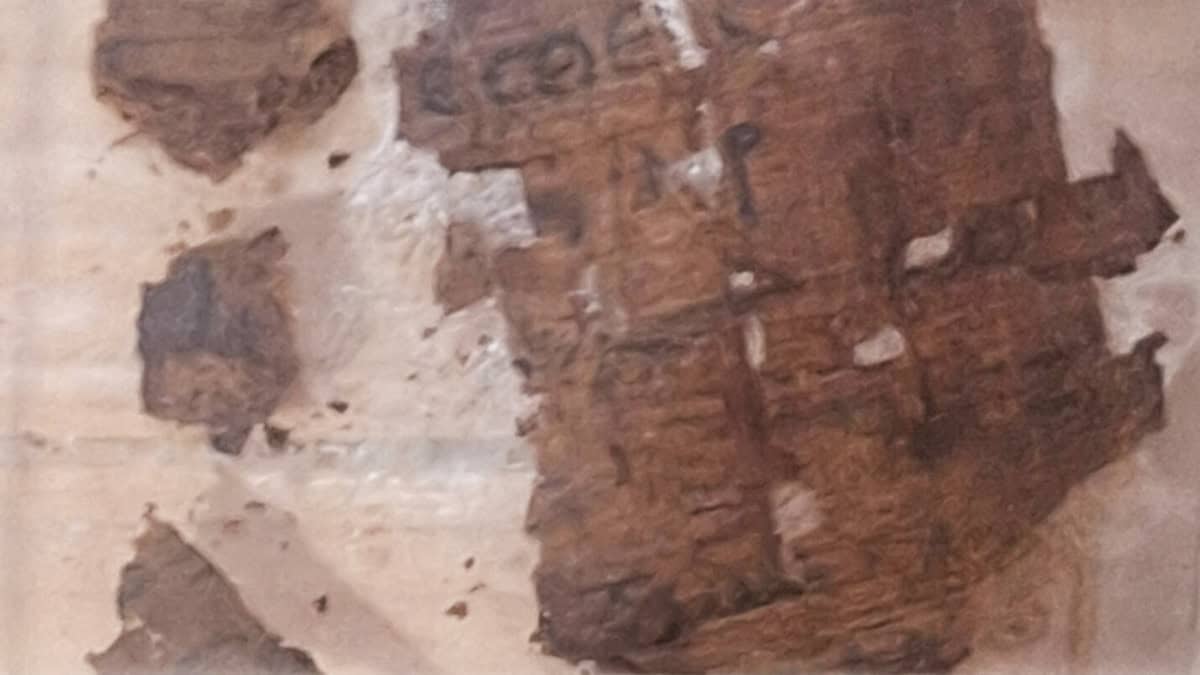
A fragment of Homer’s Iliad has been identified inside a Roman-era mummy in Egypt, in a discovery that brings together Greek literature, Egyptian funerary practice, and the long afterlife of one of the ancient world’s most influential poems.
The University of Barcelona announced the discovery in April through its Oxyrhynchus Archaeological Mission, based at the university’s Institute of Ancient Near East Studies. The mission, led by Maite Mascort and Esther Pons, works at Oxyrhynchus, modern Al-Bahnasa, one of Egypt’s most important sites for the recovery of Greek papyri.
According to the university, the mummy was discovered by Núria Castellano’s team in Tomb 65, Sector 22, during the mission’s November–December 2025 campaign. The papyrus was found on the abdomen of the mummy and was later analyzed during the January–February 2026 campaign by conservator Margalida Munar, papyrologist Leah Mascia, and Professor Ignasi-Xavier Adiego.
Mascia’s reading allowed Adiego to identify the text as part of Book II of the Iliad, the section traditionally known as the “Catalogue of Ships,” in which Homer lists the Greek forces that sailed to Troy.
The university has not yet published a full scholarly description of the fragment, including its dimensions, the number of preserved lines, or whether the wording contains variants from known manuscript traditions of the Iliad.
Greek papyri from Oxyrhynchus are not rare in themselves. What stands out here is the context: a Homeric text found inside a mummy.
The University of Barcelona has described it as the first known case in which a Greek literary text has been found incorporated into the mummification process. Professor Adiego noted that Greek papyri had been found before in similar funerary contexts, but their contents were mainly magical. In this case, the text belongs to Homer.
Still, that wording should be read carefully. The fragment may have been selected for symbolic or protective reasons, but it may also have been reused as part of the practical materials of burial preparation. The find does not yet explain why this particular papyrus was placed with the deceased.
The mummy belongs to the Roman period in Egypt, when the country was under Roman rule and Greek remained an important language of administration, education, and cultural life. In that world, Homer was not simply a poet from the distant past. His works were central to learned culture across the eastern Mediterranean.
The “Catalogue of Ships” is one of the most famous and unusual passages of the Iliad. It names leaders, regions, and contingents from across the Greek world, turning the Greek expedition to Troy into a kind of remembered geography. For ancient readers, the passage could connect myth, place, and identity in a single literary sequence.
Finding such a text in a funerary setting does not mean scholars can immediately explain its purpose. But it does open an unusual window onto the movement of Greek literature beyond classrooms, libraries, and manuscript collections.
Oxyrhynchus itself has long been one of the great meeting places of Greek and Egyptian antiquity. Since the late 19th century, the site has yielded fragments of lost plays, biblical texts, private letters, school exercises, tax records, contracts, and literary works. Its papyri have helped scholars reconstruct not only what ancient people read, but how they lived.
This discovery adds another layer to that history. It places Homer in the intimate space of burial, alongside a body prepared for the afterlife in Roman Egypt.
For Greek cultural memory, the image is striking: a few lines of the Iliad, written on papyrus, found on the abdomen of the dead and preserved through centuries in Egypt.
It is a small fragment. But like many papyrus discoveries, its importance lies in the world it briefly reveals. Homer’s poem did not remain fixed in one place or one age. It traveled through languages, empires, schools, rituals, and lives. At Oxyrhynchus, it appears to have traveled even into the tomb.