
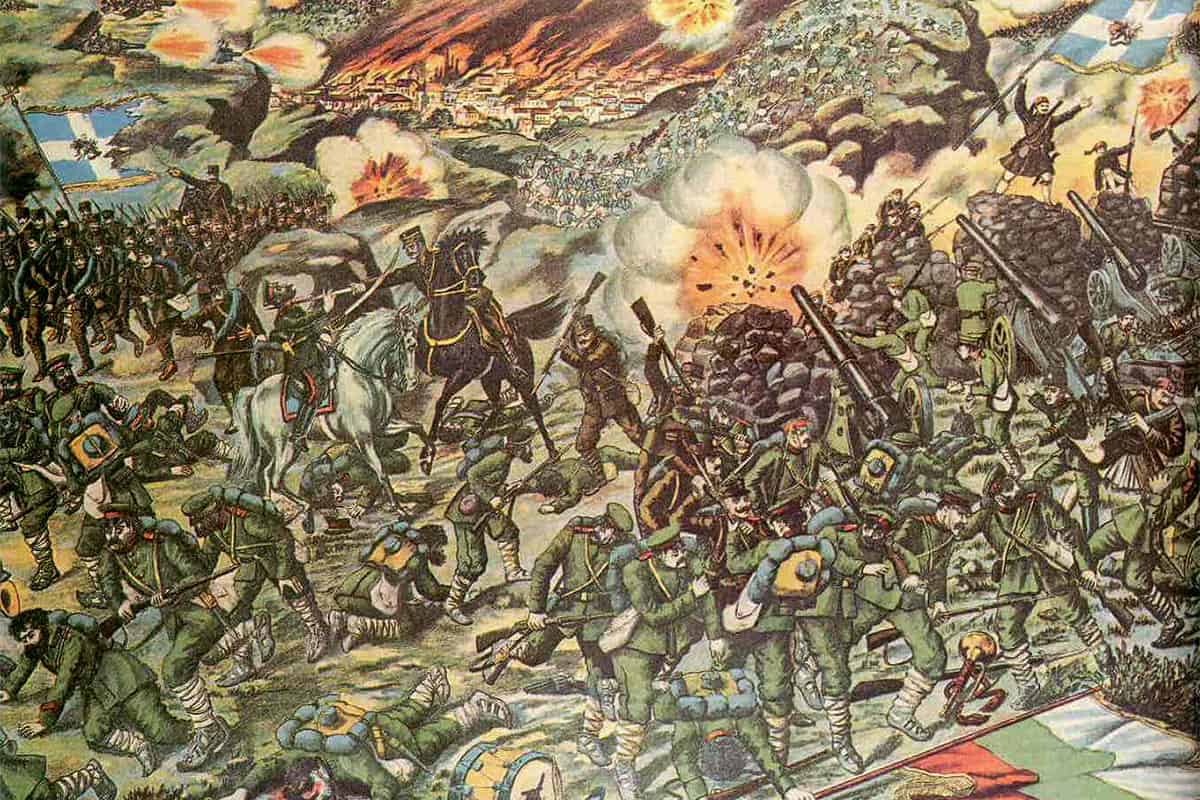
In three days in the summer of 1913, an army fighting its former allies decided where the northern border of Greece would lie and, in the longer run, who would live inside it.
The Battle of Kilkis–Lachanas belongs to the Second Balkan War, fought by the very alliance that, eight months earlier, had thrown the Ottomans out of Europe. Within months of that joint victory, the alliance fractured: Greece and Serbia turned on Bulgaria over the division of Macedonia, with Romania and the Ottomans soon joining the war from the north and east. If you have ever wondered why the map of northern Greece looks the way it does, this is the war that drew it. Kilkis–Lachanas is the battle that decided the part of the map that matters most.
Allies who could not divide what they had won
The story has to begin in October 1912, in Thessaloniki, with a race.
Greek and Bulgarian columns were descending on the city from opposite directions. Eleftherios Venizelos, the Cretan-born liberal who had remade Greek politics since 1910, had given his army an order that became famous for its brevity: Thessaloniki at all costs. The reason was simple. The Bulgarians were closer. On 26 October 1912, the feast day of the city’s patron Saint Demetrios, the Ottoman commander Hasan Tahsin Pasha surrendered the city and its garrison of roughly 26,000 men to the Greeks. Bulgarian troops arrived a day later and asked to share control. Crown Prince Constantine, commanding the Greek army, refused.
Tahsin Pasha reportedly told the Bulgarian officers what amounted to the opening sentence of the war that would follow eight months later: “I have only one Thessaloniki, and I have already surrendered it.” The twenty-four-hour margin would shape everything that came after.
The Balkan League’s pre-war agreements had carved up some Ottoman territory but had deliberately left the richest and most contested zone of Macedonia undefined, to be settled later. The allies could fight together against the Ottomans precisely because they had postponed the argument that would divide them. Victory simply moved that argument to the top of the queue.
Then the First Balkan War unfolded in a way nobody had planned for. Bulgaria poured its strength east, into Thrace, and ground through the Ottoman main army at the siege of Adrianople. Greece and Serbia, meanwhile, walked into most of Macedonia.
By the Treaty of London in May 1913, Bulgaria had done the heaviest fighting against the Ottomans but held the least of the prizes it wanted. It demanded that Greece hand over Thessaloniki and that Serbia withdraw from northern Macedonia. Both refused: Greece had signed no partition deal covering this zone, and Serbia, stripped by the Great Powers of its Albanian conquests, expected to be compensated somewhere. They fell back on the principle of who-holds-keeps.
On 1 June 1913, Greece and Serbia signed a defensive alliance in Thessaloniki, explicitly aimed at Bulgaria. The Balkan League’s two flanking members had now allied against its center.
On the night of 16–17 June, Bulgarian forces attacked the Greek and Serbian lines without a declaration of war. The order had come from General Mihail Savov, acting for Tsar Ferdinand, not from the Bulgarian civilian government, which had not approved it. The war that would redraw the Balkans began as something close to a military fait accompli inside Bulgaria itself.
The Bulgarians evicted the Serbs from Gevgelija but failed to break the Serbian line on the Axios river. Further north, along the Bregalnica, the Bulgarian Fourth Army was caught in a parallel battle with the Serbs that would last ten days and end as a serious Serbian victory, tying down forces Ivanov might otherwise have called on. The thrust toward Thessaloniki was contained within two days. Then the counterattack came.
The three days
General Nikola Ivanov’s Bulgarian Second Army held a defensive line running from Lake Doiran through Kilkis and Lachanas to Serres and across the Pangaion Hills to the Aegean. This was good ground for a defender, and the Bulgarians had been improving it since May: three successive entrenched lines on the hills above Kilkis, with captured Ottoman guns sited to sweep the open plain any attacker would have to cross. The Second Army was a veteran formation, blooded at Adrianople.
The numbers complicate the underdog story that Greek tradition sometimes prefers. The Greeks attacked with a larger army, roughly 117,000 men and 176 guns, against a nominal Bulgarian army of 75,000 and 175 guns. After the war, Ivanov claimed he had only about 36,000 effective troops, more than half of them untrained, but later scholarship has read that figure as a self-serving downward revision and places his real strength closer to the official Bulgarian roll of around 75,000.
The Greek staff at the time, in the opposite direction, overestimated him at 80,000 to 105,000. What matters is the operative reality: the defender was dug into commanding ground with effective artillery, and the attacker had to come at him across the open. That, more than anything else, explains the casualty bill.
At Kilkis, the Greeks massed 38 battalions and 100 guns against 8 Bulgarian battalions in the town, and still could not break through on the first two days. On 19 June, Greek divisions overran the forward Bulgarian lines and paid heavily: the 5th Division alone lost about 1,275 men in a single day, much of it to Bulgarian artillery firing from hilltop observation onto troops advancing in close order across the wheat fields. On 20 June, with every Greek formation committed and the cavalry reporting Bulgarian reinforcements arriving by rail, the main position was still held.
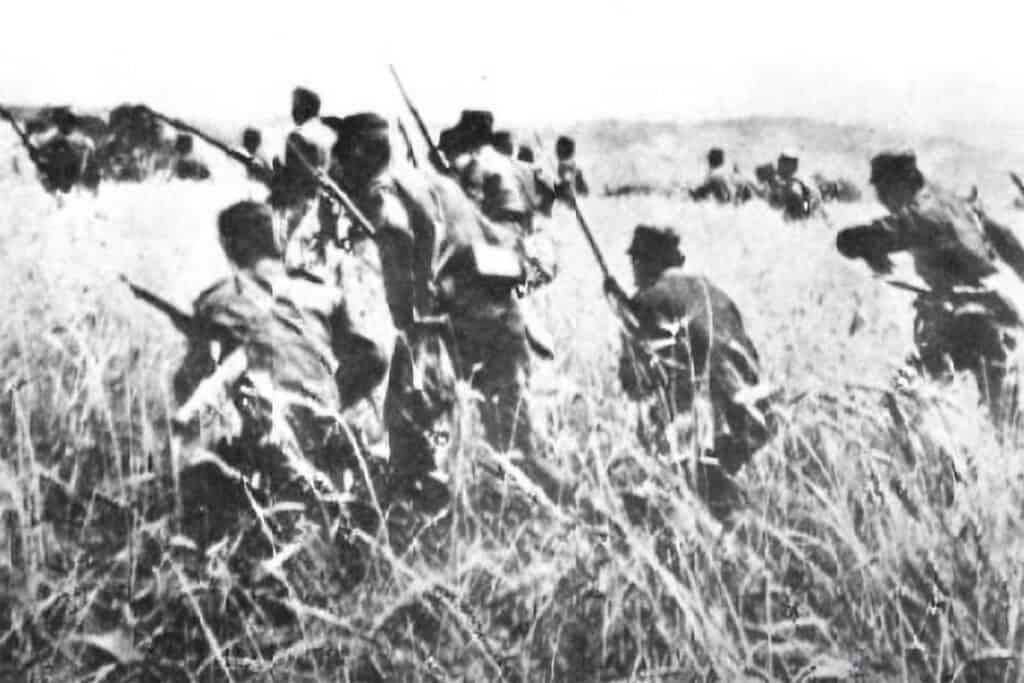
The breakthrough came from a single division acting under a hard deadline. Ordered to take Kilkis by the night of the 20th, the 2nd Division went forward alone. After a night artillery duel, two of its regiments forded the Gallikos River and pierced the three successive Bulgarian lines in turn, entering Kilkis on the morning of 21 June. The other divisions joined the assault. The Bulgarians fell back north. The fighting around Kilkis cost the Greeks 5,652 killed and wounded.
At Lachanas, on the road toward Serres, the pattern repeated against the same kind of fortified ground. The 6th Division took the Dichalo–Klepe line on the 19th at a cost of some 530 men; the 1st Division took the Vertiskos heights. On the 21st, with Kilkis finally fallen and the reserves freed, the two Greek divisions broke through by mid-afternoon. They took 16 guns and 500 prisoners. Lachanas cost 2,701 killed and wounded.
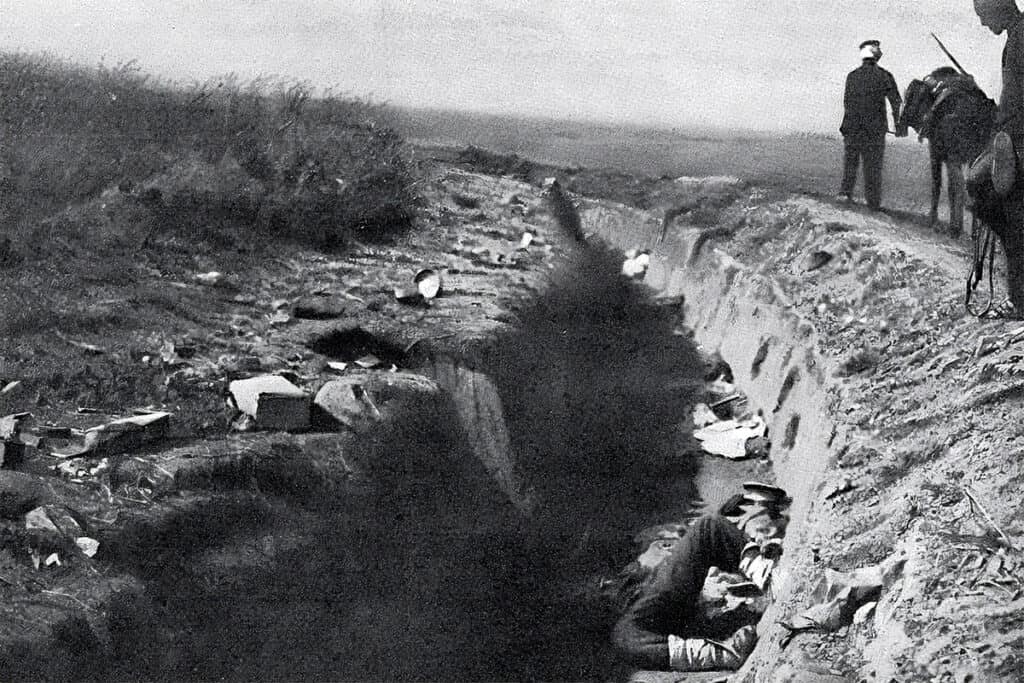
It is worth saying plainly what the casualty figures imply, because Greek and Greek-sympathetic sources do say it. The losses were not the price of facing a superior enemy. They were the price of Greek tactical doctrine: troops sent in close order across open ground in frontal assaults against entrenched positions. Ten Greek battalion or regimental commanders were killed. By the end of the battle, the General Staff had ordered all rank insignia removed from officers’ caps so they would no longer stand out as targets.
This was the summer of 1913, a year before the Western Front would teach the same lesson to the rest of Europe on an industrial scale. The firepower revolution had already arrived; the tactics had not yet caught up, and flesh closed the gap.
The cost
The Greek General Staff put its own losses at 8,828 killed and wounded over the three days, the heaviest in the modern Greek army’s history to that point. Bulgarian sources record their own losses at 6,971, with about 2,500 prisoners and 19 guns lost. Other counts that cover the whole Greek–Bulgarian front rather than only Kilkis–Lachanas run higher, into thousands more prisoners and over a hundred guns; figures should be read with attention to what they include.
The town of Kilkis was burned to the ground.
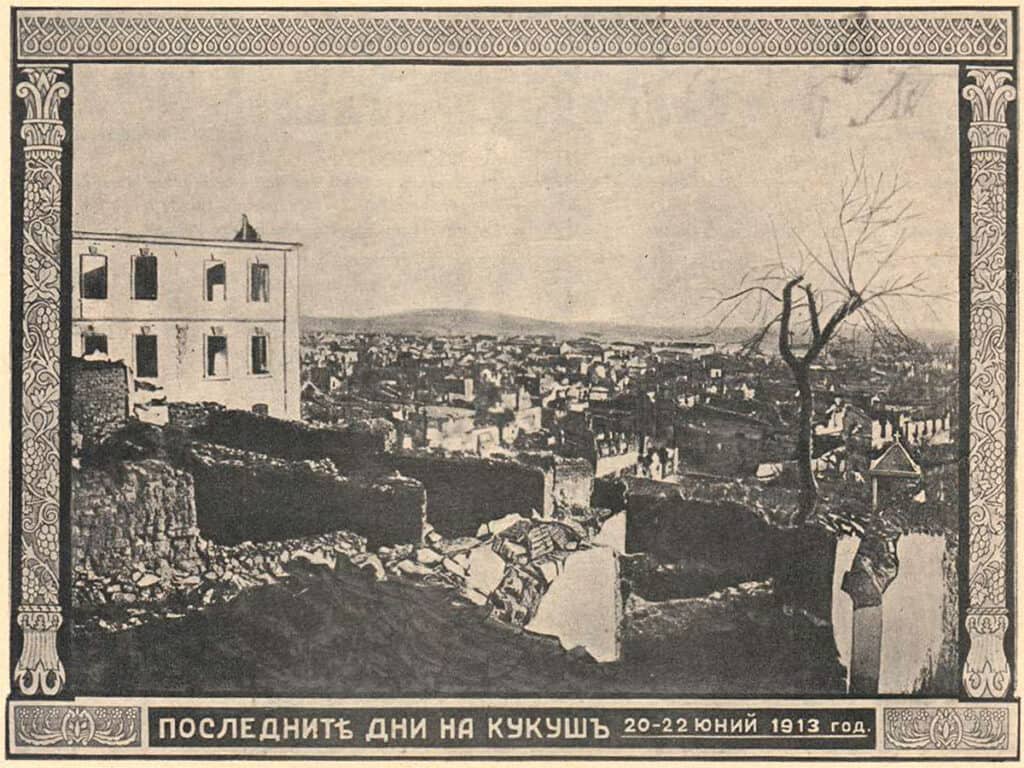
This is the part of the story that Greek commemoration has always struggled to absorb. Kilkis was not a Greek town in June 1913. Under its Bulgarian name, Kukush, it was a center of Bulgarian national life in Macedonia. A survey of 1900 counted about 7,000 Bulgarians and 750 Turks; it was the birthplace of Gotse Delchev, the revolutionary founder of the Internal Macedonian Revolutionary Organization, and a stronghold of the Bulgarian Exarchist church. After the battle, the town was destroyed, and effectively its entire pre-war Bulgarian population fled or was driven out, most settling around Sofia.
The “liberation” of Kilkis was simultaneously the erasure of Kukush. The two are the same event seen from opposite sides of the border; the battle itself was drawing.
The destruction was not confined to one town. The 1914 report of the international commission organized by the Carnegie Endowment for International Peace, still the indispensable independent record of this war, found that the advancing Greek army burned roughly 160 Bulgarian villages and destroyed at least 16,000 homes. Captured Greek soldiers’ own letters, which the commission examined, are the most damning evidence: men writing home that they were burning villages “by order of the King” in reprisal for Bulgarian atrocities at Serres; one adding that of 1,200 prisoners taken at Nigrita, “only forty-one remain.”
Atrocities ran in both directions. Retreating Bulgarian forces burned the largely Greek town of Serres (roughly 4,000 houses) and Nigrita, Doxato, and Demir-Hissar, with massacres of Greek and Turkish civilians; five to six hundred people were killed at Doxato. King Constantine publicly announced reprisals on 12 July, citing a Bulgarian massacre at Demir-Hissar of more than a hundred Greek notables, including the local bishop. The Carnegie commission added a detail that complicates any clean morality tale: Greek reprisals had, in fact, begun before the Bulgarian provocations Constantine cited.
The honest framing is not about who started it. It is structural. In a war fought to decide which nation a piece of mixed-population land would belong to, burning the other side’s villages was not a breakdown of strategy. It was the strategy. The fighting decided the border; the burning decided who would be living inside it.
What it made
The defeat of Ivanov’s Second Army was the worst military disaster Bulgaria suffered in the war. With central Macedonia cleared, the Greek advance opened to Doiran, Serres, Drama, and Kavala.
Constantine, against Venizelos’s advice, then pushed up the Struma toward the Kresna Gorge in early July, driving for Sofia itself. There, with supply lines stretched and Bulgaria pulling reinforcements from its losing fight with Serbia, his army was checked, and Greek casualties mounted again. Victory at Kilkis had tempted the victor past the point of advantage. The war was ended not by Greek arms but by Romania invading Bulgaria from the north and the Ottomans retaking Adrianople from the east. Surrounded, Bulgaria sued for peace.
The Treaty of Bucharest, signed on 10 August 1913, wrote the verdict of Kilkis–Lachanas into international law. Greece took southern, Aegean Macedonia, including Thessaloniki, Serres, and Kavala. Bulgaria was left with only the small mountainous district of Pirin Macedonia and a minor Aegean outlet that it would soon lose. The transformation of Greece was staggering. Its territory grew from 64,790 to 108,610 square kilometers; its population from about 2.66 million to 4.36 million. Greece roughly doubled in a single summer. The frontier it took in Macedonia is, in broad outline, the frontier it has today.
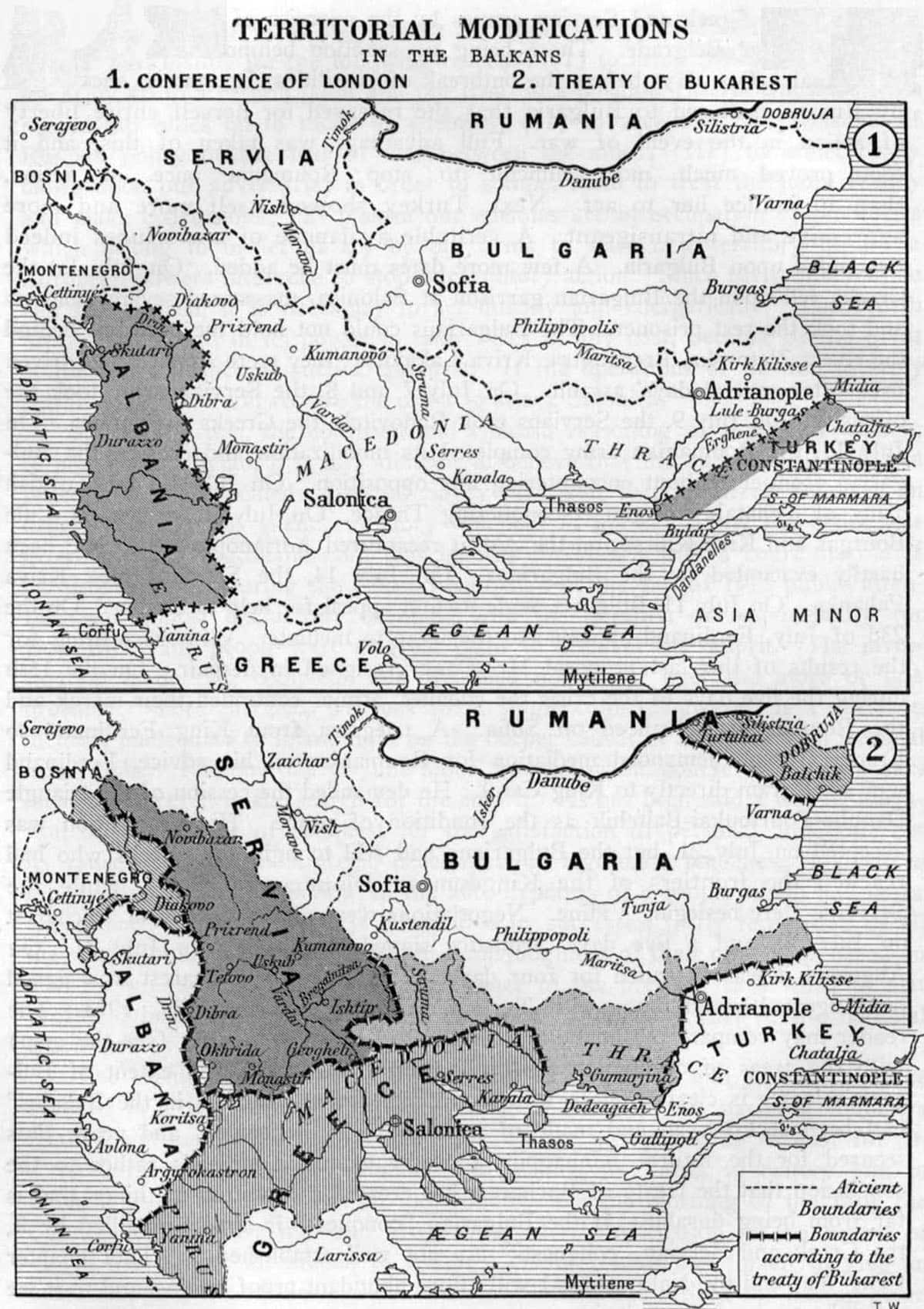
But there is a longer line to draw, and this is the one that turns the battle into the origin story of modern northern Greece. Kilkis–Lachanas won the territory in 1913. The territory was not yet demographically Greek. Greeks were about 43 percent of the population of what would become Greek Macedonia, a plurality in a region of Slavs, Turks, Jews, Vlachs, and others.
The battle began a process that two waves of forced migration would complete: first the burnings and expulsions of 1913 themselves, which started emptying the Slavic-Bulgarian towns; then the Treaty of Neuilly in 1919, which established a “voluntary and reciprocal” Greek–Bulgarian population exchange; then the great Greek–Turkish exchange after Lausanne in 1923, which brought more than a million refugees to Greece overall, including more than 600,000 who were resettled in Macedonia.
By the mid-to-late 1920s, Greeks made up close to nine-tenths of the population of Greek Macedonia.
Kilkis itself tells the whole story in one town. Burned and emptied of its Bulgarians in 1913, it was rebuilt and resettled in the 1920s by Greek-speaking and Slav-speaking Orthodox refugees: about 1,500 from Strumica, who built a church to the Fifteen Martyrs, and some 3,500 mostly from Asia Minor and Pontus. For a time, the town was renamed Nea Stromnitsa (“New Strumica”), a new town named for the old home of its new inhabitants. Few places in Europe carry the demographic logic of the early twentieth century so legibly in their address.
The point is plain enough. The battle did not find a Greek Macedonia waiting to be defended. It was the first act in producing one. The map was drawn in three days in June 1913, and the population was made to match it over the following decade.
The date
Every June, Kilkis marks the anniversary of the battle with a festival called Eleftheria (Freedom). On the pine-covered Hill of Heroes on the southwestern edge of the town stand the monument to the fallen and the Kilkis War Museum, founded by the Greek Army General Staff in 1966 and described as the oldest museum the Greek military ever built. The nearby village of Lachanas has its own battle museum. Some of the Greek dead were later moved to the great Allied cemetery at Zeitenlik in Thessaloniki.
Scholarship on the battle’s memory, notably historian Tasos Kostopoulos’s study So Strange a Liberation: The Battle and Destruction of Kilkis (June 1913) in the Collective Memory of Contemporary Greece, has pointed to the silence inside the celebration. Greek commemoration foregrounds the victory and the Greek dead; it does not foreground the burned town or the expelled population. The title’s irony is the whole argument: a liberation of a place by destroying it and replacing the people who lived there.
That is the difficulty of the date, and it is the right note on which to end. For the descendants of the refugees who rebuilt Kilkis as Nea Stromnitsa, 21 June was genuinely a liberation, the day a place became theirs. For the descendants of the people of Kukush, scattered to the suburbs of Sofia and beyond, 21 June is the day a place stopped being theirs. The two memories cannot be reconciled. The border that the battle drew runs right between them.
Note on dating: Greek military and commemorative dates in this article generally follow the Julian, or Old Style, calendar then in use in Greece. The Battle of Kilkis–Lachanas took place on 19–21 June 1913 Old Style, corresponding to 2–4 July 1913 Gregorian. International treaties are usually cited in their Gregorian dates: the Treaty of Bucharest is dated 10 August 1913. Greece adopted the Gregorian calendar for civil purposes in 1923.