
A technical labor treaty quietly triggered one of the largest postwar migrations in European history, reshaping Greek families, German industry, and diaspora life for decades.
On March 30, 1960, Greece and West Germany signed a labor recruitment agreement that would quietly but permanently reshape both countries. On paper, it was a technical treaty about jobs. In reality, it marked the birth of the modern Greek community in Germany and set one of Europe’s largest postwar migrations into motion.
The signing was the endpoint of months of negotiations. Greek Prime Minister Konstantinos Karamanlis and Foreign Minister Evangelos Averoff had met repeatedly with German Chancellor Konrad Adenauer, laying the diplomatic groundwork for what followed. The document itself slipped almost unnoticed into public life. There were no headlines, no crowds. But for the people who would soon stand in lines outside recruitment offices, it opened a door to a future none of them could fully imagine.
To West Germany, the agreement delivered the hands it urgently needed for factory floors, mines, railways, and construction sites at the height of the postwar boom.
In Greece, still living under the long shadow of occupation and civil war, it became an escape valve for unemployment and poverty that the state could not resolve on its own.
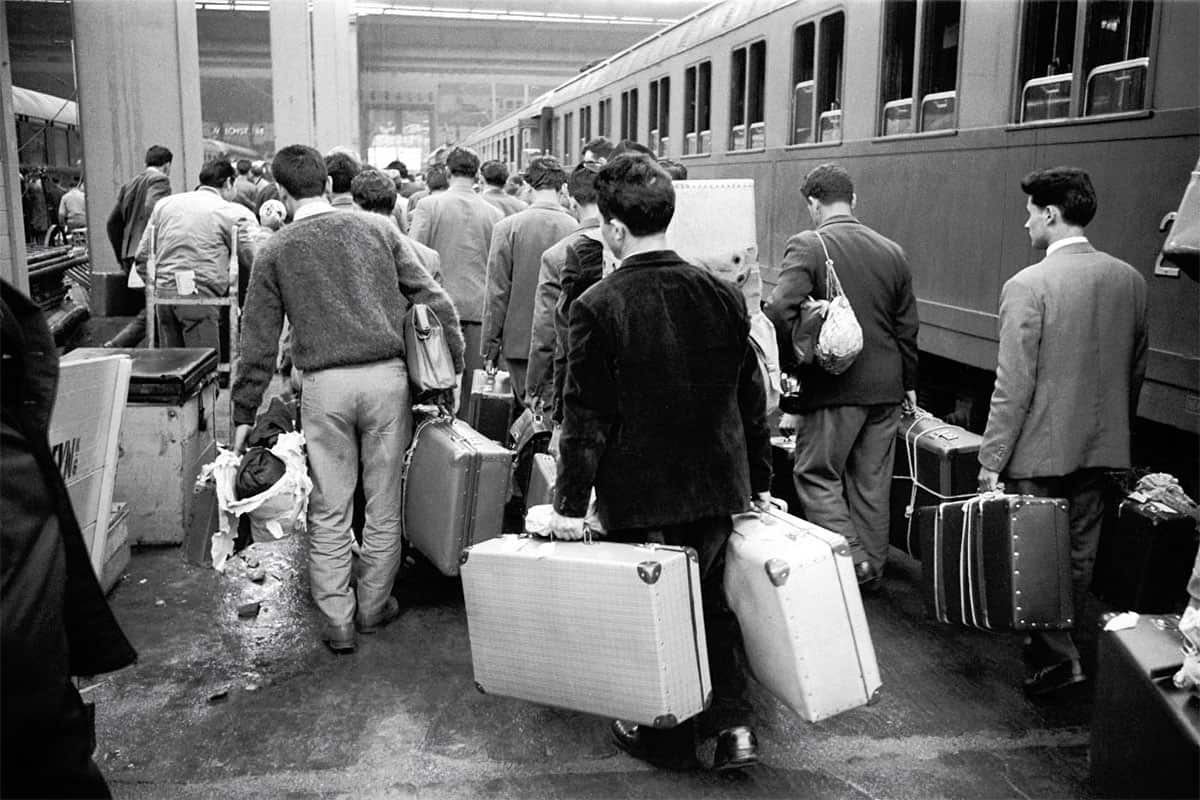
And for the people who would soon pack their lives into suitcases, it marked the beginning of a life shaped by distance, sacrifice, and survival.
Why People Left and Why Germany Needed Them
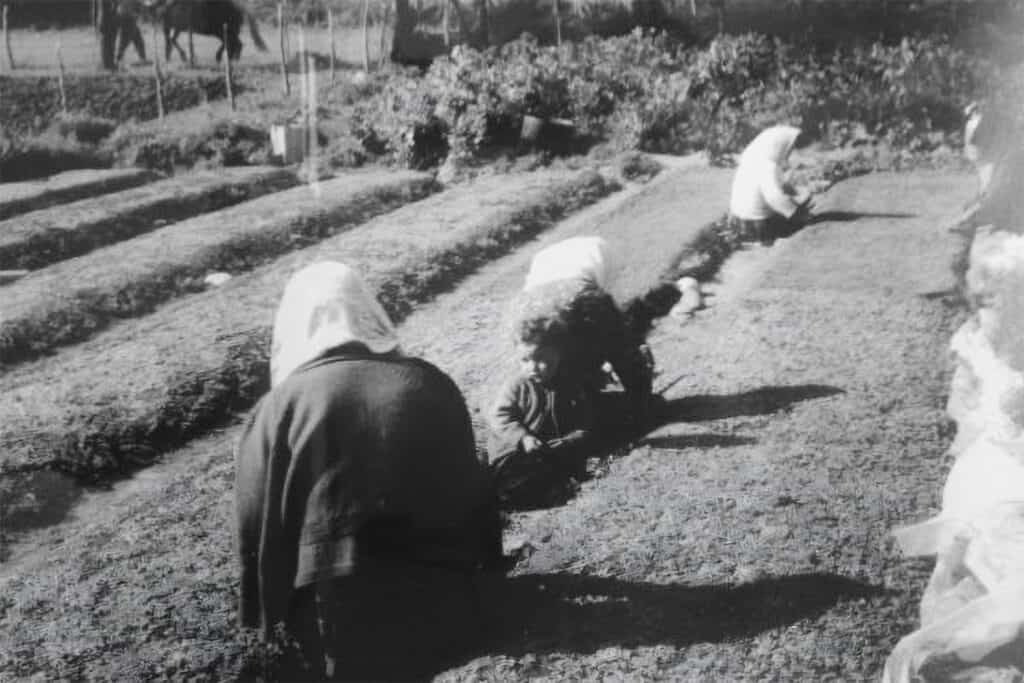
By the late 1950s, much of rural Greece was already under heavy strain. Entire regions in the north, especially Kavala and Drama, were unraveling economically as agriculture declined and the tobacco trade collapsed. Work still existed, but it barely paid.
“I used to work in the tobacco fields,” recalled Vassiliki Manisoglou. “It was a difficult and demanding job, but tobacco’s price was low, so we were not well-paid.”
For many families, the struggle was not temporary. It was constant.
“Poverty left us with no choice but emigration,” said Olympia Karatza. Her husband added quietly, “Since our governments here in Greece did not take care of us, we had to leave.”
At the same time, West Germany faced the opposite reality. Its postwar economic miracle had produced more jobs than its population could fill. War losses, an aging workforce, and limited female participation in heavy industry created a massive labor gap just as infrastructure, factories, and heavy industry expanded at full speed.
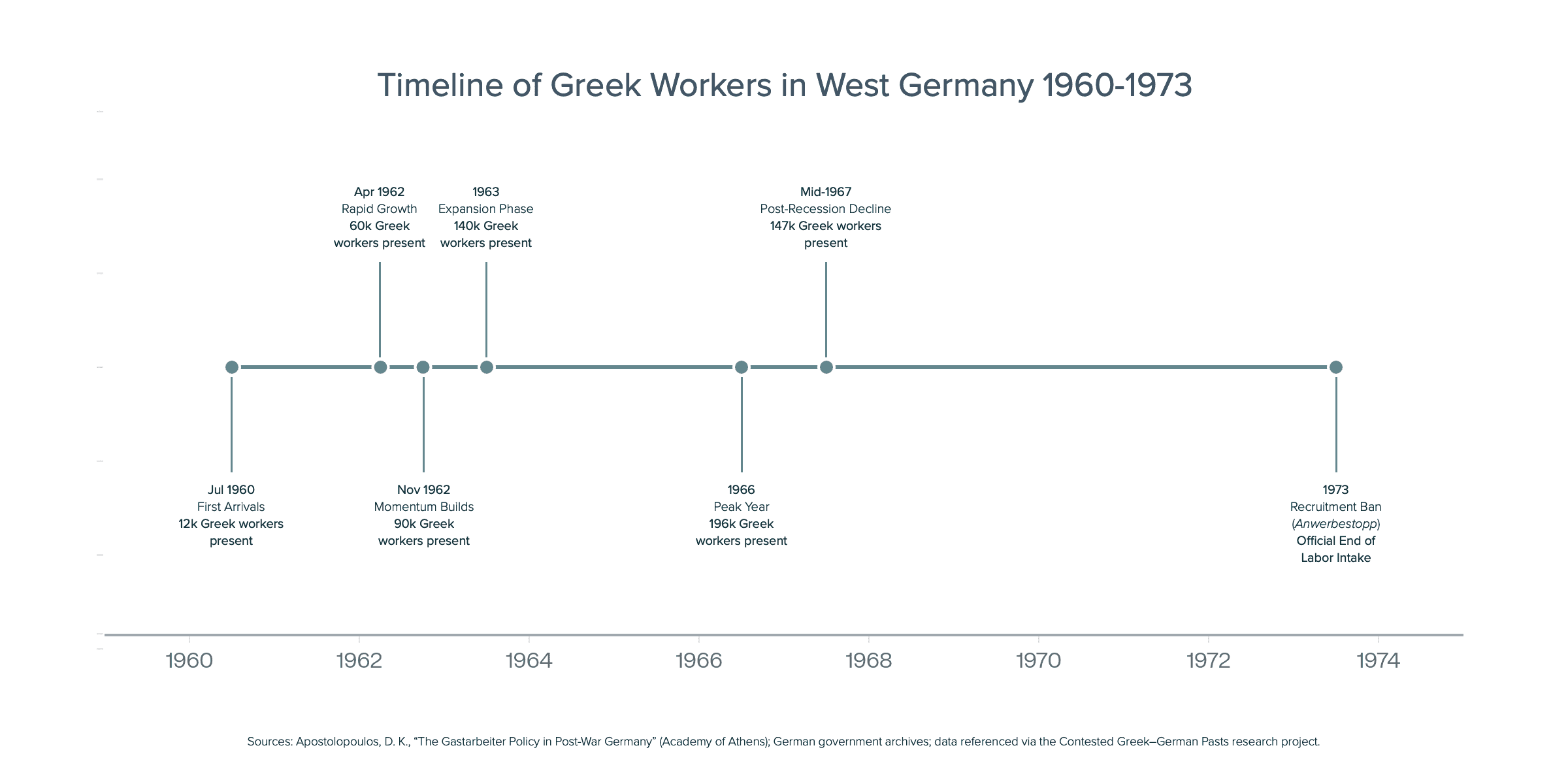
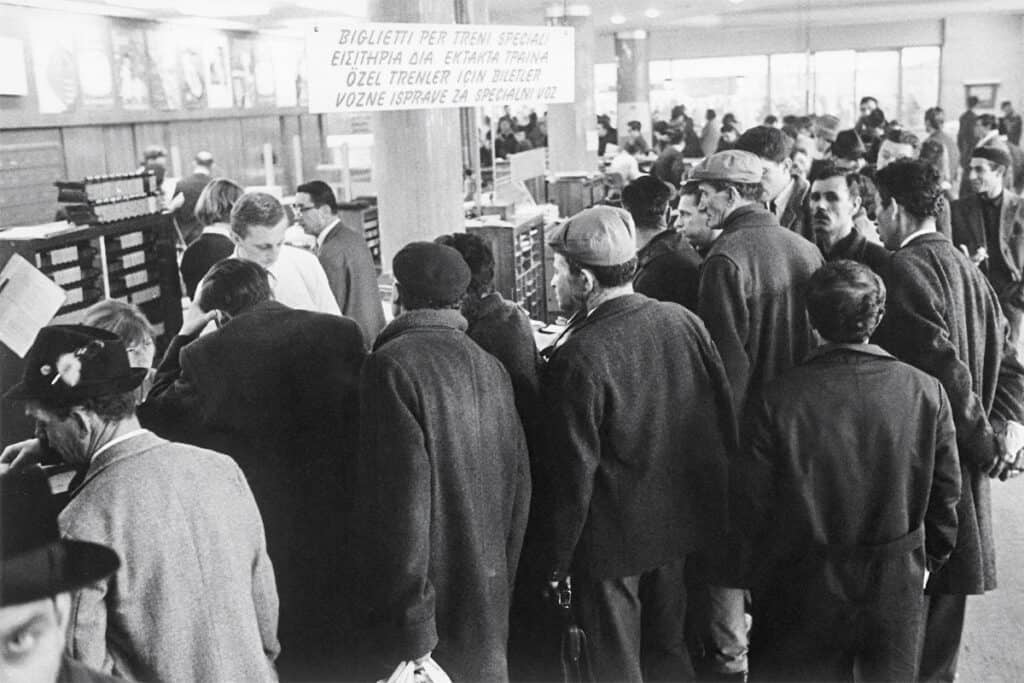
The recruitment agreement stitched these two crises together. Offices opened in Athens and later in Thessaloniki. The lines formed almost immediately. By July 1960, only a few months later, about 12,000 Greek workers had already been sent north.
Selection, Journey, and Arrival
This migration was not spontaneous. It was selective, regulated, and physically demanding from the very first step.
Most migrants were between 18 and 35 years old, the strongest and most productive years of life. To be approved, candidates had to pass strict medical exams that tested lungs, heart, teeth, muscles, and overall endurance. Anyone over forty, anyone with serious health problems, and anyone with certain criminal records was rejected.
By January 1962, the scale of demand had become overwhelming. On a single day, as many as 6,000 people crowded outside the recruitment office in Thessaloniki. Only those carrying the so-called “green card,” a certificate of complete physical fitness, were accepted. In 1963 alone, more than 3,000 applicants were rejected as medically unfit.
Many later described the experience not as a medical check, but as an inspection.
“I felt like an animal,” one worker recalled. “The doctor examined my teeth, listened to my heart, x-rayed my chest, squeezed my muscles and gave me the capability note.”
Theodora Tatsiou confirmed just how unforgiving the process was:
“The medical examination was quite thorough. Most of them had never been examined by a dentist before. But if their teeth were not perfect, they were not cleared to go.”
Even their passports reflected the temporary nature of their departure. Greek passports were issued with a validity of just one year, and they were valid only for the specific countries along the route to Germany. There was no open-ended travel, no freedom of movement. The state defined the journey, the direction, and even the limits of return.
Between 1960 and 1973, somewhere between 600,000 and 800,000 Greeks made the journey to West Germany. With repeat and short-term migration included, some estimates approach one million. By the year 2000, researchers would estimate that roughly one in ten Greeks had lived in Germany at some point in their lives.
Within Europe, Germany was almost the whole story. In the peak years, roughly 85 percent of Greeks who migrated to another European country went to West Germany, and for a short time in the early 1970s, about one in nine Greeks was living there.
At the same time, the agreement did not control everything. A large minority of Greeks, around two in five, reached West Germany outside the German–Greek recruitment offices, entering instead via consulates, employer invitations, or tourist visas and then finding work from there.
How They Traveled North
For the earliest migrants between 1960 and 1963, the main route ran by ship and rail. Thousands boarded the ship Kolokotronis, named after the hero of the Greek War of Independence. It carried them across the Adriatic to Brindisi, Italy, where they were transferred onto German-organized trains bound for Munich.
There, arrivals were gathered near the station, given a number, and each number corresponded to a final destination. When it was called, they boarded a bus toward a city they had often never heard of before.
From 1963 onward, many traveled directly by rail on the Akropolis Express, crossing Yugoslavia and Austria, with its final stop again in Munich before being sent onward to factories, mines, and construction sites across West Germany.
In everyday speech, people spoke of going “πάνω” (up) to Germany and coming “κάτω” (down) to Greece, using simple direction to describe the journey north and south.
For many, the train was a nightmare, especially through Yugoslavia, where fear of theft and harassment kept passengers awake and on guard through the night.
For countless migrants, whichever route they took, it was the first time they had ever left Greece.
The experience would later find its way into Greek music. In “Στο σταθμό του Μονάχου” (At the Munich Station), written by Akis Panou and recorded by Stratos Dionysiou, the migrant speaks alone on a cold platform, surrounded by strangers, unable to understand the language around him:
“At the station in Munich
cruel fate threw me here
my poor mother
evening is falling now
the Akropolis will arrive
maybe it will bring down
a friend, or someone I know…
The song became a quiet anthem for those who arrived alone, carrying fear, hope, and the weight of distance in the same suitcase.
Work, Danger, and Daily Life in Germany
They did not arrive to comfort. Greek workers were directed to the hardest sectors of the German economy. According to a 1964 survey, most Greek migrants were unskilled agricultural workers with minimal formal education, and only about nine percent had vocational training.
In the Ruhr, thousands entered coal mining, descending daily into one of Europe’s most punishing industrial environments. In the Stuttgart region, Daimler-Benz, Bosch, and Telefunken absorbed large Greek workforces into heavy manufacturing and mechanical engineering.
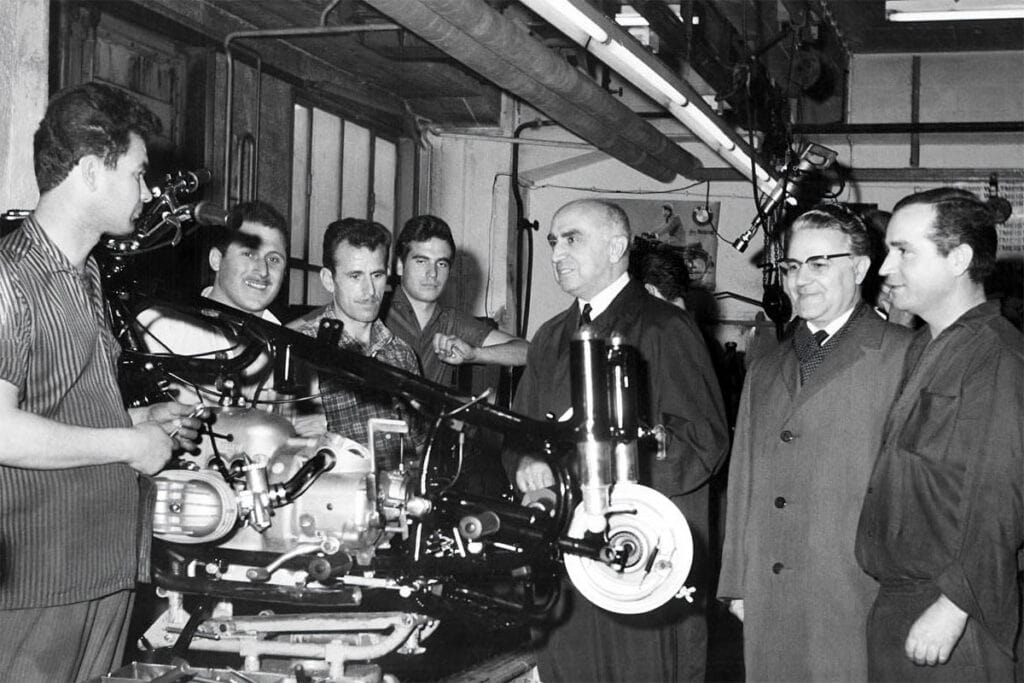
At Volkswagen Wolfsburg, the Greek workforce surged from 730 to 4,494 workers in 1962 alone, one of the fastest migrant workforce expansions of the era. In Munich, Greeks became a central labor force in building the subway system, rail expansions, and major construction projects tied to the city’s growth.
The wages were far better than anything available back home. But the body paid for it.
Welders remembered constant burns.
“All the sparks were falling on my hands and apron. My hands still have marks.”
Foundry workers endured extreme heat and metal fumes. Assembly-line workers installing car seats were exposed daily to toxic liquid rubber adhesives. Many were paid under the Akkord, the piece-rate pay system that forced impossible productivity demands and punished any slowdown.
Some German foremen later admitted they had never seen people endure shifts like that, not because they were stronger, but because they believed they had no right to slow down.
After the shifts ended, most did not go home. They returned to the Heim (worker dormitories). Four to eight people per room. Metal bunk beds. Shared bathrooms. Minimal privacy.
“We lived four people in a room,” one migrant remembered. “There were two double bunk beds. Banana, bread, and butter is all we ate.”
Seventy-nine-year-old Sofia Papadopoulou still remembers leaving Greece at just eighteen years old. She convinced her father to sign her papers because she saw no future for herself at home. With no money and only the clothes she was wearing, she took the train north and arrived alone in a small city in southern Germany.
When she reached the dormitory, she immediately asked for someone who could speak Greek. They brought her a Greek priest to act as a translator. Sofia demanded an advance on her pay. At first, they refused. She insisted. In the end, they gave it to her.
With that money, she bought soap and basic hygiene products. For the first few months, before regular wages began, she washed her clothes every night and waited for them to dry by morning. Only later, after she had earned enough, was she able to buy a second set of clothes.
Women were often housed separately under strict controls. Only married couples were allowed to live together. At first, women made up roughly one-fifth of all migrants, but their numbers grew steadily, especially after family reunification in the late 1960s, eventually reaching over 40 percent of the Greek population in Germany.
After work, the men often went to cafés, the καφενείο, or to the Greek community houses they simply called the ελληνικό σπίτι. They played cards and backgammon. They talked, smoked, and tried to feel human again.
On Sundays, they played football. Some even went on to found their own football clubs.
For many village women, loneliness was sharper than for men. After work, the men went to cafés. The women often stayed inside, because going out alone was not considered proper.
Life narrowed into a simple rhythm: work, eat, sleep, save. Nearly every spare mark was sent back to Greece.
You were there to work. Belonging was never part of the contract.
Money, Families, and the Weight of Separation
By 1961, Greek emigrant remittances had already reached $98.3 million. By the late 1960s, remittances exceeded agricultural export revenues, and Germany accounted for roughly 80 percent of all Greek migrant remittances.
“The wage was three times higher than the one in Greece,” recalled Evdokia Karageorgiadou. “Every month we spent only one of our wages and sent the other one back home for the children. From the money we saved up, we bought this property.”
Across northern Greece, villages transformed. Homes rose. Land was bought back. Small shops appeared. But those villages also grew quieter.
When many returned to Greece in the 1970s and early 1980s, they did not always return quietly. New concrete houses rose beside old mud-brick homes. Cars with German license plates appeared on empty village roads.
With them came a new label, Lazogermani (Λαζογερμανοί), used for returnees from Germany. For some villagers, they symbolized success. For others, they stood for distance, change, and a life lived elsewhere.
The savings were written in concrete, steel, and foreign plates.
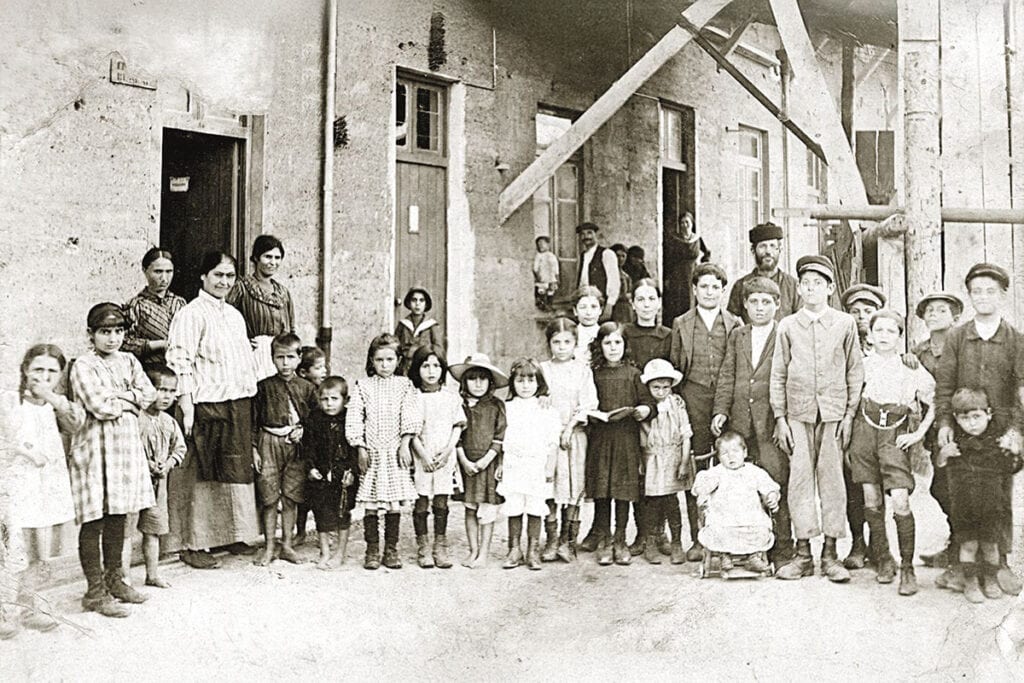
Most early migrants left spouses and children behind. Others left their infants with grandparents and returned alone to Germany.
“I had to leave my baby daughter with my mother and go back to Germany,” said Karageorgiadou. “I hated that I was obliged to do that, but there was no other way.”
When the Greek military dictatorship seized power in 1967, fear tightened everything.
“During the dictatorship, everyone who had a communist background was stalked by regime informers.”
“My brothers were arrested here in Greece, so it was really risky for me to visit,” recalled Stefanos Karatzas. “When I came in 1974, it was seven years since my last visit. I had been too afraid to return.”
Temporary labor quietly turned into political exile. What had begun as a short-term solution became a long suspension of normal life, measured in remittances, savings, and years lost between visits.
Greece gained foreign currency and stability. Families gained homes and land. But the cost was absorbed privately. Inside marriages stretched thin, and childhoods lived at a distance.
From “Gastarbeiter” to a Lasting Community
What Germany officially called them was Gastarbeiter (guest workers). The word had been introduced in the 1950s as a softer replacement for older terms like Fremdarbeiter (foreign workers), but it still carried a clear message: you were expected to be useful, and you were expected to be temporary. What they became, over time, was something no one had planned for: a permanent community.
For many, radio became a lifeline. Deutsche Welle in Cologne and Bavarian Radio in Munich broadcast Greek-language programs. The most beloved of these was Pavlos Bakoyannis’ radio show. Producer Eleni Torosi later remembered:
“The Gastarbeiter absolutely adored Bakoyannis. The show ended at nine. Every night, outside the studio, there was a group of Greeks. They were kissing our hands and congratulating us.”
Years later, Bakoyannis returned to Greece, entered public life, and in 1989 was assassinated by the terrorist organization “17 November.” The shock was felt deeply across the diaspora that had once gathered around his voice.
Radio kept them connected to Greece. Faith gave them a place to gather.
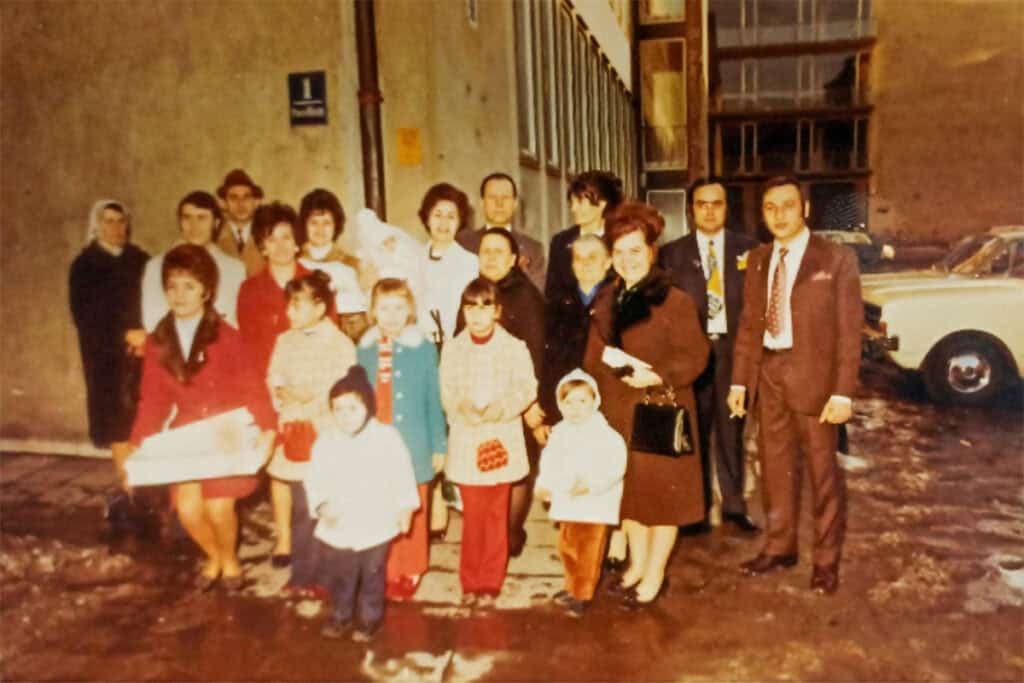
Even where church buildings did not exist, Greeks built community structures wherever they could. Makeshift parishes were formed in rented halls and cultural centers for Easter and Christmas. In some cases, the Catholic and Evangelical Church opened unused churches to Greek families, which were then transformed into Greek Orthodox churches for Sunday liturgy.
By the 1970s, in a number of factory towns, the first Greek tavernas and small import shops also appeared. Oral histories and local studies suggest that some who had arrived as shift workers used their savings to leave the assembly line and become self-employed in gastronomy, opening restaurants that served both Greek migrants and German customers.
Parents fought just as hard to preserve their language:
“My children went to both German and Greek school,” said Vassiliki Manisoglou. “They went to German school in the morning and Greek in the afternoon. They maintained their Greek identity, which was the desired outcome.”
In some German states, integrated Greek schools operate within the public system at the level of Hauptschule, the vocational-oriented lower secondary school track. Later, a full Greek Lykeio (Λύκειο) was added under the auspices of the Greek state.
One daughter of that migration, born in Germany in the early 1970s, once described growing up with two calendars. The school year belonged to Germany. Summers belonged to the village. At first, she felt fully neither. Not fully German, not fully Greek. Only later did she understand that she was both shaped by a departure she never made but lived every day.
In 1973, amid the global oil crisis, West Germany imposed a full recruitment ban (Anwerbestopp), abruptly ending the official intake of foreign labor.
From the early 1970s through the mid-1980s, hundreds of thousands of emigrants returned and resettled permanently in Greece, with roughly half of those returns coming from Germany. Many more remained in Germany.
For decades, most Greeks in Germany lived with long-term residence rights but without citizenship. Their children grew up under the same legal status. A few obtained German citizenship earlier through exceptional paths, which sometimes led others in the community to see them as having become Germanized. At the time, German law generally required naturalized citizens to give up their original nationality.
A broader legal change came only around the turn of the millennium, when Germany revised its citizenship laws and opened a wider path for German-born children of immigrants to become citizens.
Some never returned at all. They were buried in German soil, or sent back in coffins, their exile ending where it began but without their breath.
For those who returned before Greece entered the European Economic Community, the system even allowed them to withdraw their full Rentenversicherung, their state pension insurance contributions, a final symbolic closing of the circle between labor abroad and life back home.
By the end of the 1970s and into the 1980s, many lives were already lived across two countries, with no single center anymore.
Remembering March 30
Looking back, March 30, 1960, was not just a date in a government archive. It was a turning point in hundreds of thousands of lives.
It gave Greece economic relief at the cost of separation. It gave Germany the labor that powered its prosperity while denying that labor true permanence.
And even today, as Greek doctors, engineers, and students once again leave for Germany after 2010, the echo of March 30, 1960, still moves quietly through their steps.
The difference is that this newer migration is often made up of highly educated professionals rather than factory recruits. Yet some of the older emotional questions remain. Even now, some migrants say that opportunity does not always translate into belonging, and that building a life abroad can still carry a quiet sense of distance.
The journey north has changed. The suitcase looks different. The work is different.
But the feeling of leaving home in search of something better remains much the same.