
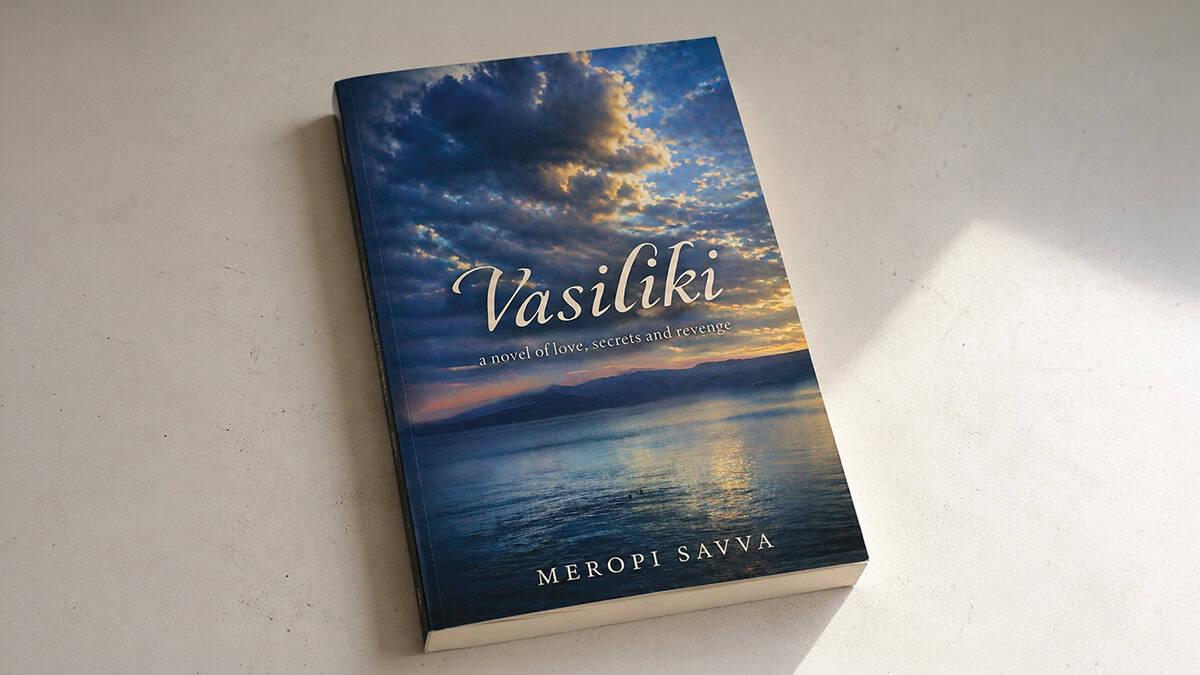
A woman returns to a Greek island hoping to catch her breath, and the place refuses to remain as she remembered it.
In Meropi Savva’s debut novel, Vasiliki: A Novel of Love, Secrets and Revenge, Myrsini is a high school teacher who goes back to the island where she spent her childhood summers. She is looking for distance from the pressure of everyday life. Instead, the sudden death of someone she loves pulls her into a search for answers, and the village she thought she knew begins to reveal a darker history.
The story is set on a small island in the Aegean, but Savva does not use the island as a postcard setting. The village carries memory. It holds family silence, social judgment, old wounds, and the stories older people know but do not always tell. As Myrsini looks into the death, the island becomes less simple and less innocent. Behind the brightness of summer and the rhythm of a fishing village, she begins to uncover a past many would rather leave buried.
What she finds reaches beyond family grief. At its center is a hidden network of human exploitation and a community that learned to look the other way. The novel moves through love, loss, forgiveness, and acceptance, toward the difficult possibility that truth may lead to healing after years of silence. The island is not only where the story happens. It holds what people remember, what they avoid saying, and what later generations are left to understand.
Readers of Greek island fiction may recognize part of that terrain. Like other novels that turn an island into a place of memory rather than escape, Vasiliki is interested in what lies beneath familiar landscapes. The difference is that Savva’s story unfolds as a more intimate mystery, one shaped by grief, local knowledge, and the pressure of secrets within a small community.
The novel, listed on Amazon, was published in May 2026 as a 218-page paperback, independently rather than through a traditional house. That gives it a quieter and more personal path to readers than a conventional publishing campaign would offer.
Savva is a Greek novelist and high school teacher whose writing, by her own account, is shaped by memory, family, tradition, and the bond between people and place. Earlier in her career, she worked at the Greek Ministry of Education’s Special Secretariat for Greek Diaspora Education and Intercultural Education, where she became familiar with Greek schools and communities abroad. That world continues to shape her fiction. Her next novel, also inspired by the Greek islands, deepens her interest in stories and ways of life that risk being lost with time.
Her own family history also reaches beyond Greece. Her parents emigrated to Gabon, in Central Africa, where they built their lives under difficult conditions before returning to Greece. Her two brothers later settled in the United Kingdom and raised their families there. Savva also has relatives in Morocco and France, along with friends and family connections in the United States.
That background helps explain one of the more interesting choices behind Vasiliki. In a statement shared with this publication, Savva said her decision to write in English was influenced partly by relatives, friends, and younger family members abroad who speak little or no Greek. English allowed her to share the story with them, and with readers who may feel connected to Greece through family memory, summer visits, inherited stories, or cultural attachment rather than through fluency in the language.
That does not make Vasiliki a diaspora novel in the strict sense. Its main world is the island itself. Its central movement is Myrsini’s return and the gradual uncovering of secrets rooted in a local community. Still, the choice of English adds another layer to the book. It opens a Greek island story to readers who may recognize its emotional world even if they live far from Greece.
Her first book asks what can happen when a familiar place becomes strange again, and when a return home forces the past into the open.