
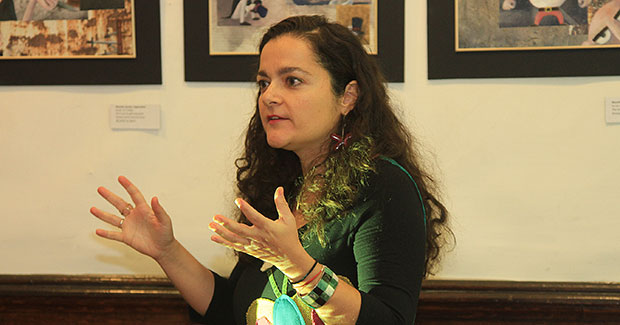
Drexel Greek Studies enters its 8th year, celebrating its anniversary with a new book on Modern Greek Culture, 30 courses ranging from Greek anthropology and medicine to business and local banking, and a thorough “Study Abroad in Crete” component. Its Founding Director, Dr. Maria Hnaraki, illustrates her views.
What distinguishes the Greek Studies Program at Drexel University from other Greek studies in the US?
Drexel’s Greek Studies offers a Minor degree, which embraces Hellenism from antiquity to today, and is designed to be interdisciplinary, with a concentration on Mediterranean issues, focusing on and starting from the island of Crete, as inspired by the late Drexel University President Papadakis.
Our students are from various majors, in constant search of Greek identity and amalgamation through the lens of creative syncretism, seeking an answer to the question “why Greece in the 21st century.” They may select their electives depending on the aspect of Greek studies they desire to focus on (for example, international area studies, business, history and politics, music industry).
We also offer language courses, but all of our classes emphasize the Greek “healthy” lifestyle, values, and ideas, such as philotimo and philoxenia, creative forms of socialization, table manners, folk practices, and performances.
Our pedagogy and didactics emphasize how all the aforementioned function as advocates of communal democracy, balance and harmony, feelings of connection and security, and how, when genuinely followed, they contribute to a form of daily psychotherapy, so to speak, diminishing the existential pain of “not belonging.”
There are a lot of original subjects that you don’t often see in other Greek-study courses, like Afghan Assimilation and Exporting Flamenco. What is the goal of tying these subjects to modern Greece?
Our more than 30 university courses aim to implement an integral, holistic, interdisciplinary academic approach to Greek and Mediterranean reality. Our goal is to show that Greece is more than the stereotypical “ancient world,” “Greek islands,” “relaxation,” or “tourist” destination. It is a unique place, a crossroads of three continents, something that has therefore shaped a peculiar Greek identity, an interesting twin of West and East.
Looking in from the outside, we might view the Greek people as simultaneously ancient and modern. This is because Greece has an extraordinarily ambiguous, complex historical relationship to the idea of Europe itself and, more generally, to the stereotyped entity we call “western culture”.
As the Greek future is predicated upon a stubbornly unfinished past, ultimately, one is at the same time exalted and despondent, grounded and soaring, rational and passionate – elements in counterbalance that define the very essence of being Greek.
All of these topics are further explored during “free to everyone” events (i.e., the Drexel community and the public).
Is there an interest by non-Greek students in the courses that the Program offers, and what is the feedback you are receiving from them>
In fact, there is greater interest among non-Greek students who, after studying “Greece,” admit they have experienced a completely different situation than they had expected due to several “media images.” For instance, they sense the security and the hospitality of the Greeks, and see a beautiful country with people who hope and strive for a change.
Moreover, they speak of a life-changing experience that they feel bodily when they eat and “act” the Greek way, for example, but also emotionally and psychologically when they dance Greek dances and feel open-handed members of a group. They respect how, in Greece, life revolves around the centripetal idea of freedom in opposition to any form of tyranny, where a community is willing to sacrifice itself for a slice of bread.
What do you hope students will learn from studying abroad in Greece?
“Our” program offers students the opportunity to literally dive into the Greek experience through an empirical study of its rich, multifaceted culture as it is expressed today on the island of Crete, strictly taught by natives of that island, namely myself and the program assistant (Drexel doctorate candidate) Theodoros Katerinakis, who cooperate with local institutions such as foundations affiliated with the Greek Parliament, local universities, innovative businesses, cultural institutions and prominent Cretan personalities.
The courses offered by the program examine Greek culture as reflected in its rich and distinctive archaeology, history, visual art sources, and the poetry, fiction, memoirs, and letters of people who have visited, studied, or even lived on the island. Students are guided through the techniques of participant observation as a research ethnographic method and are urged to apply them.
While in Crete, they selectively attend festivals, rituals, family, household, village, and city customs and practices, as these all are valuable mechanisms for learning the social, economic, cultural, political, and religious ways that underlie and make Greek culture distinctive.
Field trips have been integrated into the course requirements and offer students a wide exposure to Eastern Mediterranean history, culture, traditions, cooperatives, local economy, and society.
“Doing Greek Business” is part of your program and study-related activities. Where do you think Greek entrepreneurship, innovation, and research stand right now, and what global effect do they have?
Responding to the negative media coverage of the crisis, we have introduced a course on Greek Business and Regional Economic Policy, inviting CEOs of major “extrovert” Greek companies to lecture in a demanding seminar.
Greek entrepreneurship may lead the way out of the crisis for innovation and employment. Being “extrovert” creates a culture of merit, transparency, and best practices. Contractual farming, food-branding, energy applications, cooperative personnel culture, and a start-up burst develop and push their way in. In the Greek periphery, social economy with independent cooperatives from banking to agriculture and exchange-based networks are thriving as they keep the bonds with community and locality.
The unique Drexel-Greek Studies business course has so far, for instance, showcased: Raycap advanced engineering, S&B industrial minerals, Intelen energy analytics, Miltech avionics, Carbonpositive carbon neutrality management, EFP eco-cleaning, GAEA meze basket, Cretafarms patented deli-meat, Cocomat sleep products, Vaeni-cooperative wines, Pharmathen generics and know-how, cosmetics of Korres and 25A, Navios maritime leadership, the centennial honey of Attiki-Pittas, and The Manna rusks, as facets of innovation and applied research in their sectors.
Differentiation, penetration into niche markets, responsible business practices, problem-solving, and adaptive decision-making are coloring the Greek spirit. The pending question is how to consolidate such efforts into a national strategic plan to promote Greece’s role in the Mediterranean and the European Rim region.
Your new book, “Sing In Me, Muse, and Through Me Tell the Story,” has just been published. Can you talk a little bit about it?
This book is a collection of ethnographic essays that meditate on Greece through the looking glass method, namely a way of studying a culture from the inside out by honestly I/Eye-witnessing it. It investigates how ancient mythologies shape modern identities, while it also provides an ample description of various incarnations of Greek folklore performance.
Its goal is to show how, in an era of globalization, Greeks insist upon going local by proudly celebrating their multifaceted past as they carry it into a turbulent present. From the time of Homer to contemporary forms of resistance, the poetics of “Greekness” provide an excellent ground for investigating the ecology of expressive behaviors.
All in all, being Greek in the 21st century offers fertile ground for rediscovering the fundamental nature of life by actually experiencing Greece’s truly rich realities, which have been so stigmatized as “in crisis.”
By building bridges and understanding the wealth and uniqueness of Greek culture, the clues to our own identities may unfold, albeit via labyrinthine pathways, capable of leading us to a catharsis, by realizing that, after all, nothing in our cosmos is… Greek!
About Maria Hnaraki
A professor of anthropology, folklore, and ethnomusicology and an accomplished scholar in the field, Maria Hnaraki has extensively researched identity expressions, traditions, and customs, such as music and dance events in the Mediterranean.
Hnaraki holds a Diploma of Arts in Music Studies from the National and Kapodistrian University of Athens, Greece, along with an M.A. and Ph.D. in Cultural Anthropology, Folklore, and Ethnomusicology from Indiana University (Bloomington, USA). Additionally, she has a Piano Soloist Diploma from the Hellenic Conservatory of Athens and degrees in Theory, Pedagogy, and Music Education from the National Conservatory of Athens.
Hnaraki is currently the Director of Greek Studies and an Associate Teaching Professor at Drexel University, Philadelphia. Her first book, Cretan Music: Unraveling Ariadne’s Thread, has received the “Young Academic Writer and Researcher” prize from the Pancretan Association of America.