
When I came to Greece as a storyteller with a deep-rooted passion for Hellenism, I was not searching for sweeping vistas but for the culture’s heartbeat: its people, their rituals, the fleeting moments of daily life. Drawn by the evocative images of Constantine Manos and Nikos Economopoulos, I set out to follow their path to the mountain village of Olympos on the island of Karpathos.
In 2001 I finally made the journey. From Pigadia a bus wound along dramatic mountain roads, and I walked the last stretch, climbing the final path into the village. One of my first encounters was with a kind-hearted woman who offered me a plate of watermelon. That simple gesture radiated philoxenia, the Greek “friend to the stranger,” and captured the warmth at the heart of this place.
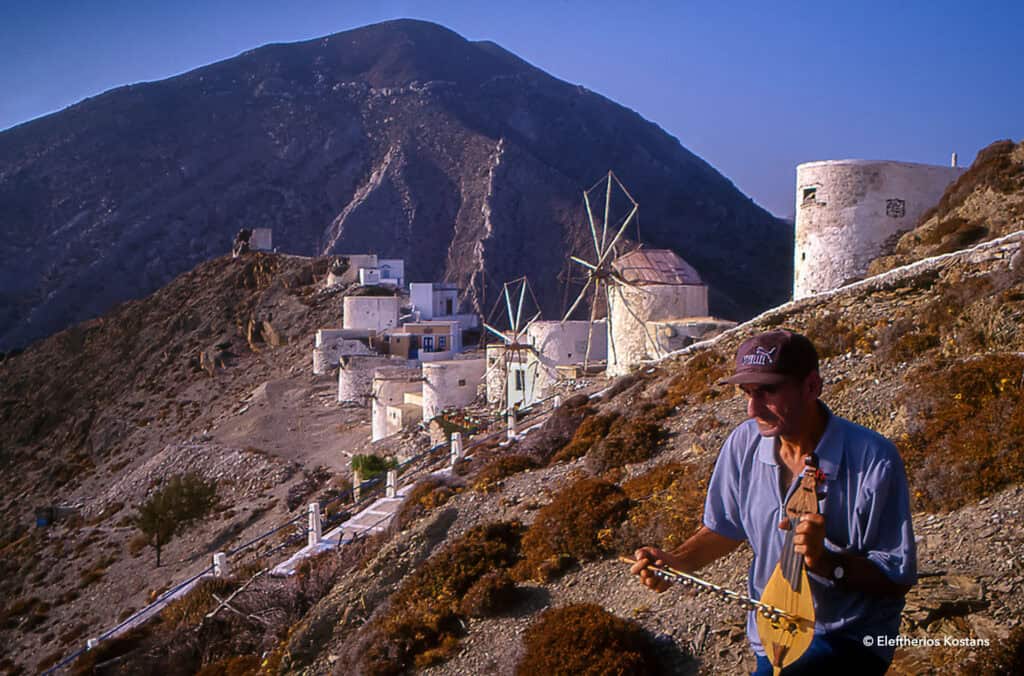
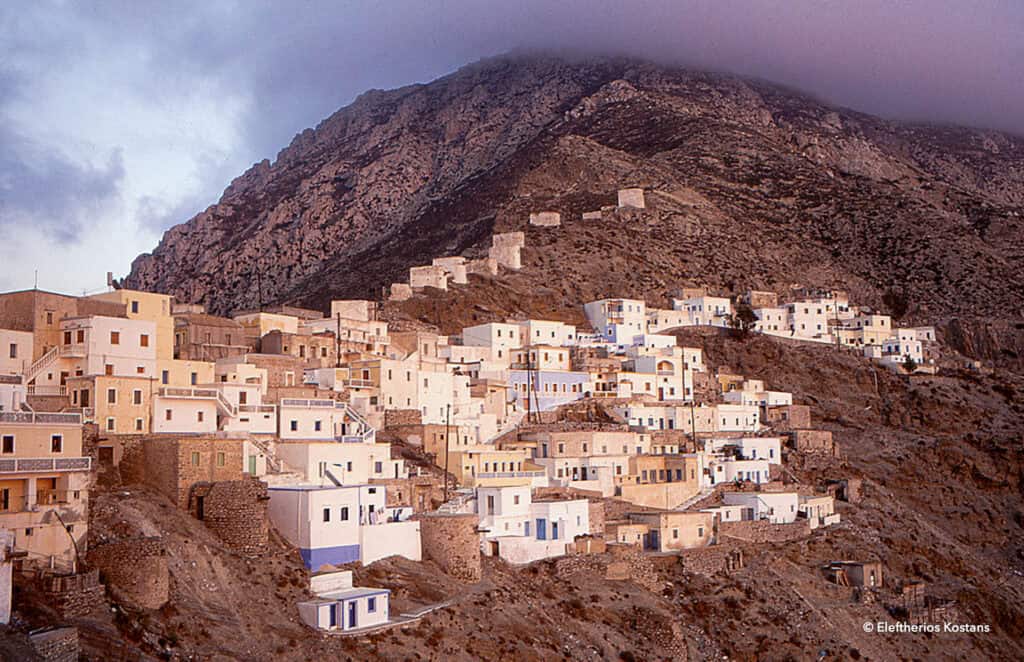
The story of Olympos reaches back to the 7th to 9th centuries AD, when Saracen pirate raids drove the people of Karpathos from their coastal homes. Seeking safety, they built anew in the island’s rugged interior, creating a settlement for defense with windmills that doubled as fortress towers, houses packed tightly into steep slopes, and labyrinthine streets meant to confuse attackers.
This isolation became their greatest shield. It preserved not only the architecture but also the old dialect, centuries-old customs and a rare matrilineal tradition in which inheritance passes through the eldest daughter and women safeguard the cultural legacy.
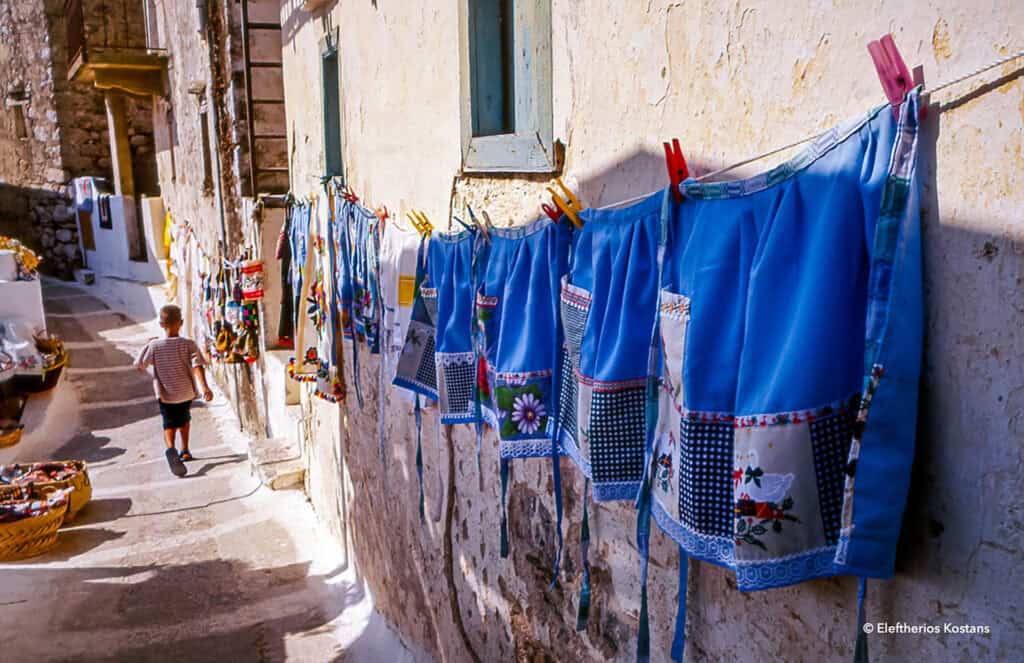
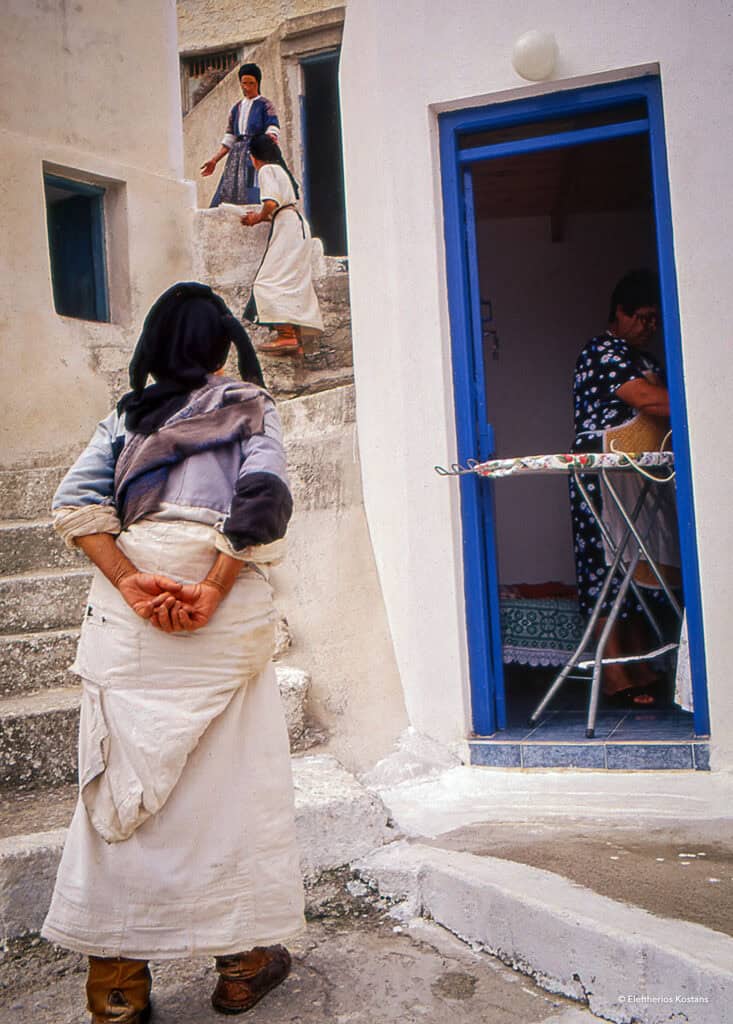
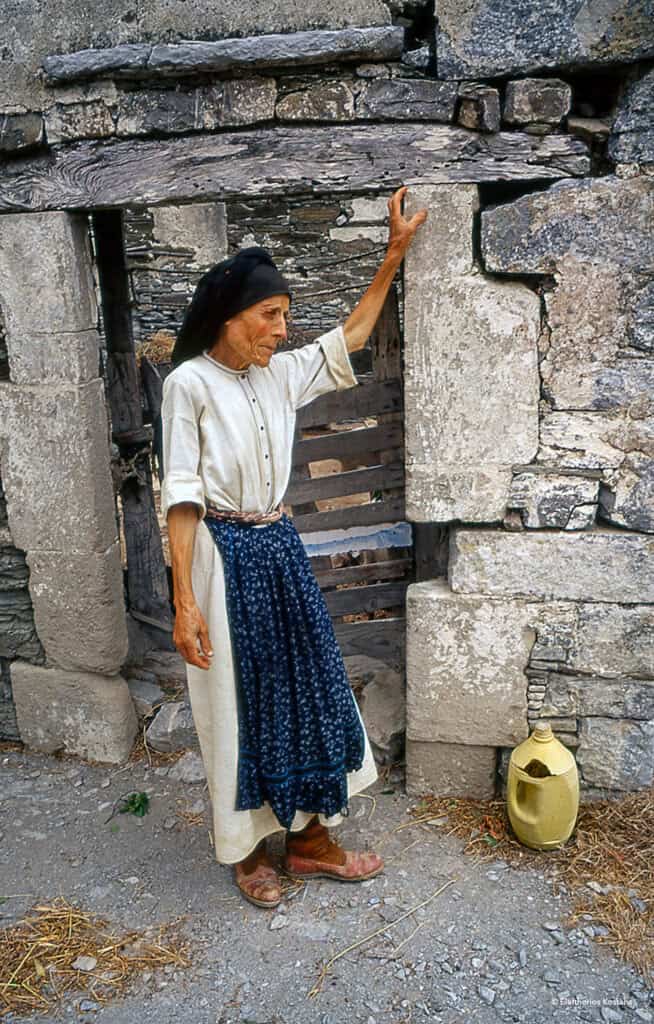
Those centuries still echo in daily life. Young women brighten the lanes in vivid sakofoustano gowns. Elder women wear black kavai adorned with gold coins. Men move about in weathered boots. Flower-filled balconies overlook the endless blue of the Aegean. Bread bakes in communal ovens. Neighbors lean in to talk in the square. Children race up stone steps polished smooth by time.
Economopoulos once described the spirit of discovery here:
Being on the road, traveling without a predetermined purpose, looking around me with visual curiosity, and being surprised by what I encounter. While shooting, somehow, thinking is suspended. It is like playing a game with reality.
Manos spoke of the same truth:
Living in Greece for three years, I traveled the countryside in search of images that capture the character and beauty of a way of life that had been virtually unchanged for centuries. These pictures are the record of random wanderings in places where the only sound might be the distant tinkling of sheep bells, where hospitality for the stranger is a sacred tradition, and where time has stood still against a backdrop of rural simplicity and serenity.
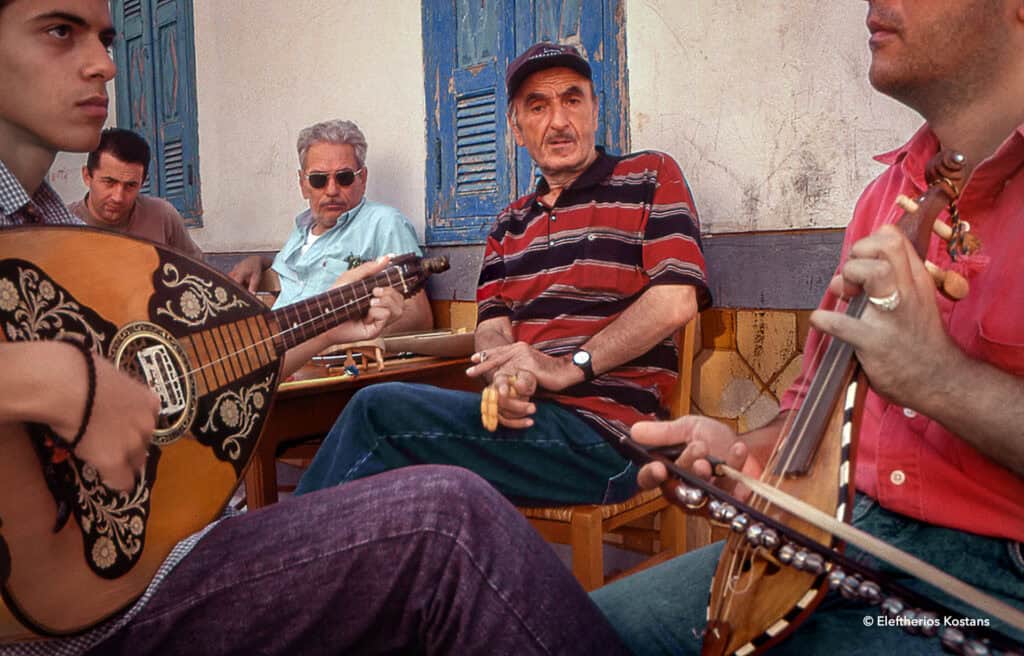
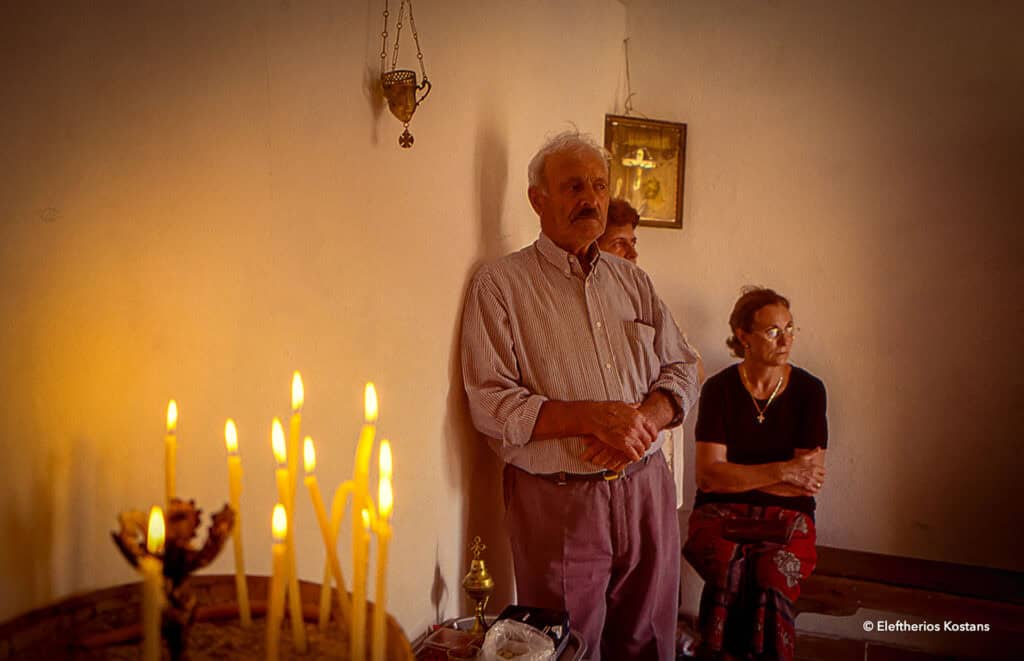
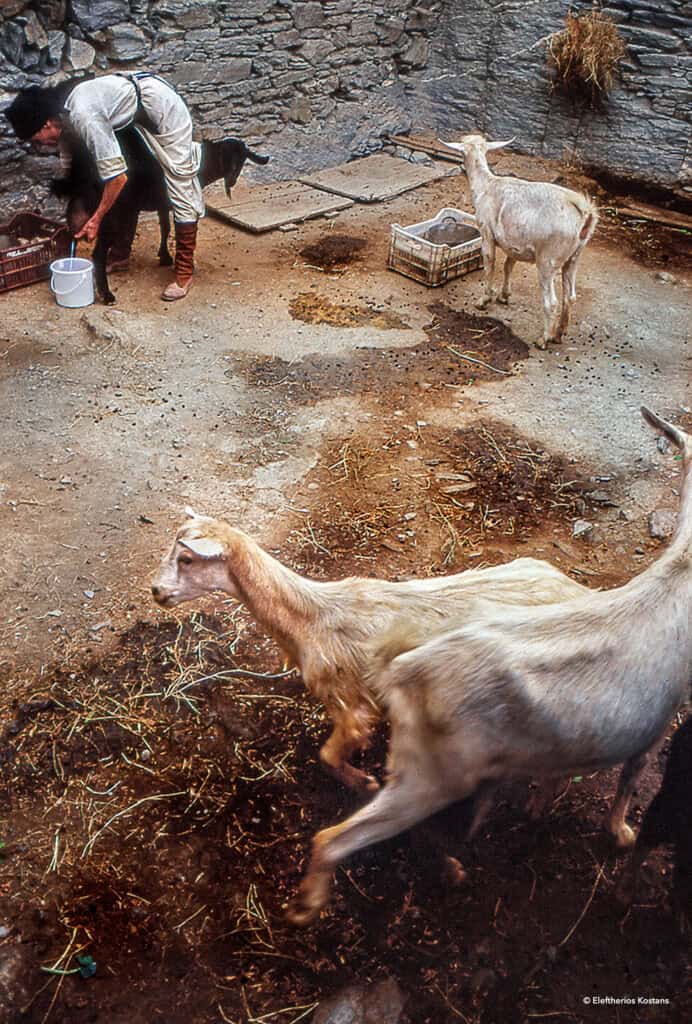
Their words guided my own lens. I sought those unguarded moments where history and present meet: women working in communal kitchens, elders speaking the old dialect, children twirling between ancient stones. Photographing Olympos meant honoring both its authenticity and the quiet magic of human connection.
Olympos continues to draw photographers and storytellers. Manos and Economopoulos were among the first to capture its spirit. Later George Tatakis, Julia Klimi and Robert McCabe followed, each finding the same honest beauty and the rhythms of changing seasons. In spring, wildflowers blanket its terraces. Summer bursts with festivals. In winter, mist curls around the mountains while kitchens glow with the scent of fresh bread.
Reaching Olympos is a journey in itself. The 43-kilometer (27-mile) road from Pigadia twists through sharp bends, every turn offering a new frame for memory and meaning. I remember leaning toward the window, watching the Aegean flicker far below and feeling the pull of the village before it even came into view. For those who make the trek it is more than a destination. The windmills still turn, centuries endure, and in every welcome philoxenia quietly extends its hand. Through the photographer’s eye, the timeless life of Olympos continues to speak in images that will outlast us all.
About the Author
Eleftherios Kostans is a storyteller, filmmaker and photographer who explores how culture, tradition and human connection shape everyday life. Rooted in his Hellenic heritage, he has spent decades capturing authentic scenes of Greek experience, from remote island villages to the streets of modern cities. His images and films have appeared in cultural publications and exhibitions that celebrate the resilience of tradition in a changing world.
When he isn’t behind the camera, Kostans writes for Cosmos Philly, sharing narratives that bridge past and present. Guided by the belief that the most powerful stories live not in sweeping vistas but in quiet human moments, he continues to travel and document the timeless spirit of Greece.