
Visitors to Mystras know the climb.
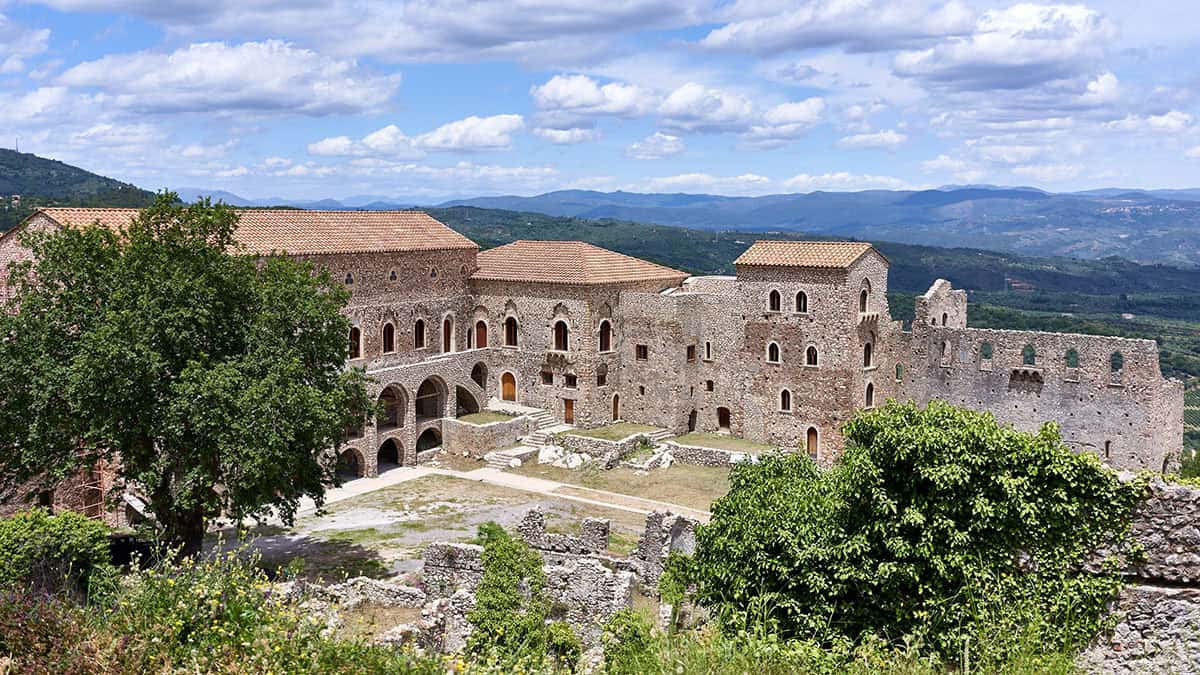
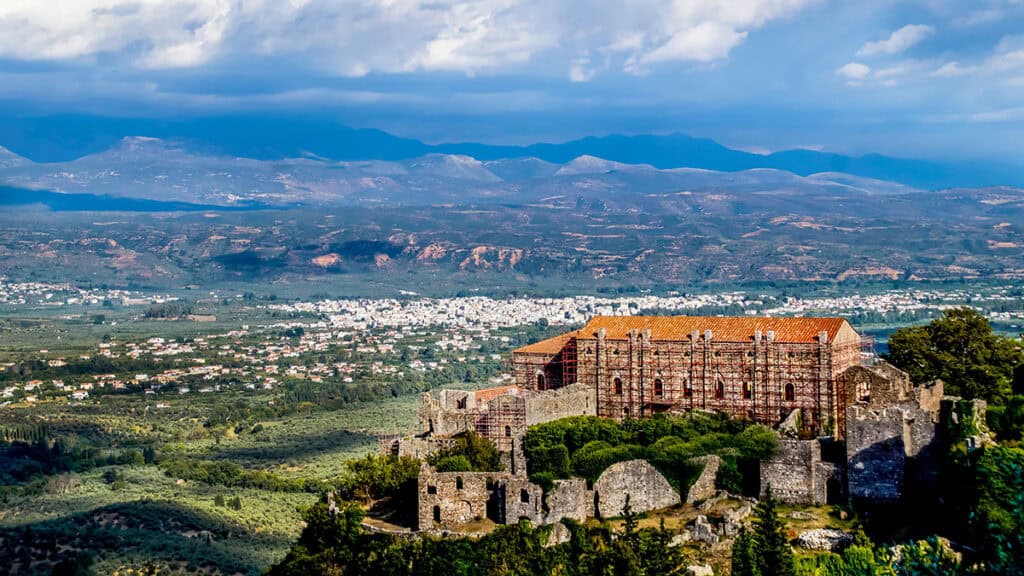
They enter the Castle City, follow the stone paths, pass churches with shadowed interiors and fragments of frescoes, and keep looking upward. Above the walls and roofs stands the Palace of the Despots, one of the great monuments of the late Byzantine period.
For decades, it was part of the view, but not part of the visit. The Palace of the Despots has now reopened to the public after 42 years of restoration, allowing visitors to enter the most important secular monument in Mystras. The inauguration ceremony took place on May 21, with Prime Minister Kyriakos Mitsotakis and Culture Minister Lina Mendoni in attendance. The palace opened to visitors the following day, according to the Greek Culture Ministry.
The ministry describes the Palace of the Despots as the only surviving Byzantine palace complex in Greece. The phrase is important, but it can sound distant until you think about the visitor’s route through Mystras.
For years, people could walk the churches, monasteries, gates, walls, and steep lanes of the Castle City while the palace remained just outside the experience. Now the building that once shaped the life of the medieval city near Sparta belongs to that route again.
A Closed Landmark Becomes a Place to Enter
Mystras was founded in the 13th century on the slopes of Mount Taygetus, above the plain of Laconia. It began as a fortress and grew into one of the major centers of the late Byzantine period. The city later became the capital of the Despotate of the Morea, a Byzantine state that played an important role in the final centuries before the fall of Constantinople.
It was a lived city, not only a fortress, with churches, monasteries, homes, roads, workshops, and a palace. The Palace of the Despots was the seat of authority in that city. Its long building history reflects the powers that shaped Mystras, from the Frankish presence in the Peloponnese to the Byzantine families who later ruled from there. The complex grew over time, with different wings and spaces added across different periods.
From the upper city, the palace looks over the settlement and the plain below. Even from outside, its position is clear. It was placed where authority could be seen. That is what made its long closure so noticeable. Visitors could photograph the palace, walk around it, and read about it, but the city’s central building remained just out of reach.
What Restorers Preserved, and What They Did Not Try to Fake
Conservators worked on surviving plaster, wall painting, stone elements, and mortars on the interior and exterior surfaces of the palace complex. They stabilized damaged layers, secured painted surfaces, removed older interventions where needed, and restored parts of the painted decoration without trying to make the building look new, according to Naftemporiki.
That restraint follows a restoration philosophy closely associated with architect Stefanos Sinos, who worked for decades on Mystras. In a 2021 interview with Greece Is, Sinos spoke about the need to keep original and newer elements readable. He warned against inventing forms when the evidence is not there.
The restored palace carries that idea. It has been made safe and understandable, but not polished into something false. The repaired sections, worn surfaces, surviving fragments, and visible age still belong to the experience. Mystras would lose something if it looked untouched.
The Throne Room and the Language of Court Life
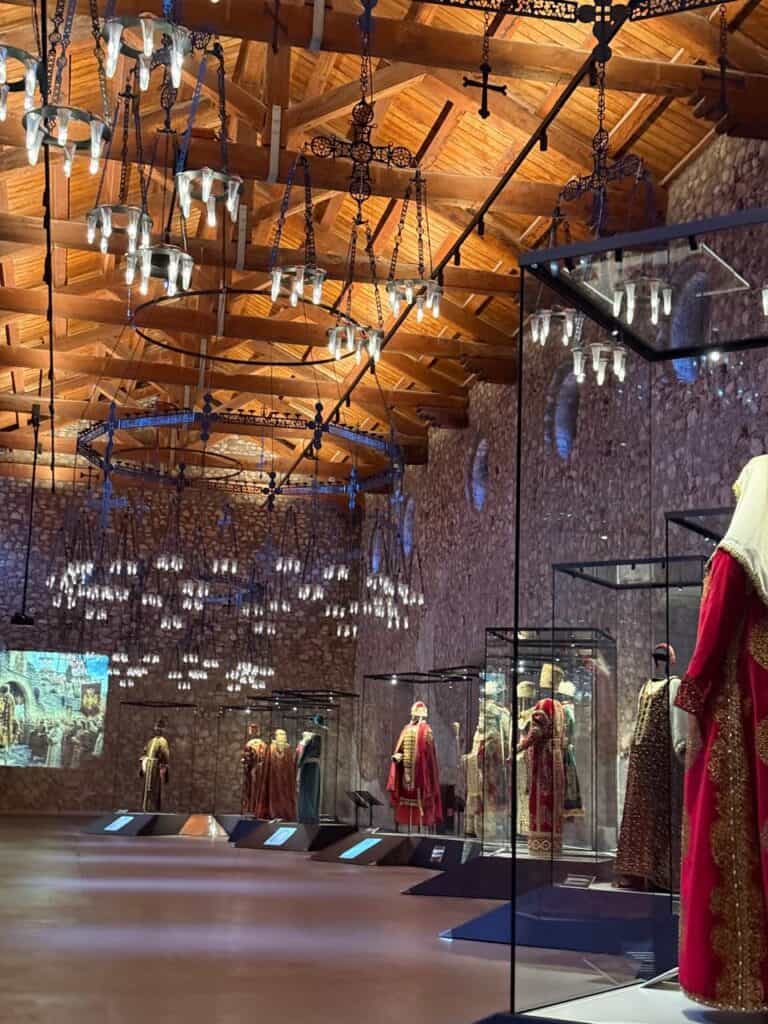
The palace now functions as a museum and exhibition space, with rooms open to visitors after decades of closure. The permanent exhibition, “Hegemonic Narratives,” focuses on the imperial families associated with Mystras and the roles they played in the city’s administration and intellectual life.
Two temporary exhibitions add more specific layers. “In the Saraya of the Princess” looks at how Mystras was imagined by European intellectuals, while “Reflection of Glorious Attire” focuses on dress as a sign of power and social identity.
The most tangible part of that story is in the Throne Room. Handmade garments inspired by the Palaiologan court are displayed there, based on Byzantine iconography. They were created by the sisterhood of Pantanassa, with support from the Greek National Opera’s costume department.
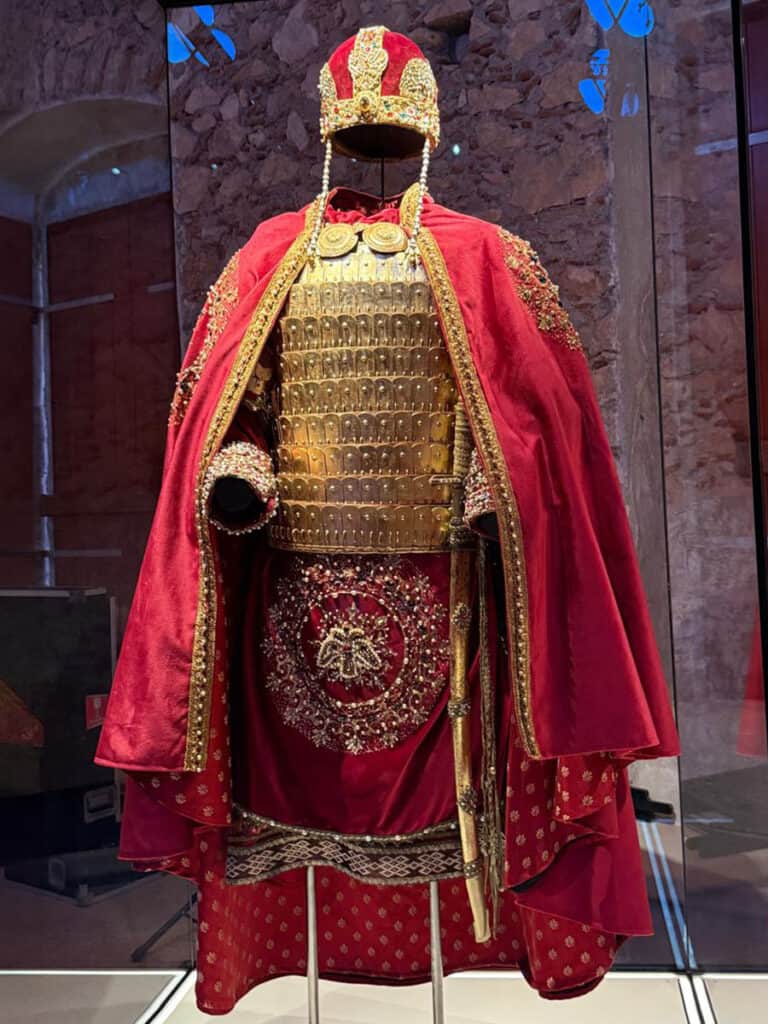
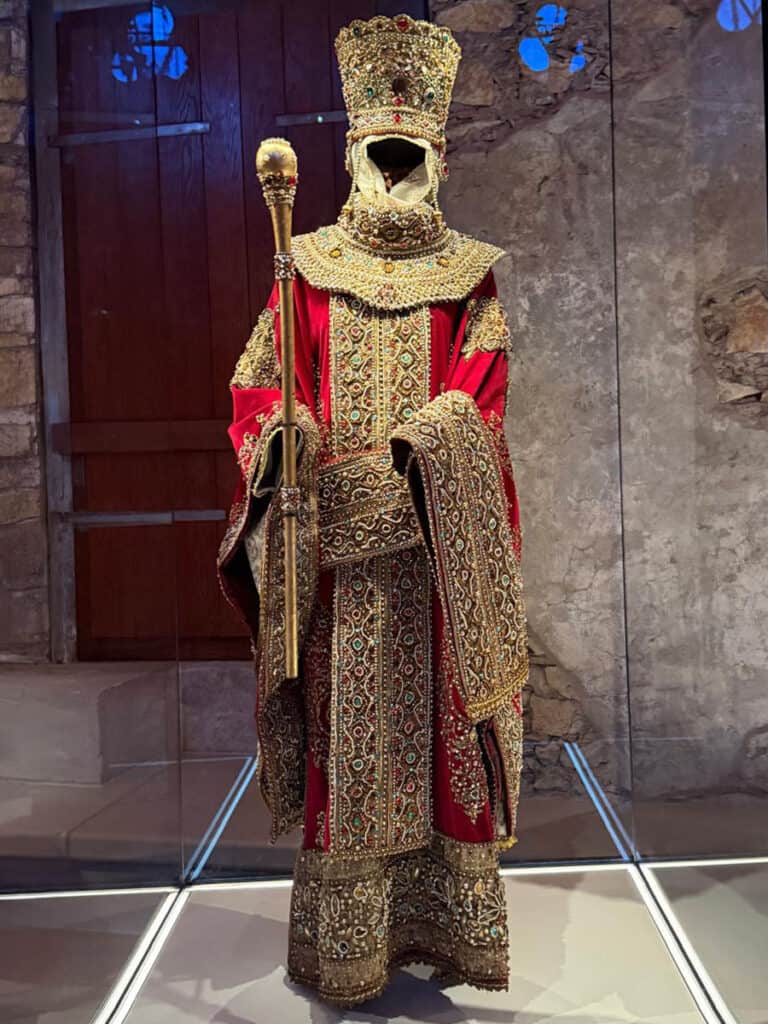
Inside that room, clothing does not feel like decoration. It becomes a way to understand how rank, office, proximity, and identity were made visible in court life.
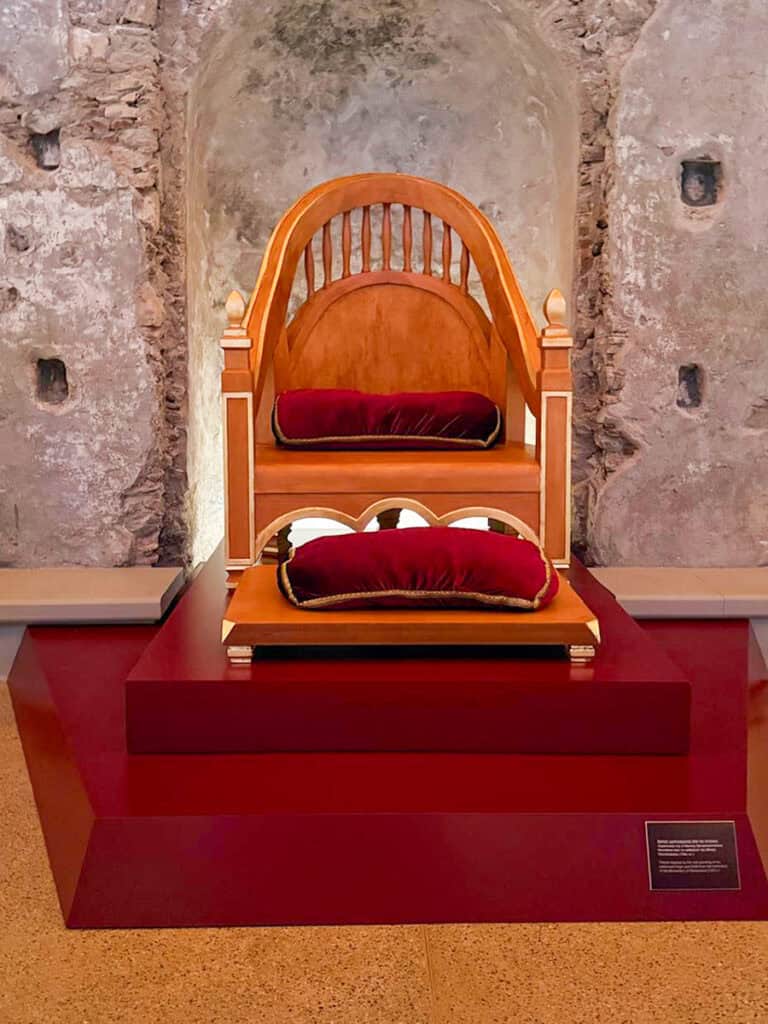
The room itself adds another detail. Sinos noted that the ruler was not placed at the narrow end of the hall, far from everyone else, as many people might imagine. He was seated along one of the long walls, near the middle of the gathering, with others seated on nearby benches.
It is a small detail, but it changes the room. The palace becomes less abstract, more like a place where people once entered, waited, watched, spoke carefully, and understood where they stood.
Easier to Reach, Better Protected
The restoration also changes how visitors move through Mystras. The central cobbled route linking the lower and upper city has been restored. Emergency access has been improved. A modern outdoor ramp has been installed at the southwest Palaiologan wing of the palace to help visitors with mobility needs reach the site more easily. A new fire suppression network has also been completed in the upper and lower town.
The work does not remove the difficulty of Mystras. It is still a city built on a slope, and the visit still asks people to walk, climb, pause, and look around. But the reopened palace makes the route feel more complete.
A Different Chapter of Greek History
Mystras belongs to a period of Greek history that many visitors encounter only after the ancient sites. Its world is medieval and Byzantine, shaped by Orthodox churches, fortified streets, court titles, manuscripts, painted walls, and a city built into a mountainside.
UNESCO’s description of Mystras links the site with the Palaeologan Renaissance and with figures such as Georgios Gemistos Plethon and Bessarion, whose intellectual world connected late Byzantine thought with the early Renaissance in the West.
The visitor does not understand Mystras by standing before one monument. The site is understood by walking. That is why the palace reopening changes the experience. For years, the Palace of the Despots stood above the city as a closed landmark. Now, visitors can enter it and place it more naturally within the life of the Castle City.
The restoration does not make Mystras complete. No restoration can do that. Too much time has passed, and the city’s power now comes partly from what has survived and what has disappeared.
After 42 years, visitors can finally walk inside the palace again.