

Walk into a village chapel anywhere in Greece and chances are you’ll find her. The Virgin Mary. Or as Greeks say with reverence and closeness, Panagia. You might see her holding the infant Christ, her head bowed in tenderness, or surrounded by silver and gold votive offerings. And always, she has a name. Not just “Panagia,” but something more. Something local. Something lived.
Panagia Myrtidiotissa. Panagia Faneromeni. Panagia Glykofilousa. Panagia Soumela. There are thousands of these names, each tied to a place, a miracle, a memory. Some researchers say there are more than sixteen hundred. Others count well over a thousand names and adjectives. The truth is, no one knows the exact number. It keeps growing. Every icon, every church, every village adds its own way of calling out to her.
In our churches here in America, you will find her too. The icon of the Virgin Mary is almost always there, waiting near the candle stand, watching quietly from the front of the nave. You see her in churches named for moments in her life like the Annunciation, the Dormition, or the Presentation. These are not names she carries, but moments we honor.
Still, the feeling is the same. That sense of closeness. That instinct to turn to her, even without words. It came with our parents and grandparents when they stepped off the boat, when they made a new life in Philadelphia, Cherry Hill, Broomall. She came too, even if only folded into a suitcase in the form of a small icon wrapped in cloth.
You can feel her presence in every parish across the Delaware Valley. At St. Luke in Broomall. Annunciation in Elkins Park. St. Demetrios in Upper Darby. St. George in Media. Evangelismos on Bustleton Avenue. St. George Cathedral in Center City. St. Sophia in Jeffersonville.
Across the bridge in New Jersey, she is there at St. Thomas in Cherry Hill, Holy Trinity in Egg Harbor Township, and St. Nicholas in Atlantic City. And in Delaware, she watches quietly from Holy Trinity Cathedral in Wilmington. Each church has its own rhythm, its own history, its own community. But she is always there, glowing in candlelight, never far from anyone who calls on her.
The names come from every corner of Greece. Some are tied to geography. Panagia of the Mountain. Panagia of the Sea. Panagia of the Rock. Others describe how she looks. The Sweet-Kissing. The Three-Handed. The Tenderhearted.
Some names come from what she does. She heals the sick. She brings children to childless families. She calms the sea. She answers quickly. She consoles. She forgives. One village remembers her for bringing rain. Another for stopping a fire. Another for saving a fisherman in a storm. These are not just stories. For the people who lived them, they are facts. A church was built. A name was given. A feast was set.
Some names became known far beyond the villages where they started.
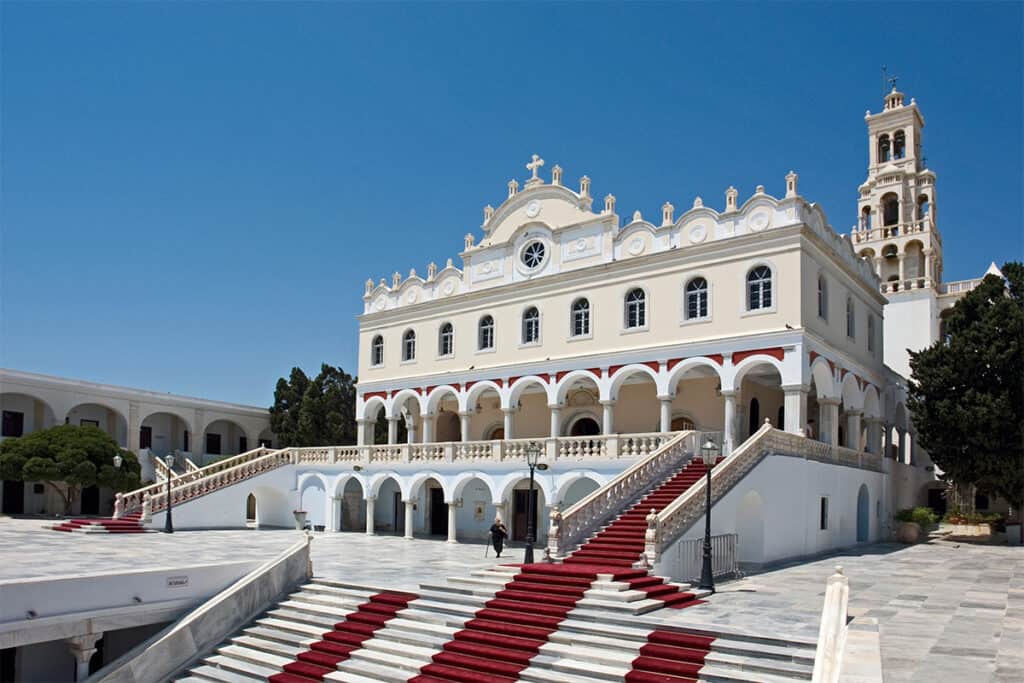
On the island of Tinos, the Church of Panagia Evangelistria is at the heart of the most important Orthodox pilgrimage in Greece. Thousands arrive every August fifteenth, some crawling uphill from the port on their knees, fulfilling a promise or asking for one more miracle. Inside, her icon is nearly buried beneath silver, gold, and tears. People call her Megalochari, She of Great Grace.
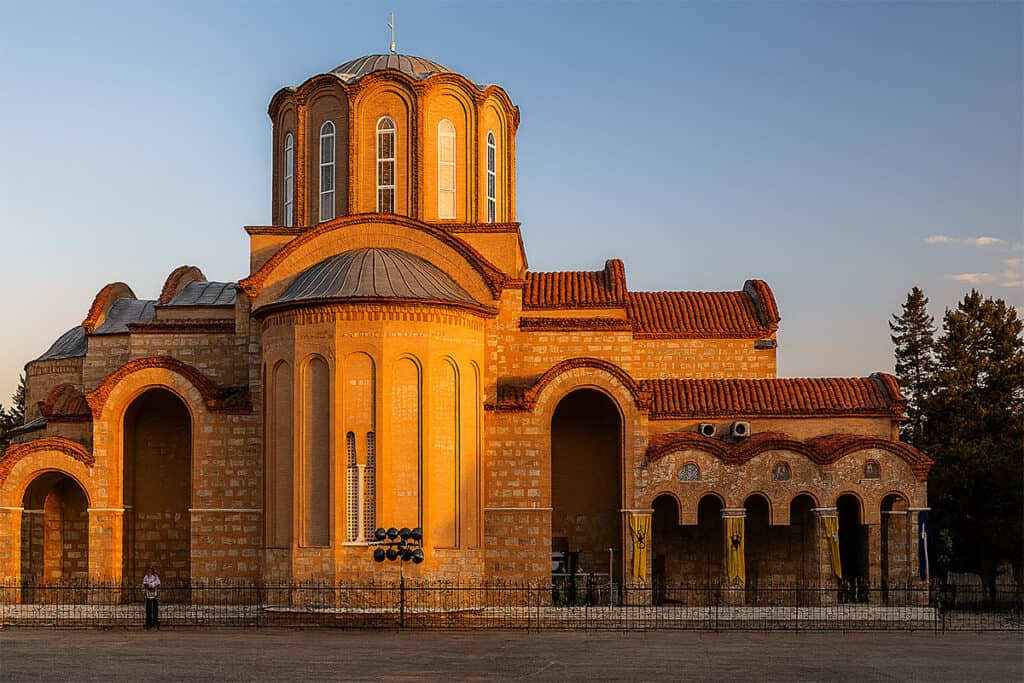
Panagia Soumela holds a different place in the hearts of Pontic Greeks. Her original monastery once clung to the cliffs above the Black Sea. After war and exile, her icon was rescued and brought to Greece, where a new monastery was built. For Pontians, she is memory, survival, and home. Her feast is marked not only with prayer, but with dance, lyra, and the kind of mourning that refuses to forget.
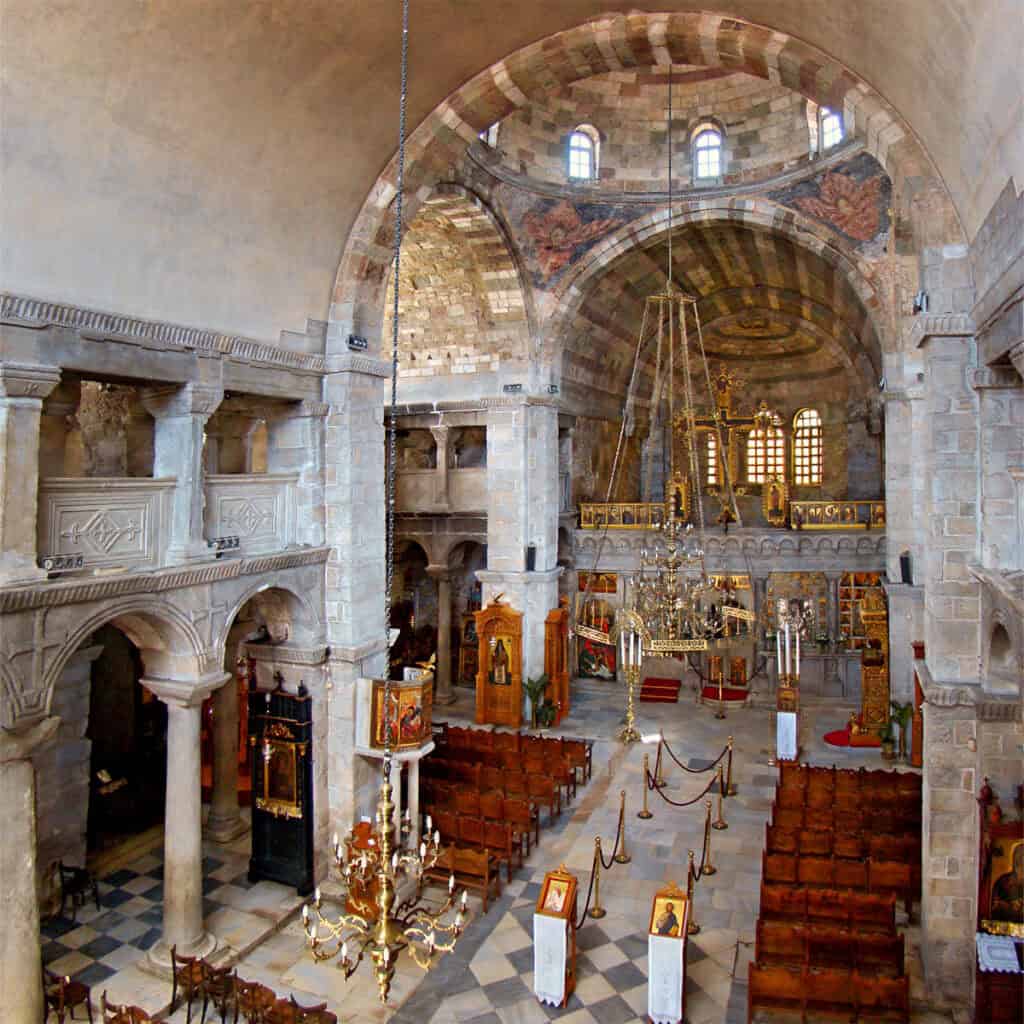
On Paros, the Church of Ekatontapyliani, the Church of a Hundred Doors, has stood since the fourth century. On August fifteenth, the island fills with light, incense, and procession. The air is heavy with history. The celebration feels older than the marble beneath your feet.
On Kefalonia, the feast of the Dormition brings a quiet miracle. Around the Church of Panagia Lagouvarda, small harmless snakes appear every year in early August. They crawl over icons and candle stands, then disappear after the feast. They did not come during the war in 1940 or after the earthquake in 1953. Locals remember both.
And on Rhodes, high on a hill overlooking the sea, stands the chapel of Panagia Tsampika. She is especially beloved by women hoping for children. Many couples who believe she answered their prayers name their daughters Tsampika or their sons Tsampikos in gratitude. The climb to her church is steep and hot. The view from the top is wide and quiet. She is there too.
In many homes, her name is spoken daily. Not always out loud. Sometimes it is just a glance at her icon before leaving for work. Sometimes it is a whisper in a hospital corridor. In the Greek-American community, especially among the older generations, this connection remains strong. Even when English becomes the language of everyday life, there are still moments when only Greek will do. Panagia mou, help me. Panagia mou, thank you.
Every August, especially on the fifteenth, that feeling returns in full. The Feast of the Dormition is more than a liturgical day. It is a reunion. Churches fill. Candles flicker in the summer heat. Bells ring. People dance, eat, and cry. It is like Easter, but in the sun. In Greece it is called Dekapentavgoustos, but you will find it marked in Greek-American churches too. Even if we cannot return to the island or village where our family’s Panagia is, we still feel her pull.
And in quiet corners of America, far from the sea and mountains of Greece, there are monasteries built in her name. In Williston, Florida, the monks of Panagia Vlahernon pray in the Athonite tradition. In Saxonburg, Pennsylvania, the sisters of Panagia Pammakaristou keep vigil day and night. In Michigan, the Dormition Monastery welcomes pilgrims into silence. Even here, thousands of miles from Greece, you will find candles flickering before her icon. The language may be English, but the feeling is exactly the same.
Some people still name their daughters after her. Maria, Panagiota, Vangelitsa, Tsampika. Some still make vows, lighting a candle every year on her feast day. Some carry her quietly inside, never saying much, but always feeling her near.
Panagia has many names. But in the end, they all mean the same thing. She is the one we ask for help when we are out of words. She is the one we thank when a baby is born or a surgery goes well. She is the one we carry in our hearts, whether we are in Greece, Philly, New York, Boston, Toronto, Frankfurt, or Melbourne.
And no matter what name we use, she listens.