
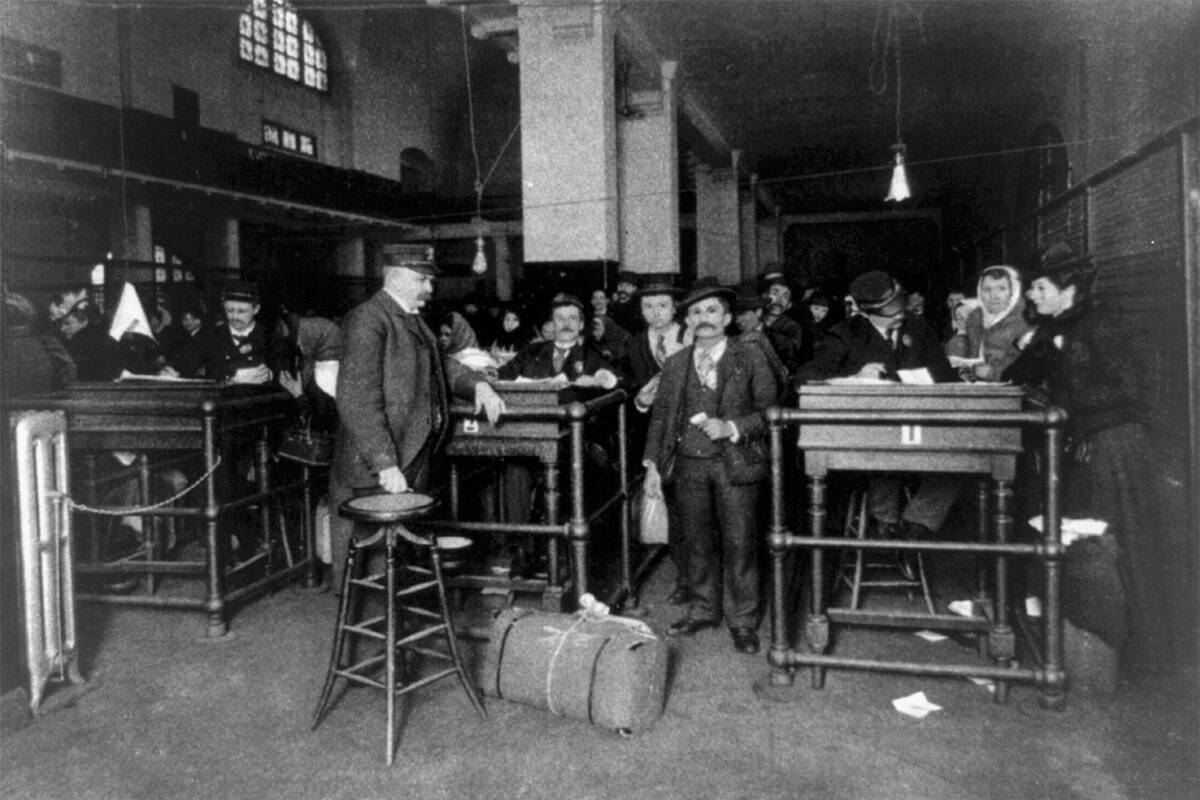
The ship came in before dawn, and by the time the line wound under the vaulted ceiling of Ellis Island, his shoes were dusted white with salt. “Papadopoulos,” he told the interpreter, steady and clear. The clerk checked the passenger list, nodded, and sent him on. No one changed his name that morning.
That idea, that inspectors at Ellis Island gave out new names to immigrants, is a myth. As the New York Public Library explains, officials worked from passenger lists already filled out in Europe. They did not have the authority to rename people. The real changes came later, in classrooms, on factory floors, and above diner doors.
In South Philadelphia, he found a mattress in a boarding house with five other men from the Peloponnese. Everyone had a cousin in candy, shoeshine, or a lunch counter. Everyone had a story about a boss who could not say their name. The foreman tried “Papa…Papa…” and gave up with a wave. A sign painter looked at ten letters and said, “Kid, I have room for six.” By spring, the coffee shop window read Pappas. Same root, same priestly meaning, just shorter. It fit on the glass. It fit in a mouth used to Smiths and Browns.
Letters from the village still came to “Papadopoulos.” The landlord and the bank ledger said “Pappas.” Some men never bothered to make it official. Others changed the record when they took their citizenship oath, or in a local court, because a judge would stamp what life had already decided.
Between the 1890s and the early 1920s, more than 400,000 Greeks crossed the Atlantic, many driven by rural poverty and the collapse of the raisin trade in the Peloponnese. They filled mill towns, stockyards, and corner diners.
Each name carried a little map of Greece. Endings like -poulos often point to the Peloponnese, -idis to Macedonia and Pontos (Pontus), -akis to Crete, and -oglou to Asia Minor. In the kafenio, you could still hear the old endings called across the room. Outside, they were clipped. Papadopoulos became Pappas. Stamatopoulos became Stamos. Christopoulos became Christ or Christy.
But changing a name did not mean you suddenly blended in. A new surname could look American on paper, yet the man behind it might still struggle to express himself in English. The paradox was common: an easy-to-pronounce name paired with halting speech. For many, it was a reminder that adopting a shorter name was only the beginning of a much longer road toward acceptance.
Common Greek Name Adaptations
- Papadopoulos → Pappas, Pope, Paul
- Stamatopoulos → Stamos
- Christopoulos → Christ, Christy, Chris
- Katsigiannis → Katz
- Antoniadis → Anthony
There were harder reasons, too. In places where newspapers labeled Greeks undesirable, blending in was often the safest choice. In South Omaha in 1909, a mob burned Greek homes and shops after a police officer was killed during an arrest. The South Omaha Historical Society records how families fled into the night. Stories like that traveled fast. They shaped how you carried yourself and how you said your name when a stranger asked.
At the time, Greeks were legally classified as white, but socially, they were not seen that way. In many towns, Greeks were treated as outsiders, sometimes even as people of color. They faced “No Greeks Need Apply” signs, violent prejudice, and the same suspicion directed at other immigrant groups who were not yet considered part of America’s mainstream. The history of AHEPA shows that the organization was founded in 1922 partly to combat this discrimination and to help Greek Americans gain acceptance.
Against this backdrop of prejudice and the slow push for acceptance, families found their own balance between the old and the new. He married in church under the full name on his baptismal record. At the restaurant, he took orders as “Mr. Pappas.” His children grew up speaking kitchen Greek and schoolyard English. Teachers wrote report cards for Peter, not Panagiotis, and Helen, not Eleni. It was not about shame. It was about rhythm. The phone rang, a job opened, and you chose the version that kept the conversation easy.
On the night he filled out his naturalization papers, he wrote the long name first, then crossed it out and wrote the short one. The clerk did not blink. Courts had seen it all.
Years later, when the coffee shop became a proper diner with red stools and a neon sign, a salesman suggested a rebrand. “Why not ‘Dean’s’ on the awning? Short. American. Looks good in lights.” He smiled, then shook his head. “Pappas is fine,” he said. The sign went up exactly that way.
And what about the grandchildren? They grew up in Philadelphia knowing both names. At school and on job applications, they wrote Pappas. At church festivals, yiayia introduced them as Papadopoulos. One granddaughter, proud of her roots, chose to print the full name on her college graduation announcement. The cousins laughed, then admitted they were glad she did. Three generations after Ellis Island, the family carried both names without apology.
From Then to Now
The story of names does not end with the first wave. It changes with each chapter of Greek American life.
In the early 1900s, young men came alone, looking for work and carrying names that America struggled to pronounce. Many shortened them to survive and to fit on a diner sign.
After World War II, a second wave of around 150,000 to 200,000 Greeks arrived between the late 1940s and the 1980s, especially after the Hart–Celler Act of 1965 removed restrictive quotas. By then, Greeks were no longer strangers but allies. Communities were already established. Parish networks, diners, and AHEPA halls meant new arrivals did not have to hide their names the way their uncles had. By then, Papadopoulos could remain Papadopoulos, and teachers were ready to pronounce it.
Today, few Greeks migrate here permanently, but the community is well rooted. Being Greek in America is now a point of pride. You see it in summer festivals, on parish rolls, in diners, and in shipping companies. Long names that once looked intimidating now stand as markers of identity.
Even into the 1980s, though, Greek endings could still puzzle American ears. One worker remembers a colleague glancing at his surname and asking, “What is this ‘dis’ disease?” It was said as a joke, but it showed how foreign those sounds could still seem.
By the 1990s, the language barrier was still part of everyday humor. One Philadelphia family recalls the Greek-born head of the household insisting on speaking Greek to the Latin American workers repairing his house. When his wife pointed out that they could not understand him, he shook his head. “They understand,” he said. And somehow, the job got done.
Many families kept the shorter version, but when younger Greek Americans discover their roots, they often want to restore the original. A Pappas grandchild might put Papadopoulos back on a business card or a graduation program. Today, it is not unusual to see Greek names kept intact and celebrated in public life, from professors and doctors to politicians and business leaders. What once felt like a burden has become a badge of identity.
That is the arc. From bending names to fit the American ear, to carrying both side by side, to reclaiming what was left behind. Walk through Philadelphia, New York, Chicago, Boston, or Tarpon Springs today, and you will see both versions on storefronts, church plaques, and family headstones. A name can travel, adapt, and return, while the story behind it never disappears.