
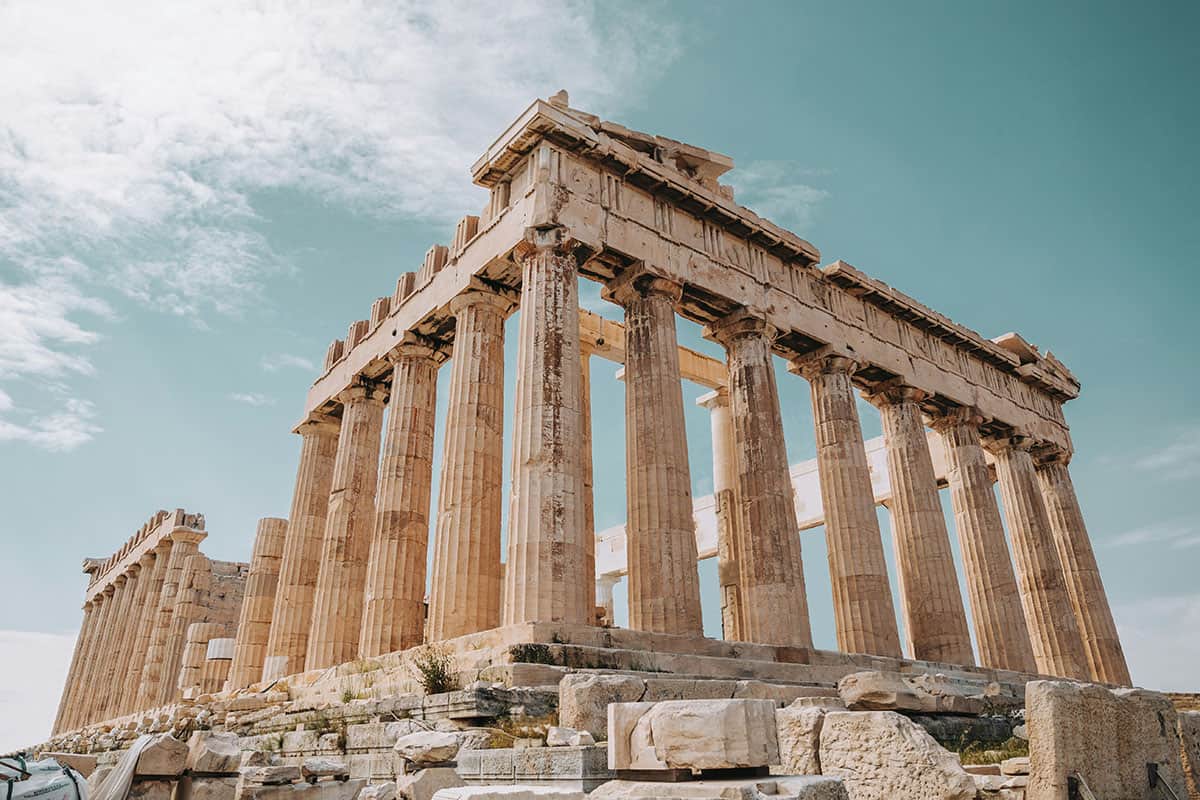
With the west pediment restored and the scaffolding removed, visitors can now see the temple’s western side in its most complete possible form in about 220 years.
For many people, the Parthenon feels fixed in memory: the image on schoolbook covers, postcards, old travel albums, and calendars in Greek homes far from Athens. That familiarity can make even a small change on the monument feel larger than it sounds.
Greece’s Culture Ministry announced that restoration work on the western pediment has been completed, after the last pieces of scaffolding were removed from the western facade. According to Kathimerini, the work included the placement of two upright marble elements, known as orthostates, in empty positions on the pediment, along with restoration on a supporting wall structure.
The result is not a rebuilt Parthenon, and it is not the end of restoration work on the Acropolis. It is a more precise kind of change. The western face of the temple can now be seen in its most complete possible form for the first time in about 220 years.
That side is not just another angle. It is the side many visitors first see when they enter the monument. The Associated Press reported that restorers placed the two orthostates into long-empty gaps high on the western end, restoring part of the outline that had been broken for generations.
Before the work was completed, those gaps interrupted the triangular backing of the pediment above the columns. The absence may not have been obvious to every visitor, especially from below, but it affected the way the western face held together. On the Parthenon, a missing stone is not only a missing stone. The temple depends on proportion, line, and balance, so even a gap high above the eye changes how the whole side reads.
In the same AP report, Culture Minister Lina Mendoni called the restored view “truly stunning,” saying the new stones do more than fill a gap. “They allow the unique proportions and the geometric perfection of the Parthenon’s western face to be seen once again,” she said.
For decades, scaffolding was also part of the modern view. Visitors photographed around it. Guides explained it. Athenians lived with it in the skyline. When the western scaffolding was removed in 2025, Mendoni said people were seeing “a different, a completely different monument,” according to an earlier AP report. At the time, conservation work still had to continue. Now the latest phase on the western pediment has reached its endpoint.
For the Greek diaspora, the image carries a particular pull. Many inherit the Parthenon before they ever stand in front of it. It comes through family stories, church classrooms, books, photographs, and the idea of Greece passed from one generation to another. Seeing it change, even slightly, is a reminder that the monuments of Greece are not frozen in the past. They are still being studied, repaired, and cared for in the present.
The scope of the restoration should also be kept clear. The work concerns the western pediment and western facade. It does not restore the entire Parthenon, and it does not recreate the sculptural scene that once filled the pediment. The change is architectural. It restores part of the frame, the outline, and the visual order of the western side.
That restraint is important. Good restoration does not try to erase time. It protects what remains, uses new material where necessary, and avoids turning the monument into a replica of itself. In this case, the intervention is enough to change the view without making a false promise of completeness.
For roughly two centuries, visitors approached the western side of the Parthenon through visible loss. Now that side appears closer to its intended balance than anyone alive has seen it. Not complete in the ancient sense, and not finished forever, but clearer than modern memory has known it.
For a monument so many people thought they already knew, that is enough to make them look again.