
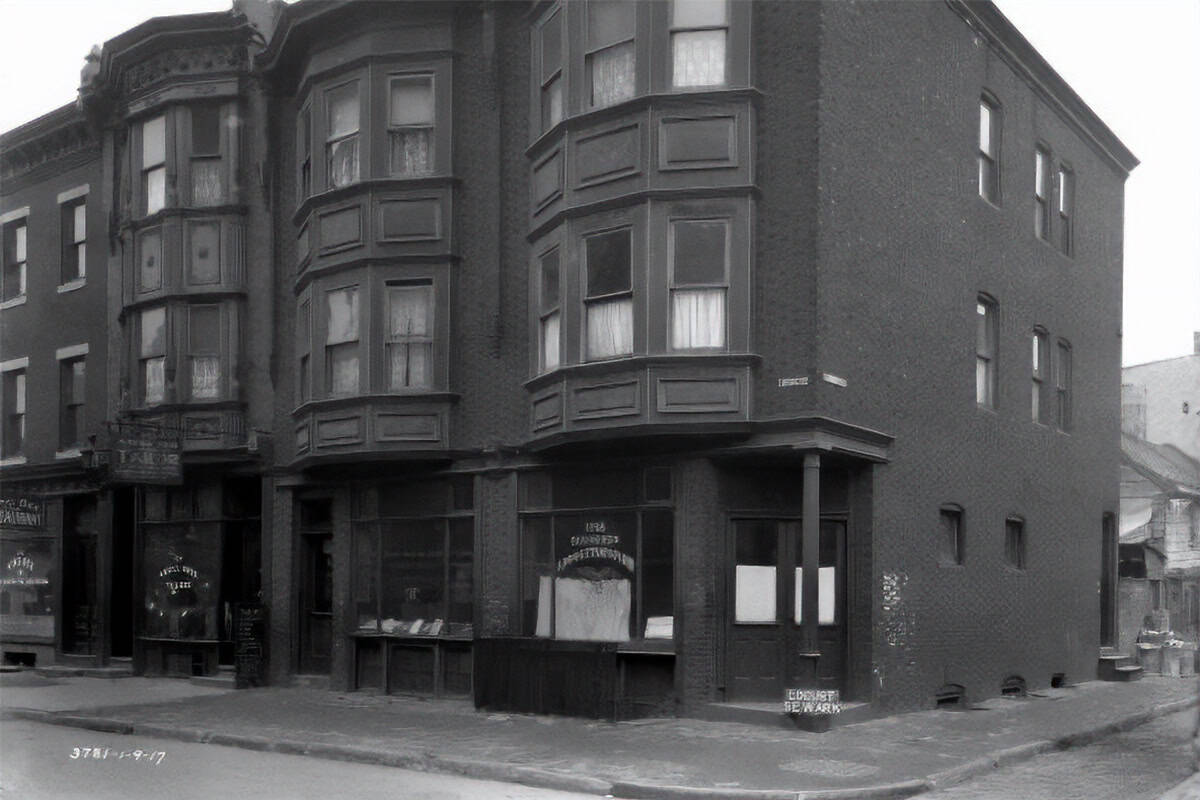
Long before Upper Darby became a second center of Greek life in the Philadelphia region, there was a smaller Greek quarter in Center City.
It was not large. It did not have the scale of New York’s Lower East Side or Chicago’s Greektown. In Philadelphia, the first Greek neighborhood took shape in a few blocks around Locust and 10th Streets, close to churches, boarding houses, restaurants, fruit shops, factories, and Greek-owned storefronts.
Most of that world is gone now. The streets remain, but the neighborhood has been changed almost beyond recognition by hospitals, redevelopment, and the steady remaking of Center City.
Still, one address lets us see the old Greek quarter more clearly: 1018 Locust Street.
In 1917, a city photograph captured a Greek storefront at that address. The Greek lettering on the window identified it as a Καφενείον, a kafeneion. Architectural historian Kostis Kourelis connects the address with Kentron Restaurant and Philadelphia’s early Greek business corridor.
The same address also appears in the memory of Yiorgos Katsaros, one of the important figures in early Greek-American café music. In interviews collected by Steve Frangos, Katsaros recalled performing at Kentron Restaurant and nearby Culture Restaurant before recording in Camden.
A neighborhood of a few blocks
Historian Alexander Kitroeff describes Philadelphia’s early Greek settlement as modest compared with other American cities. About 400,000 Greeks entered the United States between the 1890s and the 1920s, but only a few thousand settled in Greater Philadelphia. Many better industrial jobs in the city required English, while other manual jobs had already been taken by earlier immigrant groups, especially Italians.
That smaller scale shaped the neighborhood. Greeks in Philadelphia found openings in tobacco, food service, confectioneries, fruit shops, lunchrooms, and small restaurants. Many of these businesses were narrow and plain from the street, but inside them, work and social life often overlapped.
The first Greek Orthodox community in Philadelphia was organized in 1901. In 1908, the community purchased the former All Saints Episcopal Church at 745 S. 12th Street and converted it into Evangelismos, the Annunciation Greek Orthodox Church. St. George Greek Orthodox Cathedral, at 256 S. 8th Street, came later, when the congregation acquired and rededicated the former St. Andrew’s Episcopal Church in 1921.
This was not separate from the world of Greek business. Constantine and Stephen Stephano, the brothers behind Stephano Brothers tobacco, also presided over the establishment of the Greek Orthodox Community of Philadelphia and contributed to the building of its first church.
Factory, church, and kafeneion were not the same institution, but they belonged to the same early Greek geography. The church gave the community a formal center. The kafeneion gave many men their everyday place to go.
The storefronts around 1018 Locust
The 1000 block of Locust Street was a real Greek business cluster, with names and addresses attached to it.
Kourelis’s mapping of the 1911 Greek-American Guide compiled by Seraphim Canoutas places Greek establishments at 1012, 1015, 1018, and 1031 Locust Street. The 1911 entry for 1018 Locust lists Geo. Thomakos. By the time of the 1917 photograph, the storefront was identified in Greek lettering as a Καφενείον.
The directory evidence matters, but the photograph gives the story its weight. It shows that at least one Greek establishment in Philadelphia identified itself in the language of the kafeneion, even if English-language records could call the same kind of place a restaurant.
That overlap was common in early Greek immigrant life. A restaurant could also be a coffeehouse. A coffeehouse could also be a labor exchange. A storefront could serve food, pour coffee, carry newspapers, and become a place where newcomers learned who was hiring and where they might sleep that night.
At 1018 Locust, the available record suggests the kind of overlap common in early Greek immigrant life: restaurant, coffeehouse, workplace, and meeting place.
Across from the tobacco factory
The map helps explain why that storefront mattered.
Constantine and Stephen Stephano, immigrants from Dikorfo in Epirus, built one of the most successful Greek-owned businesses in early Philadelphia. Their cigarette company began in a Center City basement and eventually occupied a major building at 1014 Walnut Street. The firm became one of the largest producers of Turkish and Egyptian tobacco cigarettes in the United States and employed almost 500 workers at its height.
The factory stood just across Warnock Street from the Locust Street kafeneion. That distance was small enough to shape daily life. A Greek worker leaving Stephano Brothers did not need to search the city for familiar voices. He could cross the street.
The 1920 federal census gives the building another layer of reality. Kourelis notes that two tenants lived upstairs at 1018 Locust: George Skapavos, listed as a restaurant cook, and Gregores Boulous, listed as a dishwasher. They were most likely part of the working staff connected to the venue below.
That detail changes the way the building reads. The kafeneion was not only a sign in a photograph or an address in a directory. Men lived above it. Men worked inside it.
Coffee, news, and work
In Greek immigrant communities, the kafeneion often served practical needs as much as social ones. Men could drink coffee, smoke, play tavli or cards, read Greek-language newspapers, and keep one foot in the politics of the old country.
In places like this, arguments could move from the Balkan Wars to the National Schism, from labor politics in America to village rivalries back home. Regional loyalties mattered. Political allegiance could divide a table.
But the kafeneion was practical before it was anything else. It helped newcomers find work, locate relatives or fellow villagers, arrange rooms, ask for small favors, and enter the informal networks that made immigrant life possible.
For many men, the church marked Sunday. The kafeneion marked the rest of the week.
The music passed through Philadelphia
Philadelphia’s early Greek coffeehouses were mostly workingmen’s spaces, not large public entertainment districts. The city did not develop a Greek music café scene on the scale of New York.
But the music passed through Philadelphia, too.
Yiorgos Katsaros later recalled performing at Kentron Restaurant and Culture Restaurant in Philadelphia. Frangos preserved that detail in his 1992 Indiana University study of Katsaros, and later scholars have used it to show how café, restaurant, and coffeehouse spaces often overlapped in Greek-American music culture.
In the account preserved by Frangos, Katsaros was discovered in Philadelphia by an RCA Victor agent in 1919 and brought across the river to Camden, where he recorded “Greek Pleasure,” one of the early Greek-American recordings later associated with the rembetiko-related café music of the period.
That is where Philadelphia’s geography mattered. Camden was close, and Camden was a recording center. A performer who passed through a Greek restaurant or coffeehouse in Philadelphia could be drawn into the recording industry just across the river.
The coffeehouse at 1018 Locust was a place for workers, but Katsaros’s memory also ties it to a wider circuit that connected immigrant storefronts to commercial recordings.
What was lost
The first Greek quarter around Locust and 10th did not survive as a visible ethnic neighborhood.
As Greek families became more established, they moved outward. Some went to West Philadelphia, Upper Darby, Elkins Park, Broomall, Cherry Hill, Delaware County, Chester County, South Jersey, and beyond.
Postwar suburbanization changed the community. Hospitals, universities, redevelopment projects, and the rising value of Center City land changed it, too. In 1967, the 1000 block of Locust Street was demolished for Jefferson’s Alumni Hall. Kourelis notes that the Greek establishments on that block now lie beneath the medical campus, while the green space of Lubert Plaza may still cover the backfilled basements of buildings that once stood there.
That gives the loss a sharper edge. The neighborhood did not simply fade. Parts of it were physically removed.
What remained were fragments: St. George Cathedral on 8th Street, memories in family albums, business listings, scattered photographs, and the work of researchers and community archivists trying to map what once stood there. The Greek American Heritage Society of Philadelphia has helped preserve that memory and collect materials tied to the city’s Greek-American past.
The old kafeneia were especially easy to lose. They were small businesses. They did not always advertise heavily. They rarely left behind archives of their own. Many appear in the record only when a directory, a photograph, a census page, or a musician’s memory catches them for a moment.
That is why 1018 Locust still gives the old neighborhood a traceable shape.
A room behind a storefront
The room does not need much embellishment.
A narrow storefront after dark. Men arriving from the tobacco factory, restaurant kitchens, markets, and lunch counters. Coffee on the table. Perhaps a Greek newspaper. Perhaps a tavli board. Work talk, news from home, and the ordinary arguments of men trying to make a life in a new city.
This is not pure invention. In 1920, George Skapavos, a restaurant cook, and Gregores Boulous, a dishwasher, were listed upstairs at that same address. Their names bring the room closer. They remind us that 1018 Locust was not only a symbol of early Greektown. It was also someone’s workplace, and perhaps someone’s room after a long shift.
The kafeneion was where men who were almost invisible to the larger city became visible to one another. It was where news traveled, help was negotiated, loneliness was softened, and a neighborhood began to recognize itself.
At 1018 Locust Street, the record briefly opens. What remains is not much: a photograph, a sign in Greek, a directory listing, a tobacco factory across the street, two names in the census, and a musician’s memory that leads to Camden.
The evidence is scattered, but it leads back to the same room. In that small space, Philadelphia’s first Greek neighborhood becomes visible again.