
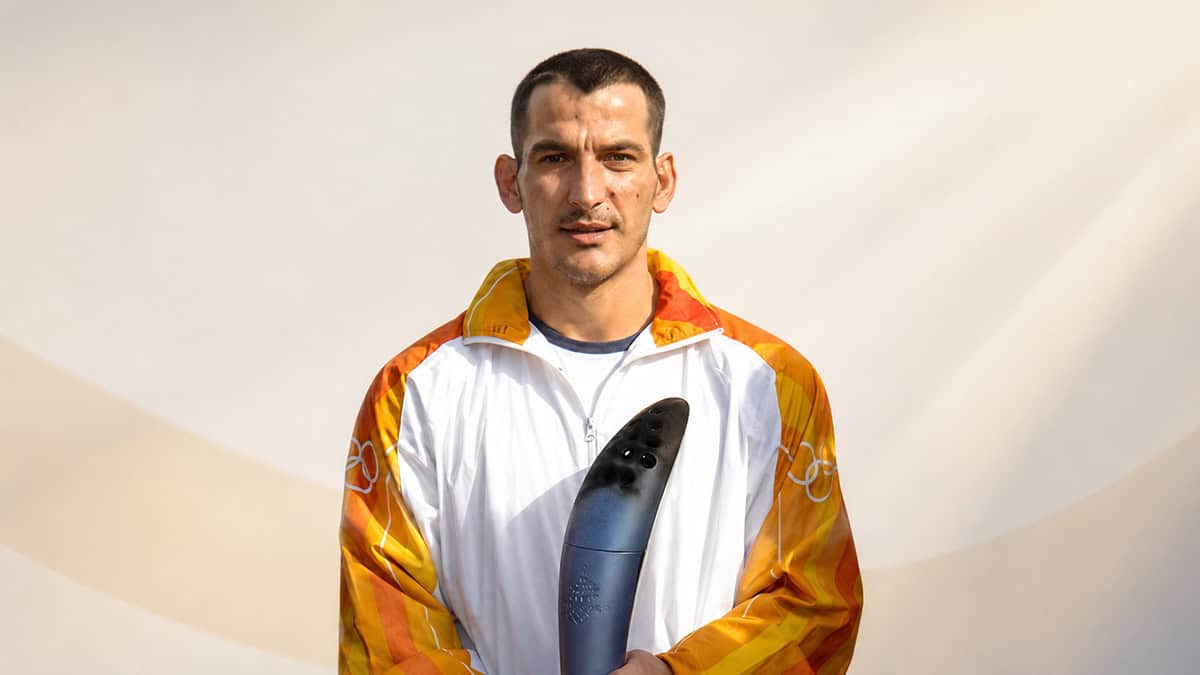
There are athletes who retire, and then there are athletes who remain part of a country’s emotional vocabulary.
Pyrros Dimas belongs to the second group.
The International Weightlifting Federation named the Greek Olympic legend an official Weightlifting Ambassador, a title that sounds ceremonial until one considers who holds it. For Dimas, weightlifting was never just a sport of bars, plates, and totals. It became a language of belonging, a public test of endurance, and for many Greeks, one of the most powerful sporting memories of the last half-century.
Now the sport is asking him to carry it again, but this time the weight is different. It is the weight of representation, memory, and trust. It is also the weight of a sport defending its place in the Olympic movement and needing trusted voices to explain why weightlifting still matters. Dimas is one of the few people who can do that without sounding like a spokesman.
He was born in Himara, North Epirus, Albania, to an ethnic Greek family. His life began in a place where Greek identity was not abstract or decorative. It was kept inside homes, memory, language, church life, elders’ words, and the stubborn insistence that identity could survive even when politics tried to narrow it.
At 13, he had to choose between football and weightlifting. He chose the bar, and the choice became total. In a recent Sportsin interview, Dimas remembered that discipline plainly: “I went to sleep thinking about weightlifting and woke up with it on my mind.”
That background gives his public life a deeper shape. Dimas did not arrive in Greece as a ready-made national symbol but with a complicated inheritance. In North Epirus, he was shaped by Greekness. In Greece, he had to prove he belonged. He recalled “a very difficult bureaucratic process” to prove his Greek identity before Barcelona.
That double pressure is one of the hidden keys to his story. It also explains why his victories felt so charged.
When Dimas reached Barcelona in 1992, few outside his circle knew what he was capable of. Greek television reporters asked athletes about their goals, and most answered cautiously. Dimas did not. “I came here to win the Olympic gold medal,” he said.
When he won, Greece saw more than an athlete. It saw a young man from Himara, North Epirus, lift for a country that had not won Olympic weightlifting gold since 1904. His famous cry, “For Greece,” became more than a moment of celebration. It became a declaration answering a question that should not have needed answering but often did.
Who are you?
Dimas answered with the bar above his head.
The 1990s were a strange and formative decade for Greece. The Cold War had ended and borders opened. Athletes with Greek roots, complex biographies, and lives shaped outside the old national center began to carry the Greek flag into world arenas. Greek weightlifting became one of the great stories of that era, not only because it won medals but because it expanded the image of who could represent Greece.
Dimas was the face of that expansion.
His greatness was measurable. Three Olympic gold medals, one Olympic bronze, three world titles, world records, and a career that placed him among the greatest weightlifters in the history of the sport. But numbers alone do not explain why Greeks still speak of him with such feeling.
The feeling came from the way he won.
Dimas was not theatrical in the easy sense. His drama came from concentration. He stood over the bar with an almost private intensity as if the crowd disappeared for a few seconds. Then came the lift, the lockout, the release, and the roar. In those moments, strength looked like discipline under pressure, not noise.
That is part of what made him so powerful to watch. He did not make victory seem effortless but made effort visible. Barcelona made him a national hero. Atlanta made him dominant. Sydney made him mythic.
Still, the private moment after Barcelona may say as much about him as the public celebration. Years later, Dimas remembered that after winning gold at 20, he could not sleep. While the Olympic Village quieted down, he sat near a refrigerator until morning, eating ice cream and trying to understand that he had become an Olympic champion.
By the time he reached Athens in 2004, the story had changed. He was no longer the young champion from Himara who shocked the field. He was a wounded man lifting before his own people, carrying the expectation of a country wanting one more miracle from him. He had injuries, pain, and a body that no longer obeyed as it once had. And still, he lifted.
The bronze medal he won in Athens was not his greatest athletic performance but may have been his most human. When he took off his shoes and left them on the platform, everyone understood the gesture. No speech was needed. The platform had been his public stage, battlefield, and confession. Leaving the shoes there meant the chapter was over.
The crowd answered with something deeper than applause.
That farewell remains one of the rare Olympic moments when defeat, pain, gratitude, and national pride lived together in a single image. He did not win gold that day. Somehow, that made the moment more permanent.
For Greeks around the world, those moments were not distant Olympic highlights. They belonged to the same emotional world as family stories, old country loyalties, church festivals, Greek school memories, and the complicated pride of seeing Greece recognized on a world stage. In Dimas, many saw something familiar: a Greek identity carried across borders and affirmed through achievement.
That is why “For Greece” still lands differently. It was not a slogan but a life compressed into two words.
His post-competition career has been less mythologized, but it may now be just as important. Dimas did not disappear into nostalgia. He moved into institutions, and the platform became less visible: federation work, public life, technical leadership, committee rooms, development programs, and the slower work of helping a sport survive beyond its great moments.
After retiring from competition, he became involved in rebuilding and leading Greek weightlifting. He later served in the Hellenic Parliament, bringing the voice of an athlete and a Greek from North Epirus into public life. His work also took him to the United States, where he joined USA Weightlifting in 2017 as Technical Director and remained part of the organization through two Olympic cycles.
When he and USAW amicably parted ways in 2026, the federation credited his role in a period that included four American Olympic medals and a major rise in U.S. international results. Dimas closed that chapter by saying he did so “with a heart full of gratitude and pride.”
Dimas has rarely been allowed to remain only a memory. His name gives weightlifting history, but his work after retirement gives it continuity. He is not simply a former champion being brought out for applause. He is one of the figures weightlifting turns to when it wants to speak about renewal, discipline, and leadership.
That is especially important now. Weightlifting does not need only legends. It needs credibility. The sport has spent years strengthening governance, protecting clean competition, and reassuring the Olympic world that it belongs at the center of the Games. In that context, Dimas’ ambassador role is not just symbolic but strategic. It not only honors his past but also draws on the credibility he still carries with athletes, fans, and national federations.
The work is not only ceremonial. During the European Weightlifting Championships in Batumi, Dimas described his role on the IWF Executive Board and as president of the federation’s Innovation Commission. “We are working to make competitions more dynamic and engaging,” he said, pointing to efforts to reduce long pauses and create a faster format that spectators can follow more easily.
Dimas is not only being asked to stand for what weightlifting was. He is being asked to help make the sport understandable to a new audience.
That role raises a different question.
What happens to a national hero after the country stops needing him to win medals?
The easy answer is that he becomes a memory. The better answer is that he becomes a bridge between the athlete who once shouted for Greece and the official now asked to speak for weightlifting across continents.
Pyrros Dimas is not just the man who lifted for Greece. He is the man whose life keeps returning to the same platform in different forms. First, as a child from Himara. Then, as an Olympic champion. Then, as a wounded hero in Athens. Then, as a federation leader, public figure, technical director, and now global ambassador. Each return gives the same story a new meaning.
The bar has changed.
The lift has not.
For Dimas, the platform was always small. The weight was never only metal.