
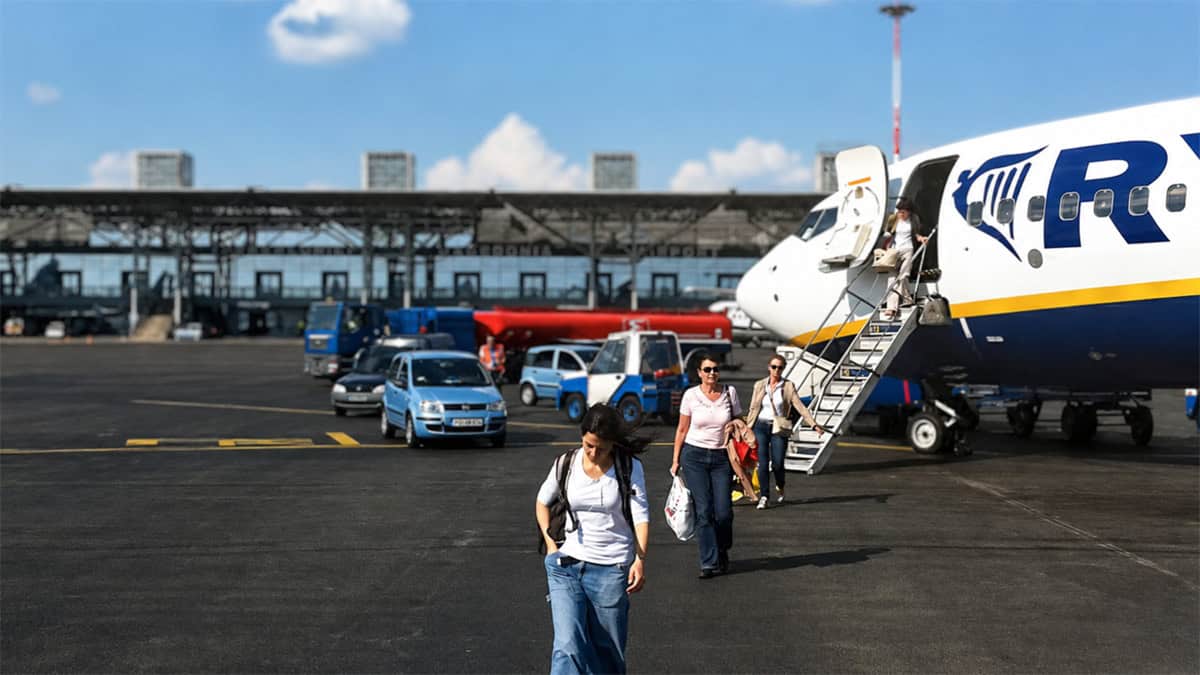
Macedonia Airport is how Northern Greece reaches Europe. In 2025, Thessaloniki’s airport handled 7,982,798 passengers, an 8.2 percent increase from the previous year, according to Fraport Greece. December alone brought 580,267 passengers, a reminder that the airport is not only a summer gateway but part of the region’s year-round economic infrastructure.
That is why Ryanair’s decision to close its Thessaloniki base for the winter 2026 season has caused such concern. The airline says it will remove three based aircraft from Macedonia Airport, cut 500,000 seats, and drop 10 Thessaloniki routes as part of wider reductions across Greece. Across the country, Ryanair says the cuts will total 700,000 seats and 12 routes for winter 2026.
Ryanair blames airport costs. It argues that Fraport Greece and Athens International Airport have failed to pass on the reduction of Greece’s Airport Development Fee to passengers, while airport charges have continued to rise. The airline says those costs make Greece less competitive during the winter and shoulder seasons, when low-fare connectivity matters most.
Fraport Greece rejects that explanation. In a statement carried by Makedonika Nea, the airport operator called Ryanair’s claims about aeronautical charges and the Airport Development Fee unfounded and pretextual. Fraport said Ryanair’s decision was tied instead to the airline’s own commercial planning, business model, and profitability.
That exchange places the dispute above the local level. Fraport runs the airport. Ryanair decides where to base aircraft. The Airport Development Fee is set by the Greek state. Aviation regulation involves national authorities. Thessaloniki, meanwhile, lives with the consequences.
The immediate question has now shifted. Ryanair says the base will close for winter 2026. What remains unclear is whether any negotiation could still change the outcome, which routes could return later, and which services might continue from aircraft based elsewhere.
The deeper question is why Thessaloniki seemed to reach crisis mode only after the issue had become public.
A recent Voria.gr column framed the case less as an airport story and more as a civic diagnosis. The Ryanair dispute, columnist Giorgos Mitrakis argued, shows a city that responds to strategic problems with meetings, statements, and institutional concern, but has not built the machinery needed to anticipate risks before they become crises. The column also argued that warning signs of Ryanair’s possible withdrawal had reportedly existed for months, but that local representatives either did not hear them or assumed the best-case scenario would prevail.
That diagnosis matters because air connectivity is strategic infrastructure for Thessaloniki, Halkidiki, Central Macedonia, and the wider Northern Greek economy.
Ryanair has done this before
Thessaloniki is not the first European city to learn how mobile Ryanair can be. The airline’s model is built on flexibility. Bases remain in place when demand, costs, airport fees, labor rules, and public policy fit the airline’s commercial logic.
In Marseille, Ryanair pulled staff and aircraft from its French base in 2011 after a dispute with French authorities over employment contracts for Marseille-based crews. The Guardian reported at the time that the French state and pilots’ unions had taken legal action over Ryanair’s use of Irish contracts for staff based in France. The case was not about passenger demand alone. It was about the legal and cost environment around the base.
In Denmark, Ryanair closed its Billund and Copenhagen bases in 2015 during a dispute with Danish unions. Aviation Week reported that the airline moved a Copenhagen-based aircraft to Kaunas while saying it would continue serving Copenhagen from aircraft based outside Denmark. That distinction is important. A city can keep some flights while losing based aircraft, local jobs, scheduling depth, and the ability to support early morning departures and late-night returns.
Germany offers a recent version of the same lesson. In April 2026, Ryanair said it intended to close its seven-aircraft Berlin base from October 2026, blaming airport-fee increases, aviation taxes, security charges, and air-traffic-control costs. Ryanair said it would still serve Berlin, but from aircraft based elsewhere, while shifting aircraft to lower-cost markets.
The circumstances differ from place to place. Marseille involved labor law. Billund involved unions. Berlin involved airport charges and national aviation costs. Thessaloniki now involves airport charges, the Airport Development Fee, winter profitability, and a public dispute between Ryanair and Fraport Greece. The common thread is cost discipline.
Why the base matters
The Thessaloniki discussion should not collapse two different questions into one. The first is whether Ryanair continues flying some routes to Macedonia Airport. The second is whether Ryanair keeps aircraft and crews based there.
A based aircraft gives an airport more operational depth. It can support early departures, late returns, denser rotations, and seasonal expansion. If the base closes, some routes may still continue from aircraft stationed elsewhere, but Thessaloniki becomes more dependent on decisions made outside the city. The network can become thinner even if it does not disappear.
Ryanair says its Thessaloniki cuts will remove 10 winter routes: Berlin, Chania, Frankfurt-Hahn, Gothenburg, Heraklion, Niederrhein, Poznan, Stockholm, Venice Treviso, and Zagreb. The airline also says it will suspend winter operations at Chania and Heraklion. That does not mean those airports are closing. It means Ryanair is pulling its off-season operations there.
Fraport’s response makes the other side of the picture clear. The company says Macedonia Airport continues to be served by more than 40 airlines, connecting Thessaloniki and the wider region of Macedonia with 93 destinations in 33 countries. It also points to more than €100 million in airport infrastructure investment and a 40 percent increase in passenger traffic during its nine years of management.
Both things can be true. Thessaloniki Airport can be growing, better equipped, and served by many airlines. It can also be vulnerable if one low-cost carrier removes based aircraft and cuts winter capacity.
Ryanair’s footprint is large enough to matter, even if its exact passenger share at Macedonia Airport should not be guessed. Fraport’s public statistics provide useful airport totals, but they do not provide airline-by-airline passenger figures for Thessaloniki. Ryanair says it provided 90 percent of Thessaloniki’s international capacity last winter. That figure comes from the airline and should be treated as part of its argument, not as an independently published airport statistic.
Aegean’s role should not be overlooked. The Greek carrier has been expanding from Thessaloniki and said in 2024 that its summer schedule from the city included 20 international and 15 domestic destinations, while its winter schedule connected Thessaloniki with more than 14 European destinations and 11 domestic destinations. That gives Thessaloniki a stronger domestic and regional anchor than many airports have.
But Aegean cannot automatically replace every low-cost route, especially to secondary airports or highly price-sensitive markets. Replacement capacity depends on aircraft availability, yields, seasonality, airport costs, and whether a route fits a carrier’s strategy.
Northern Greece is not just a summer market
Macedonia Airport serves Thessaloniki, but its reach goes far beyond the city. It is the main air gateway for much of Northern Greece, including Halkidiki, Pieria, parts of Central Macedonia, business travel, student movement, family visits, conferences, and the wider Balkan catchment.
The airport’s pattern shows both seasonality and year-round relevance. Traffic rises sharply in the summer, but winter does not disappear. Fraport’s 2025 figures show full-year growth, with December alone above 580,000 passengers.
A weakened route network would not only affect beach tourism. It could mean fewer hotel nights in Thessaloniki, fewer conference visitors, fewer weekend travelers, fewer diaspora visits, fewer students moving easily between countries, and fewer travelers using the city as the front door to Northern Greece.
For years, local officials and tourism bodies have spoken about Thessaloniki as a city-break destination, a Balkan hub, a gateway to Halkidiki, and a year-round tourism center. Those ambitions depend on actual flights.
That is why the winter part of the story matters. Summer demand can hide structural weaknesses. Aircraft come when the numbers are obvious. The harder test is what happens in November, February, and March, when a region has to prove that it can support steady traffic outside the peak season.
What Thessaloniki should know before the next route map changes
One of the most revealing points in this case is not what the public data shows. It is what it does not show.
Fraport Greece publishes airport traffic figures, and its 2025 statement confirms Thessaloniki’s strong growth. It also publishes airport-charge documents for the airports it operates, including Thessaloniki. But the public material reviewed does not provide a clear airline-by-airline passenger split for Macedonia Airport. That means the public can see the airport’s overall expansion, but not Ryanair’s exact passenger contribution, route-by-route exposure, or the markets most vulnerable to a base closure.
For air-connectivity planning, that gap matters. Thessaloniki needs a shared, regularly updated picture of its own air links: which routes are fragile, which carriers could plausibly replace capacity, which markets need marketing support, and which connections are strategic for year-round tourism and business travel.
That work cannot be left to the municipality alone. Fraport Greece operates Macedonia Airport as part of a 40-year concession covering 14 Greek regional airports. The company sets and publishes aeronautical charges for the airports it operates, while the wider concession and aviation-regulation framework places key decisions above the municipal level.
A permanent Northern Greece air-connectivity board, convened by the Region of Central Macedonia, could bring together the municipality, Fraport Greece, tourism bodies, hotel and chamber representatives, national aviation and tourism officials, and, when appropriate, active or potential carriers.
Such a body would not control airline decisions, but it could reduce surprise. It could maintain a route-risk register, commission market data, coordinate destination-marketing funds, identify replacement-carrier targets before a route is lost, and make sure local, regional, and national authorities are working from the same evidence.
If public support is used, it should be transparent and tied to public goals: extending the season, protecting strategic markets, supporting inbound tourism, and strengthening year-round connectivity. The goal should not be to pay any price to keep any airline. It should be to reduce the city’s vulnerability to sudden decisions made elsewhere.
A warning, not a collapse
The Ryanair dispute does not mean Thessaloniki is collapsing as a destination. The airport is growing. Northern Greece remains attractive. The city has a broad European traffic base, and Aegean’s presence gives it a domestic and regional anchor that many airports would envy.
Fraport is right to point out that Macedonia Airport has grown under its management and that dozens of airlines still serve the city. Ryanair is also right about one basic reality of aviation: aircraft go where the economics work. When costs rise or incentives look better elsewhere, low-cost carriers move quickly.
For Thessaloniki, the problem is not that Ryanair is uniquely unreliable. The problem is that the city appears to have been caught reacting to a strategic risk that should have been tracked long before it became an emergency.
European experience shows that warning signs usually appear before the break. Ryanair’s disputes over labor rules, airport charges, taxes, and access costs are rarely invisible. Local leverage weakens once aircraft have already been reassigned.
That is the lesson from Marseille, Billund, Berlin, and now Thessaloniki. The issue is not that Thessaloniki should depend less on Ryanair because Ryanair is bad. It is that no serious city should depend casually on any one airline, any one business model, or any one summer schedule.
Ryanair’s winter 2026 decision has shown Thessaloniki something about itself. The question is whether the city will build the tools to see the next risk earlier.