The fall of Tripolitsa secured Greek independence in the Peloponnese, but it also marked one of the bloodiest and most contested moments of the revolution.
Every March 25, Greek schoolchildren line up for the national holiday parade, holding small flags and singing about freedom. The story of 1821 is told as a triumph of courage against tyranny, a tale of heroes and martyrs who rose against the Ottoman Empire and reclaimed a nation’s soul. For many of us, that was how history began, simple, glorious, unquestioned.
But behind the songs and speeches, there was another story, one that our textbooks rarely mentioned. The Άλωση της Τριπολιτσάς (Álosi tis Tripolitsás), the Fall of Tripolitsa, was both a turning point and a tragedy. The violence that followed was not born in a moment but out of generations of resentment and fear. Across the Greek lands under Ottoman rule, Christians lived as second-class subjects, paying the harac tax imposed on non-Muslims and facing restrictions in law and daily life. The memory of forced conversions and of the old child levy for the Janissaries still lingered in families and folklore. When the uprising finally came, it carried with it the anger of those years, and the desire for revenge was as strong as the desire for freedom.
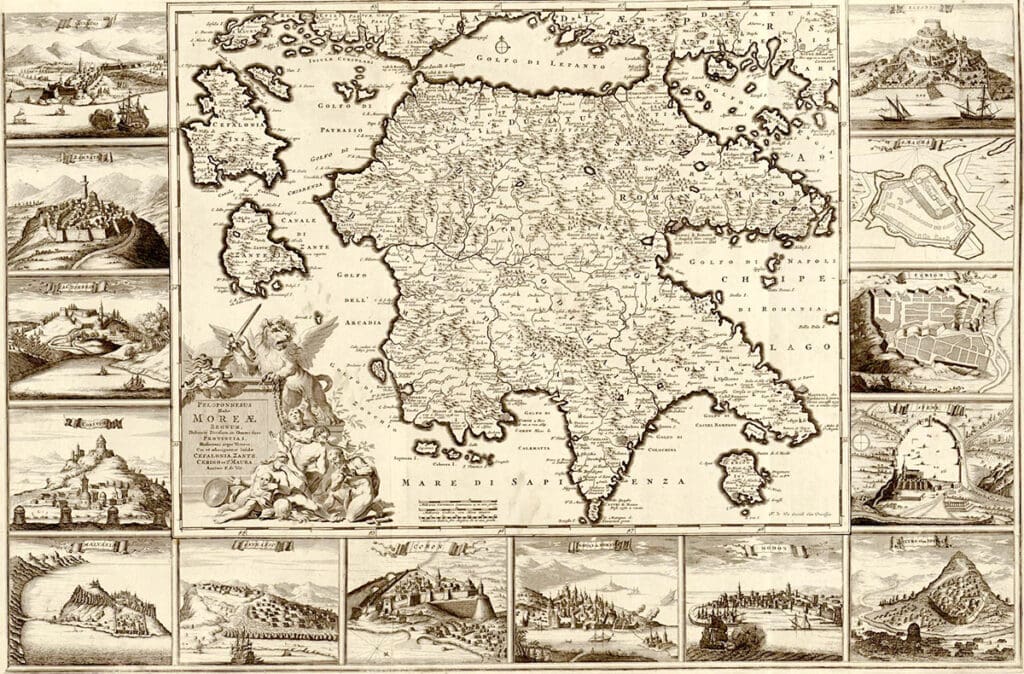
Tripolitsa, or Tripoliçe, known today as Tripoli, was the capital of the Ottoman province of Morea (Eyalet i Morea). It housed the governor’s palace, tax offices, and the provincial courts that enforced imperial authority across the Peloponnese. When the revolution began in the spring of 1821, the city became the ultimate objective. Inside its walls were thousands of Muslims, Albanians, and Jews who had fled there for safety. For the revolutionaries, the city represented power itself. For those trapped inside, it became a waiting place of hunger and fear.
Five Months of Hunger and Waiting
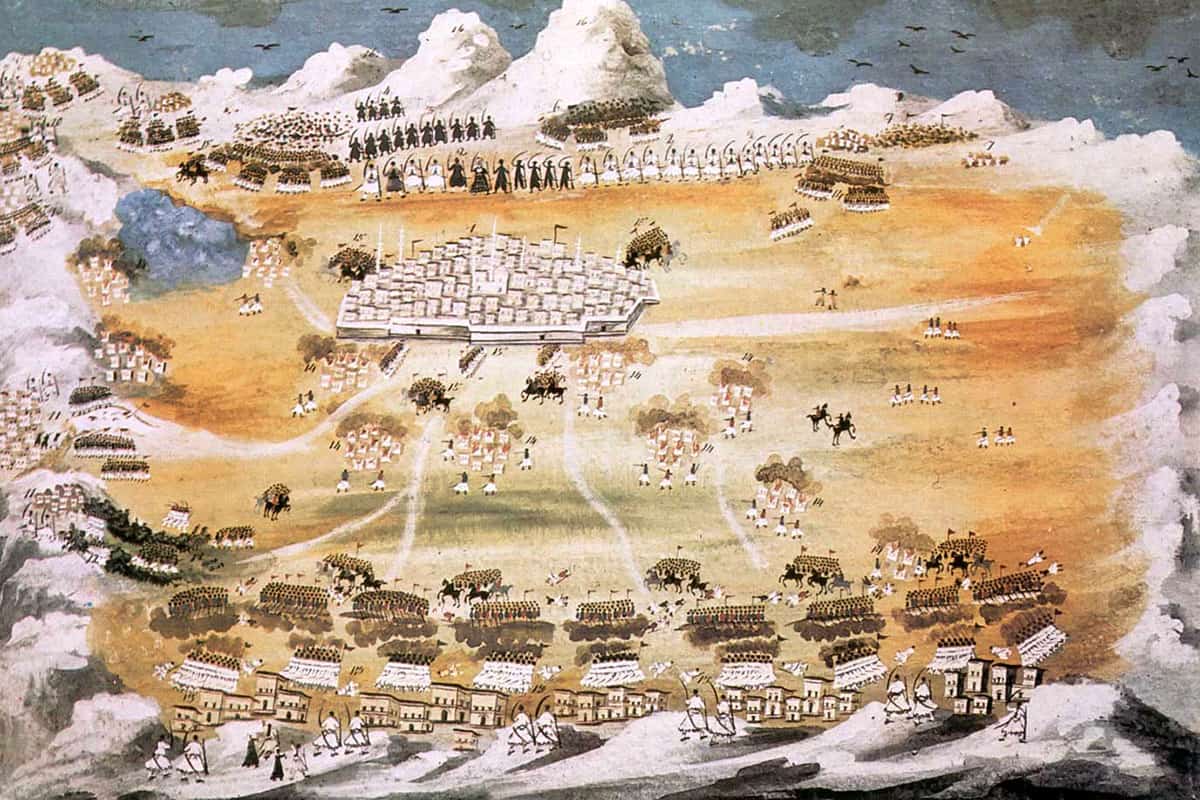
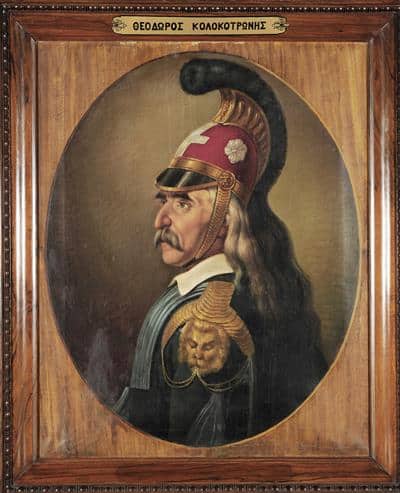
From April until September 1821, Greek fighters surrounded the city. They were villagers and mountain men with few trained officers. Theodoros Kolokotronis, one of the few with military experience, took command. He fortified the surrounding hills, cut the supply lines, and ordered an earthwork trench that closed the last roads in and out.
The siege lasted nearly five months. Food ran out, disease spread, and despair set in. On the night of 9 to 10 August 1821, Ottoman troops attempted a breakout near the trench at Grana. The Greek victory was decisive and sealed the city’s fate.
Kolokotronis later wrote that “the very earth seemed to breathe war.” By mid September, he feared what would happen once his men broke through the gates.
The Day the Gates Fell
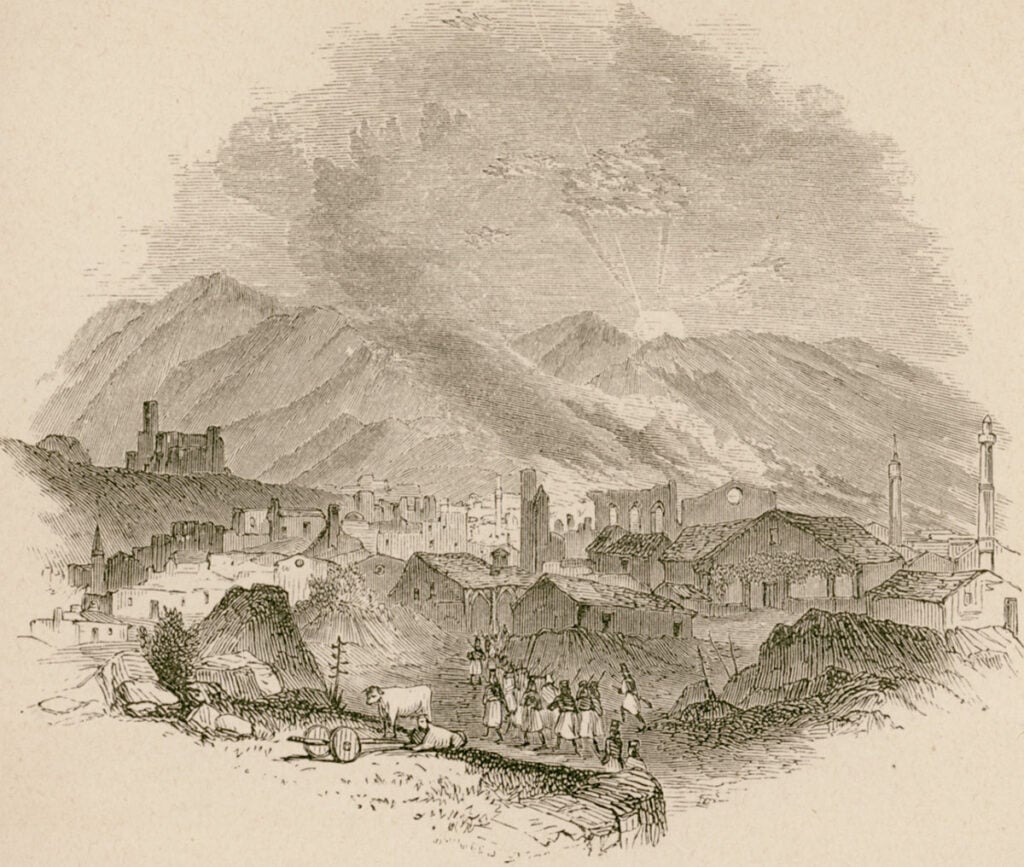
At dawn on 23 September 1821, Greek fighters entered through a weakened section of the northern wall. The defenses collapsed, and what followed was not an organized assault but an explosion of rage.
Scottish officer and eyewitness Thomas Gordon described “the carnage continuing for three entire days, until the streets were choked with bodies.” He estimated about 8,000 Muslims were killed.
Ottoman historian Seyyid Mehmed Esʿad Efendi, in Üss-i-Zafer (1827), wrote that between 6,000 and 15,000 Muslims and the entire Jewish community were slaughtered, with only 97 Turks ransomed. Modern studies generally accept a range of 6,000 to 15,000 deaths, mostly civilians, though Kolokotronis’ memoirs claim up to 32,000, a figure likely inflated by revolutionary fervor (see Kolokotronis, Memoirs; discussed in Thomas Gordon, History of the Greek Revolution).
The Jewish quarter was also destroyed. Most historians agree that the violence was indiscriminate rather than targeted. Kolokotronis later admitted that he could not bear to walk through the city and that the sight was “beyond description.” For three days, Tripolitsa burned.
Greek chronicler Fotakis, a close associate of Kolokotronis, wrote that commanders such as Petrobey Mavromichalis tried to halt the killings amid what he described as a “drunken frenzy” of fighters, but to no avail, highlighting the lack of discipline in the chaos of victory.
Tripolitsa gave the revolution its first real victory and its first moral wound.
Victory That Changed Everything and Everyone
The capture of Tripolitsa gave the revolution control of the Peloponnese. It yielded thousands of muskets, horses, and stores of powder that would keep the war going for years. It also gave the insurgents a seat of power and legitimacy.
Yet the victory divided them. Commanders quarreled over loot and prisoners, and old rivalries deepened. Kolokotronis warned that “we had won the town but lost our unity.”
George Finlay, the Scottish historian of the revolution, later called it “the triumph of independence and the first discord of liberty.” Even at the time, some Greek leaders, including Dimitrios Ypsilantis, condemned the killings as unworthy of a nation fighting for freedom.
What People Remembered and What They Forgot
When the killing stopped, the story began. Each generation that followed tried to explain Tripolitsa in its own way, choosing what to emphasize and what to forget.
Greek historian Spyridon Trikoupis described the massacre as an uncontrollable outburst after centuries of oppression. Later writers such as Apostolos Vakalopoulos acknowledged the tragedy but framed it as the price of liberation, placing it within a longer cycle of violence that included earlier Ottoman reprisals in places like Mani (see Aristides N. Hatzis, “The Absolute Barbarians as Victims…”).
Foreign philhellenes, who had imagined the rebirth of ancient Greece, were shocked. Gordon’s report circulated in Europe, breaking the romantic illusion. William St. Clair later wrote that “the dream of liberty met the reality of blood.”
Ottoman chroniclers recorded the event as a katliam, a massacre, and modern Turkish historians still use that term. The Turkish Historical Society (Türk Tarih Kurumu) describes Tripolitsa as one of the earliest mass killings of Muslims and Jews during the uprising. At a 2022 panel in Ankara, TTK President Birol Çetin called it ethnic cleansing and argued that Greeks had turned against their long-standing Ottoman neighbors after centuries of peaceful coexistence. The event was presented not as rebellion but as betrayal, a story of coexistence broken, rather than empire lost.
Violence did not end at Tripolitsa. Across the region, the first years of the war were marked by retaliation and collective punishment. Ottoman garrisons executed Greek civilians in cities like Constantinople, Thessaloniki, and Nicosia, while Greek forces destroyed Muslim and Jewish communities in parts of the Peloponnese and Central Greece. Entire islands, from Samothraki to Psara, were burned by Ottoman fleets. In April 1821, the Patriarch Gregory V was hanged in Constantinople; the following year, the Massacre of Chios shocked Europe and turned sympathy toward the Greek cause. By then, the war had become a struggle not just for independence but for survival, where neither side spared civilians.
What endured was not a single memory, but two. Greeks remembered freedom. Turks remembered slaughter. Between them lived a harder truth, where ordinary people paid the price for the making of nations.
Timeline of Events
| Date | Event |
|---|---|
| April 1821 | Greek forces surround Tripolitsa. Thousands of Muslim and Jewish civilians take refuge inside. |
| May to July 1821 | Encirclement tightens. Food shortages and disease devastate the population. |
| 9 to 10 August 1821 | The Battle of the Trench (Grana). Ottoman breakout fails and the city is cut off completely. |
| 23 September 1821 | Tripolitsa falls to Greek forces. Massacres and looting last for three days. |
| Late September 1821 | Kolokotronis restores order. Weapons and supplies seized strengthen the revolution. |
How 1821 Still Echoes Today
Two centuries later, the fall of Tripolitsa still echoes across Greece and Turkey.
In Turkey, nationalist commentators often revive it to counter Greek commemorations of independence. Newspapers such as Yeni Şafak and Sabah publish anniversary articles under headlines like “The Forgotten Massacre of Muslims in Tripolitsa.” Politicians from the far right MHP and columnists close to the government cite it when relations worsen, using it to argue that Greeks also committed atrocities. The timing is rarely random. When tensions rise over the Aegean or Cyprus, Tripolitsa returns to the headlines.
In Greece, the memory is quieter but selective. Schoolbooks and public ceremonies describe a great victory. The killings are mentioned briefly or explained as chaos. The story of independence remains centered on suffering and survival, not on cruelty. Admitting that Greeks committed violence feels to many like weakening that moral foundation.
Between the two nations, this difference in memory keeps the event alive. Turkish voices accuse Greeks of denial. Greek voices see Turkish reminders as provocation. Yet both nations do the same thing: they protect their version of the past.
For Greece, Tripolitsa marked the moment when independence became irreversible. For the Ottoman world, it was a wound remembered for generations.
Two centuries later, it stands as both the beginning of freedom and the shadow it cast, as Scottish historian George Finlay put it, “the triumph of independence and the first discord of liberty.” To tell it truthfully means holding both sides together: the courage of liberation and the human cost that came with it.