
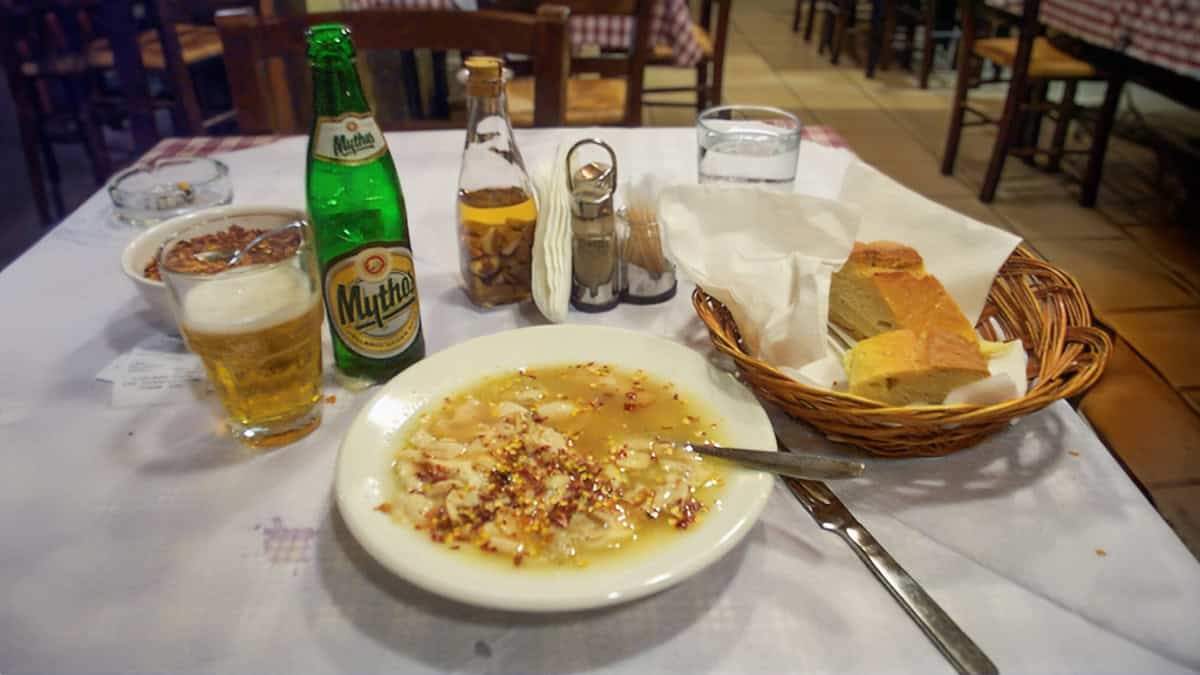
In Thessaloniki, patsas has never been just a bowl of soup. It is a dawn ritual, a worker’s meal, a hangover cure, a dare for some, and for others, a taste tied to memory. Now it has become something else too: the center of a familiar argument between Greece and Turkey over who gets to claim a dish shaped by centuries of contact, including the long Ottoman world both societies emerged from.
The latest round began after Dimitris Tsarouhas, owner of the well-known Tsarouhas patsatzidiko in Thessaloniki, pushed to have the know-how around patsas recognized as part of Greece’s cultural heritage. That effort has drawn attention in Greece and a much sharper response in Turkish media.
The first thing worth saying clearly is that this is not yet a final UNESCO showdown, at least not in the way dramatic headlines can make it sound. The Athens-Macedonian News Agency reported that Tsarouhas and author Lena Kalaitzi-Oflidi submitted a twelve-page dossier to the relevant department of the Greek Ministry of Culture after work that began in February 2024. According to that report, the file covers the soup’s preparation, history, the people involved in the craft, and the continuity of the tradition. The process described there is a domestic cultural-heritage step first, with any broader international move coming later.
That matters because UNESCO’s intangible heritage system is not meant to work like a patent office. It is built to safeguard living practices and encourage cooperation, not to hand one side exclusive ownership. UNESCO itself says traditions can cross borders and explicitly encourages multinational nominations when heritage is shared.
Still, that is not how food arguments are usually felt by the public. They land more personally than that. Tsarouhas told AP that he assembled a detailed file with collaborators in an effort to secure recognition for patsas as part of Greece’s cultural heritage. In the same report, he tied the dish to an older Greek lineage and even to Homer, arguing that a scene in the Odyssey points toward an ancient predecessor of the soup. But that should be understood as his interpretation, not as a settled classical conclusion. No formal scholarly consensus identifies patsas as the dish in question.
Even the language around the dish complicates any simple ownership claim. The Greek word πατσάς is itself a borrowing from Ottoman Turkish paça, a word associated with trotters, while the Turkish işkembe refers specifically to tripe. That does not settle the cultural question by itself, but it does show how entangled the histories are even at the level of naming.
And in Thessaloniki, the story may be more layered still. Thessaloniki’s municipal gastronomy material says the city’s dedicated patsatzidika took recognizable shape with the arrival of Asia Minor refugees after 1922. Lena Kalaitzi-Oflidi has gone further, describing the patsatzidiko in Thessaloniki as, in organized business form, “rather a refugee story.” At the same time, other accounts note that patsas was already known in the Ottoman period. The more careful conclusion is not that patsas suddenly arrived in the city from nowhere after 1922, but that the refugee world helped establish, strengthen, and define the patsatzidiko as a distinct urban institution in Thessaloniki.
On the Turkish side, the reaction has been sharper and more openly possessive. Sözcü framed the story with the headline “Yunanlılar bu kez de şifa kaynağımıza göz dikti,” or “This time the Greeks have set their sights on our source of healing.” That makes it clear that the dispute is no longer really about soup. It is about whose inheritance counts, whose version is treated as authentic, and whose history gets public recognition.
That tone runs through much of the Turkish coverage. Habertürk reported that Greece was preparing to move the dish toward UNESCO’s intangible cultural heritage framework after first filing it with the Greek Ministry of Culture, while Türkiye Gazetesi, Sözcü, and T24 cast the move as another attempt by Greece to claim something that belongs to Turkish cuisine. AP also quoted Turkish restaurateur Ali Türkmen, who reacted in the same spirit, comparing the issue to earlier disputes and arguing that it would be difficult for Greece to claim something Turks see as rooted in their culture for centuries. That gives the Turkish side a human voice beyond the headlines.
This is where the story opens into something larger: the shared world of the Aegean and the older Ottoman-Balkan space around it. Patsas in Greece is not a perfect one-to-one equivalent of every Turkish soup now being pulled into the debate. AP describes the Greek version as made from bovine bellies and legs, while the Turkish version in its report uses tripe only. In Turkish cuisine, işkembe and paça are distinct dishes, even if they sit close to one another in the same offal tradition. That matters because the Greek dish falls somewhere between those categories rather than matching either exactly.
The Turkish historical case is also more concrete than it may first seem. Reporting on the dispute points to the 17th-century traveler Evliya Çelebi and his Seyahatname, which Turkish sources cite as evidence of established offal and paça trades in Ottoman Istanbul. That does not prove modern national ownership any more than the Homeric claim proves exclusively Greek origin. But it does give the Turkish side a documentary reference point that deserves to be taken seriously.
That is also why the argument feels so familiar. Greeks and Turks have gone through versions of this before over coffee, baklava, stuffed grape leaves, yogurt, and other foods that moved through shared worlds long before modern national branding took hold. Turkish media explicitly placed the patsas story into that same pattern. The point is not that one side invented the comparison. Both publics already know the script.
What gives this case extra weight is that Thessaloniki is not just being used as scenery. It is one of the places where patsas still has a real urban identity, and possibly the city where the modern patsatzidiko became most strongly tied to refugee memory, late-night culture, and working-class routine. Athens-Macedonian News Agency’s report on the dossier focused not only on the soup itself but on the know-how around it: the makers, the shops, the process, and the continuity of a living food tradition. That is a more serious claim than simply saying “we have this dish too.” It tries to root the case in practice and transmission.
The Turkish reaction has also been broad enough to matter. There were at least two clear waves of coverage. The first came in mid-February 2026, when outlets such as Habertürk reported on the Greek filing. The second arrived on April 16, 2026, when Turkish outlets revived the story with harder language and a more openly adversarial tone. That second wave matters because it shows the story was not just noticed in Turkey. It was absorbed into a larger narrative of cultural competition with Greece.
The phrase “source of healing” is revealing in another way too. In both countries, the soup is discussed not simply as food but as remedy, recovery, and bodily repair, even when those claims are closer to folklore than science. AP noted that Tsarouhas described the soup as helpful for ulcers, joint recovery, and alcohol-related stomach problems, while also making clear that such beliefs are not backed by medical evidence. The same caution should apply to the more precise collagen statistic circulating in some reports. It reads more like a promotional claim than a verified nutritional finding.
In the end, the most honest version of this story may be the least satisfying one for nationalists. Patsas does not become less Greek because it has Turkish parallels, and it does not become less Turkish because Thessaloniki has its own deep, living tradition. The soup belongs to a region before it belongs to a headline. That is what makes the argument so heated. Both sides are reaching for something real. They are just trying to name it in national terms. UNESCO, at least in theory, leaves room for a different answer: that some traditions are shared, entangled, and still alive across the region.