
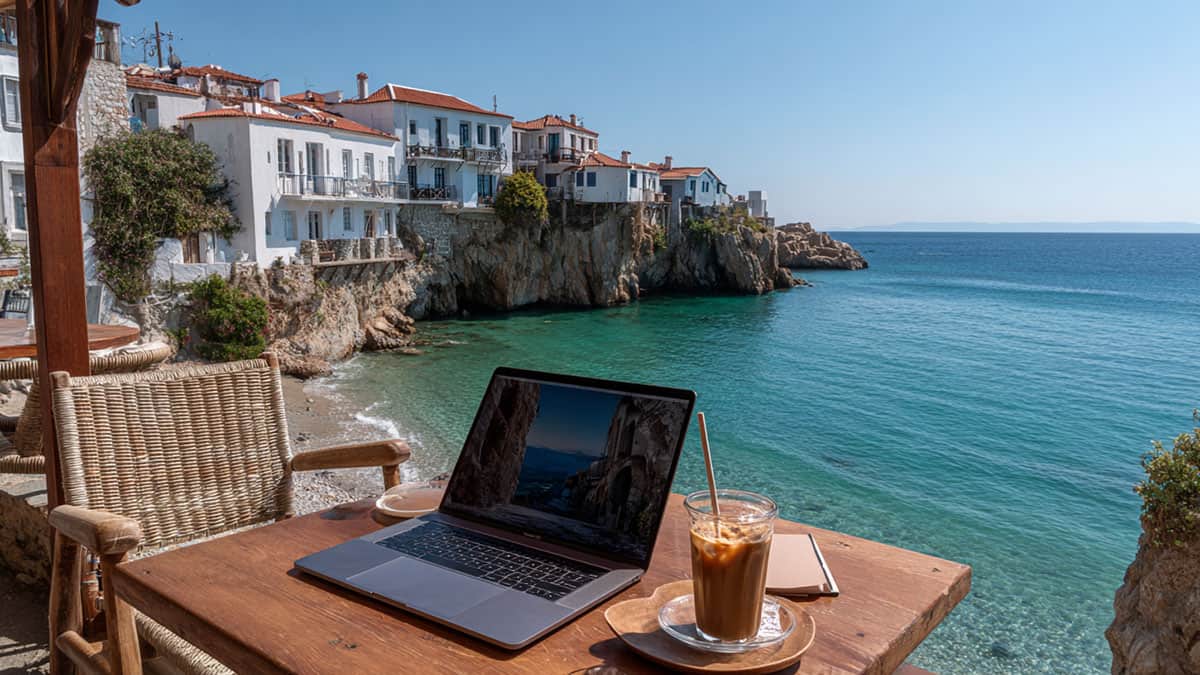
Greece has become one of the most appealing places in Europe for people who want to work remotely while living a healthier and more grounded life. Greek Americans feel the pull for obvious reasons, but more Americans in general are discovering that Greece offers a practical way to balance work, travel, and a slower pace of everyday living. The good news is that it is fully possible to live in Greece while keeping your career based in the United States.
Greece offers a clear path for non-EU citizens who earn their income from abroad through what most consulates and attorneys still call the Digital Nomad Visa. It is issued as a Type D long-stay visa and followed by a residence permit. The name may vary depending on the office, but the purpose stays the same. You can live in Greece while working for a foreign employer or running your own business outside the country.
The requirements are straightforward. You need to show a steady income of at least 3,500 euros per month after taxes. The amount rises for a spouse or partner and for each dependent child. Your income must come from outside Greece. You also need health insurance, a clean criminal record, and proof that you have a place to stay. Applications are submitted at a Greek consulate in the United States or, in some cases, through the Ministry of Migration if you are already legally in Greece.
There are fees to budget for. The visa application fee is 75 euros, plus a 150-euro administrative fee per family member. When you later obtain the residence permit in Greece, you pay a one thousand euro fee plus another one hundred fifty euro fee for each additional family member.
If approved, you receive a Type D visa that lets you enter Greece and apply for your residence permit. The initial residence permit is valid for two years and is renewable as long as you continue to meet the requirements. To maintain the permit, you must spend at least 6 months per year in Greece. Permit holders also enjoy visa-free access to the Schengen Area, which makes travel around Europe far easier.
Taxes are a common concern, but the main rule is simple. If you spend fewer than 183 days a year in Greece, you are not considered a Greek tax resident, and you do not owe Greek taxes on your foreign income. If you stay longer, you may become a tax resident. Greece has a program that cuts income tax by half for up to 7 years, but it has strict conditions. You must have been a non-Greek tax resident for five out of the previous six years, and the structure of your work or employment must meet the program’s rules. It does not apply automatically. Anyone planning a long stay should speak with an accountant to understand their specific situation.
The cost of living depends on where you settle, but Greece is still more affordable than most of Western Europe. Athens has the largest remote worker community and the highest rents, yet many people live comfortably on 1,200 to 1,800 euros a month. Thessaloniki offers lower costs and a relaxed, friendly atmosphere. Crete and Rhodes are popular island choices with reliable infrastructure and year-round communities. Smaller islands are beautiful but can have seasonal rent spikes or uneven internet coverage, so it helps to check before committing long-term.
Internet reliability has improved across Greece. Fiber connections are common in the big cities, 5G is widely available, and coworking spaces continue to grow. Athens and Thessaloniki have active groups where remote workers meet, and cafés across the country are used by people to spend a few hours with a laptop and a coffee.
For Americans, the attraction is straightforward. Life slows down. The food is fresh. The climate is gentle. Daily routines feel more human. For Greek Americans, the experience adds another layer, since time in Greece strengthens family connections and the sense of belonging that many feel on their summer visits but never get to explore fully.
Related articles and websites you may find helpful
- You Do Not Have to Choose Between Ambition and Belonging. Why More Greeks Abroad Are Moving Back Without Starting Over
- Retiring in Greece. What Greek Americans Should Know About the FIP Visa and the Golden Visa
- WorkFromGreece.gr
A practical external resource with information on remote work, life in Greece, and available local services for newcomers.
Becoming a digital nomad in Greece is not difficult. The paperwork takes some patience, the lifestyle is rewarding, and the chance to live in a place that feels both new and familiar can be transformative. For anyone considering a longer stay in 2026, this is a good moment to explore the option and see whether Greece can become a second home, or even a first one.