
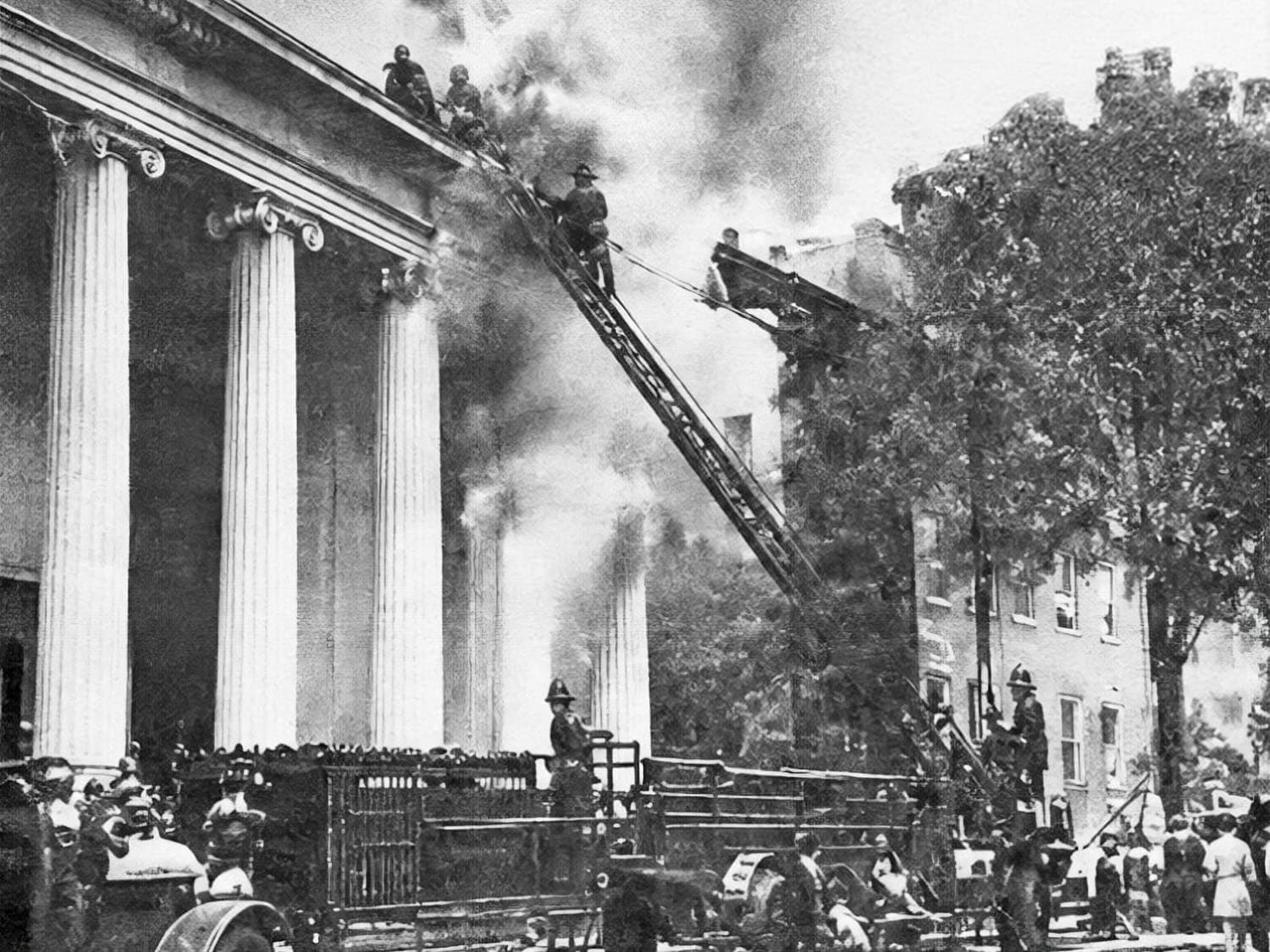
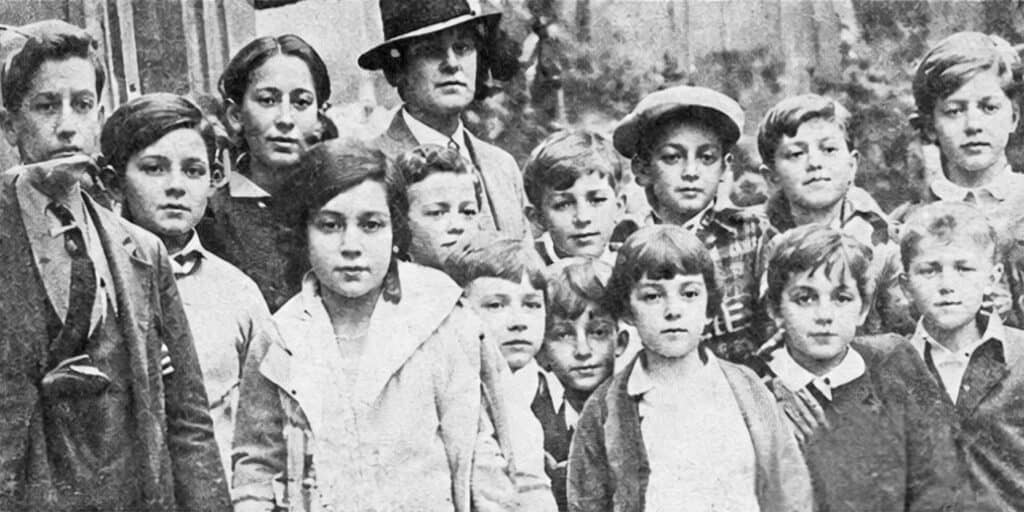
On Thursday afternoon, October 9, 1930, a fire at St. George’s Greek Orthodox church and school on South Eighth Street in Philadelphia threatened dozens of children in their third-floor classrooms. As smoke spread through the building, a teacher gathered the pupils at the fire escapes while neighbors rushed to help. All the children made it out safely.
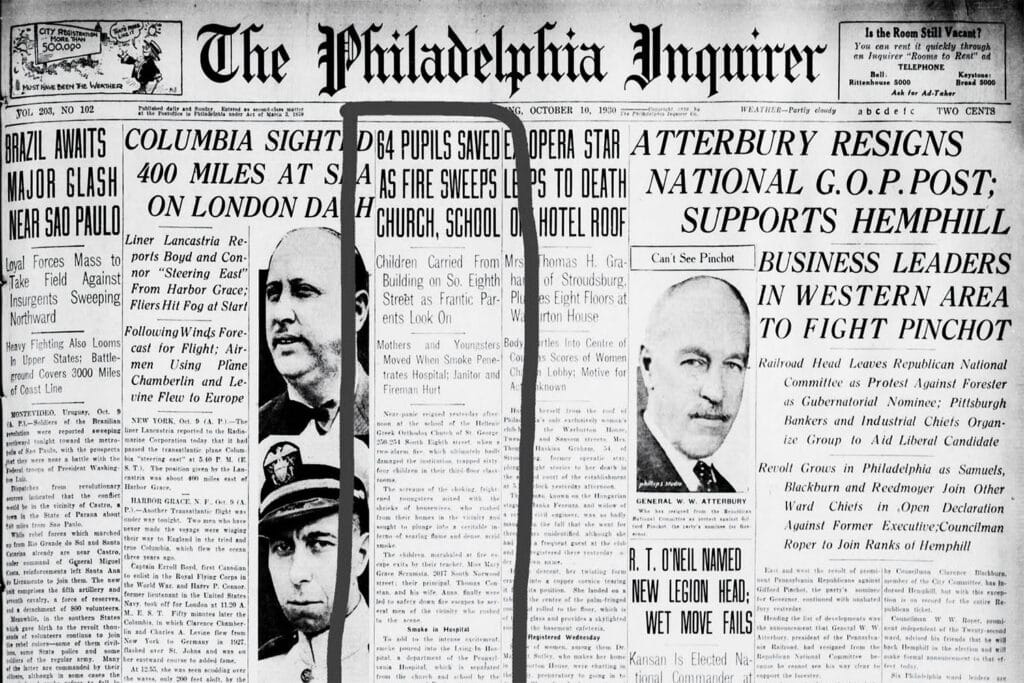
The Philadelphia Inquirer, reporting the following morning, identified Mary Grace Scramsta as the teacher who assembled the children at the fire escape exits. Several men from the surrounding neighborhood helped pupils and school staff down the exterior escapes as firefighters battled the blaze.
Outside, frightened parents and neighbors watched the emergency unfold. The Inquirer described children crying out as smoke filled the building and women hurrying from nearby homes, some attempting to reach those still inside. Among those helped to safety were Thomas Constan, identified as the school’s principal, and his wife, Anna.
Firefighters responding to the two-alarm blaze climbed ladders toward the roof, above the six Ionic columns of the church’s Greek Revival façade. Smoke rose from the building as hoses stretched across South Eighth Street and spectators gathered nearby.
The emergency reached beyond the church. Smoke entered the neighboring Lying-In Hospital, a department of Pennsylvania Hospital, separated from the school by narrow Darien Street. Staff hurried mothers and infants away from the affected areas, while smoke also reached other hospital wards. The Inquirer reported injuries to a janitor and a firefighter.
The Philadelphia Daily News recorded the scene in photographs. One showed the rescued children standing together, with an adult man behind them. Another captured firefighters working above the church’s entrance, with smoke rising around their ladders. An inset portrait identified Mrs. Grace Charalambous as the school’s principal.
The newspapers differed on two details. The Inquirer reported that 64 children had escaped, while the Daily News counted 65. The Inquirer also named Thomas Constan as principal rather than Mrs. Charalambous. The surviving accounts do not establish whether the two held different responsibilities at the school.
St. George had occupied the building for only nine years.
Originally St. Andrew’s Episcopal Church, the Greek Revival structure was designed by architect John Haviland and built in 1822–1823. Haviland himself belonged to the St. Andrew’s congregation. The Greek Orthodox community acquired the building in 1921, when the surrounding neighborhood was home to a growing population of Greek immigrants.
Philadelphia’s early Greektown extended across several blocks around Locust and Tenth Streets, where Greek families had established businesses and community institutions. As historian Alexander Kitroeff documents in the Encyclopedia of Greater Philadelphia, St. George joined Annunciation Evangelismos as another center of Greek Orthodox life in the city.
The children escaped, but the church suffered extensive damage. The cathedral’s architectural restoration records describe the destruction of much of its interior, including the ornate plaster ceiling and balcony windows. The roof was also damaged, and only a single icon from Greece is recorded as having survived the fire.
During reconstruction, the original flat, coffered ceiling was not replaced. Instead, the charred beams were enclosed and the roof trusses left exposed, changing the sanctuary’s appearance.
The congregation faced another crisis during the Depression. In 1935 and 1936, St. George nearly lost its building to foreclosure. The cathedral’s restoration history credits two women from the congregation with delaying the sheriff long enough for money to be raised to save the property.
By 1942, the interior had been restored, as shown in a photograph taken during a visit by King George II of Greece.
Today, the exposed roof trusses remain visible above the sanctuary of St. George Greek Orthodox Cathedral at 256 South Eighth Street, part of the reconstruction that followed the October 1930 fire.
Archival acknowledgment: Special thanks to the Facebook page “In Memory of Rev. Demetrios Katerlis” for sharing the Philadelphia Daily News clipping. The newspaper page was preserved by the late Rev. Fr. Demetrios S. Katerlis after receiving it from a parishioner.