

Greece is increasingly dealing with a problem created by having abundant renewable electricity at the wrong time of day. On sunny, low-demand days, solar and other renewable generation can push wholesale electricity prices toward zero while the grid is unable to accommodate all of the power available. Hours later, as solar output falls, more expensive generation is needed to meet evening demand.
The regional power market serving Philadelphia is changing too, but not in the same way. As solar expands, PJM expects more system pressure to shift toward later hours, while current wholesale prices are being shaped by rising demand, transmission constraints and fuel costs.
More renewable generation increases the need for storage, transmission and flexible demand that can shift electricity from the hours when it is plentiful to the hours when consumers need it.
During the first half of 2026, renewable and large-hydroelectric generation reached a record 18.8 terawatt-hours, according to The Green Tank’s analysis of Greek electricity data. At the same time, an estimated 1.6 TWh of renewable generation was curtailed, equal to 9.6% of renewable output.
Curtailment means available wind or solar generation is deliberately reduced because the electricity system cannot use all of it at that moment.
Wholesale prices show the same imbalance. Greece recorded 788 hours with day-ahead prices that were near zero or negative during the first six months of 2026. The Green Tank defines near-zero prices as below €0.05 per megawatt-hour.
Earlier monthly data showed most renewable curtailment occurring between the morning and midafternoon, when solar production is strongest.
Greece can export surplus electricity through its international interconnections, and exports have risen sharply. Even so, there are periods when domestic demand, exports, storage and the grid cannot absorb all available generation.
Wholesale electricity can therefore be priced near zero at midday and considerably higher a few hours later.
Natural-gas plants still play an important role when renewable output falls. Gas-fired electricity generation remained high during the first half of 2026 despite record clean-energy production. The same system can curtail renewable electricity during periods of abundance and rely on fossil gas later in the day.
Batteries have started to enter the Greek market
Battery storage has now begun operating in the Greek electricity market.
Greece’s first standalone battery systems started participating in April. By May, nine units were operating with about 210 MW of absorption capacity, according to The Green Tank’s review of the first months of battery operation.
The batteries generally charged during the morning and early afternoon, when renewable electricity was abundant, and discharged mainly from late afternoon into the evening.
Their impact remains modest. From April through June, batteries prevented only about 2.2% of renewable curtailments and reduced gas-fired generation by about 0.6%, according to The Green Tank.
More storage could move electricity that would otherwise be curtailed at midday into the evening. Stronger interconnections can do the same by allowing excess Greek generation to reach neighboring markets when demand is higher elsewhere.
PJM is seeing more late-day pressure
Philadelphia is part of PJM Interconnection, the regional electricity market stretching across all or parts of 13 states and the District of Columbia.
Solar is becoming a larger part of that system. Solar generation in PJM increased 23.9% during the first six months of 2026 compared with the same period last year, according to the Independent Market Monitor’s latest State of the Market report.
PJM has described how increasing solar changes the shape of electricity demand seen by grid operators. Its study of system flexibility found that stronger midday solar production reduces net demand during the day and shifts more system pressure into the hours after solar output begins to fall.
That is the familiar “duck curve” in net electricity demand. It does not necessarily produce the same hourly wholesale-price pattern seen in Greece.
A comparison of official day-ahead prices from August 11 through August 14 makes that distinction clear. HEnEx market data show Greek prices collapsing to near zero for several hours around midday before rising sharply toward the evening. In the PJM Data Viewer, PJM-RTO day-ahead prices over the same 72-hour period were lowest overnight and climbed through the afternoon, reaching their highest levels around the early evening.
Both markets showed stronger prices later in the day, but only Greece displayed the pronounced midday collapse during that period.
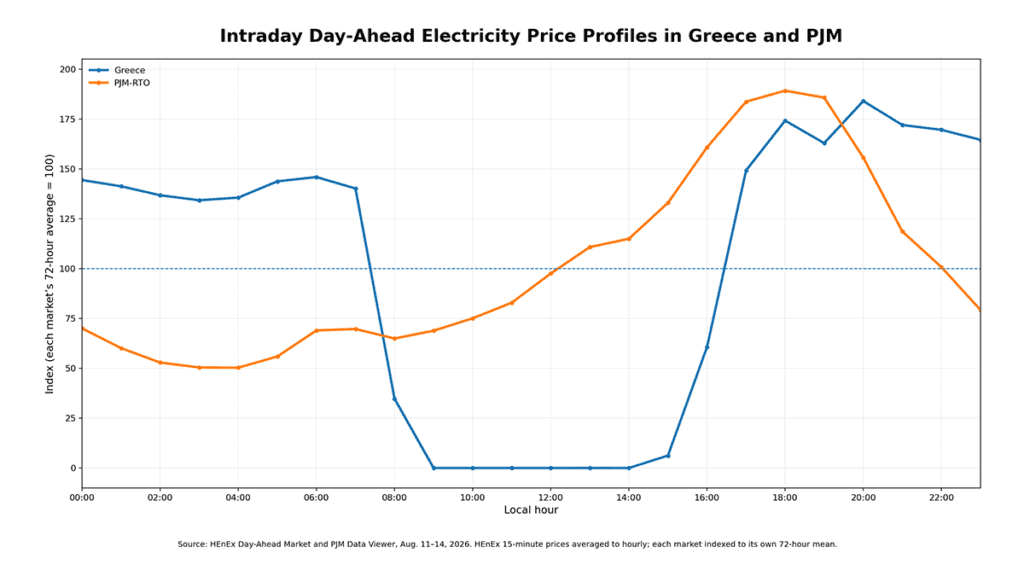
Battery storage can help in either system by charging when electricity is less valuable and discharging when prices and demand rise. The scale and timing of that opportunity, however, differ between the two markets.
PJM’s current price pressures have other causes
Wholesale electricity prices across PJM have risen substantially in 2026.
The Independent Market Monitor reported that the real-time load-weighted average price reached $72.54 per megawatt-hour during the first half of the year, up 40.2% from the same period in 2025. The day-ahead average rose 49.3% to $74.25 per MWh.
Solar growth was not the main reason. Transmission constraints accounted for the largest portion of the year-over-year increase in real-time prices, followed by higher fuel and operating costs. Natural gas remained the marginal resource setting prices during much of the period.
Demand is also increasing. PJM reached a preliminary all-time peak of 168,158 MW during extreme heat on July 2, with the peak occurring between 5 and 6 p.m.
The region is preparing for much larger electricity loads in the years ahead, particularly from data centers. The Independent Market Monitor identifies data-center growth as a primary reason for the tightening balance in PJM’s capacity market.
The hourly energy market is only one part of what consumers ultimately pay.
PJM also operates a capacity market, which pays resources for being available to meet future demand. In July, the 2028–2029 capacity auction cleared at the federally approved price cap of $325 per MW-day. Together with resources secured outside the auction through PJM’s Fixed Resource Requirement option, committed capacity was 6,831 MW short of PJM’s reliability requirement.
Capacity costs do not follow the same midday-to-evening solar pattern. They reflect whether enough dependable resources will be available when the regional system needs them most.
Recent electricity-price pressure in the Philadelphia region therefore cannot be explained by solar power or the duck curve alone.
Greece offers an early view of what can happen when renewable generation grows faster than the system’s ability to shift electricity across the day. Record curtailment and hundreds of near-zero or negative-price hours show how far that problem has progressed there.
PJM is not yet showing the same wholesale-price pattern. What the two systems increasingly share is pressure later in the day, when solar generation falls and electricity demand remains high.
Adding panels can make daytime power more plentiful. Storage, transmission, and flexible demand determine how much of that electricity can be carried into the hours when it is worth more.
Editor’s note: This article was originally published on August 2, 2025. It was updated on August 14, 2026, with new data on renewable curtailment and battery storage in Greece, current PJM figures on solar generation, wholesale prices, electricity demand, and capacity costs, and a new comparison of official day-ahead market data from Greece and PJM.