

On a weekday morning outside the Bulgarian consulate in Skopje, the line moves slowly. Students check their phones, older men wait in silence, and a young father holds his child. They are not there for a vacation stamp. They are there for something that can change their lives in the Balkans, a Bulgarian passport.
In North Macedonia, more than 216,000 people have received Bulgarian citizenship since 2007. That is nearly one in ten of the country’s residents. Applicants must prove they have Bulgarian roots or identify as Bulgarian under Bulgarian law. For many, the benefit is EU citizenship, with the right to live and work anywhere in the Union. For Sofia, there is another benefit. Every new passport holder becomes part of a Bulgarian “minority” abroad that can be cited in politics, negotiations and, if needed, in future territorial arguments. While this strategy can be used as a geopolitical tool, some applicants are motivated by genuine ancestral connections rather than political agendas.
Bulgaria is not alone in using passports this way. Serbian media report that between 5,000 and 8,000 Serbs already hold Bulgarian passports, and more than 2,000 have been issued in just the last two years. Some in Belgrade warn that one day Bulgaria might claim tens of thousands of Bulgarians live in southern Serbia and should be considered part of its cultural space.
The passport wars reach into Albania’s Prespa region, where the small municipality of Pustec is almost entirely ethnic Macedonian. Limited survey data found that nearly all men interviewed held both Albanian and Macedonian citizenship, while most women had only Albanian. Researchers suggest this may be linked to patterns of male labor migration and the political weight citizenship carries in the region, but the sample size was too small to draw broad conclusions.
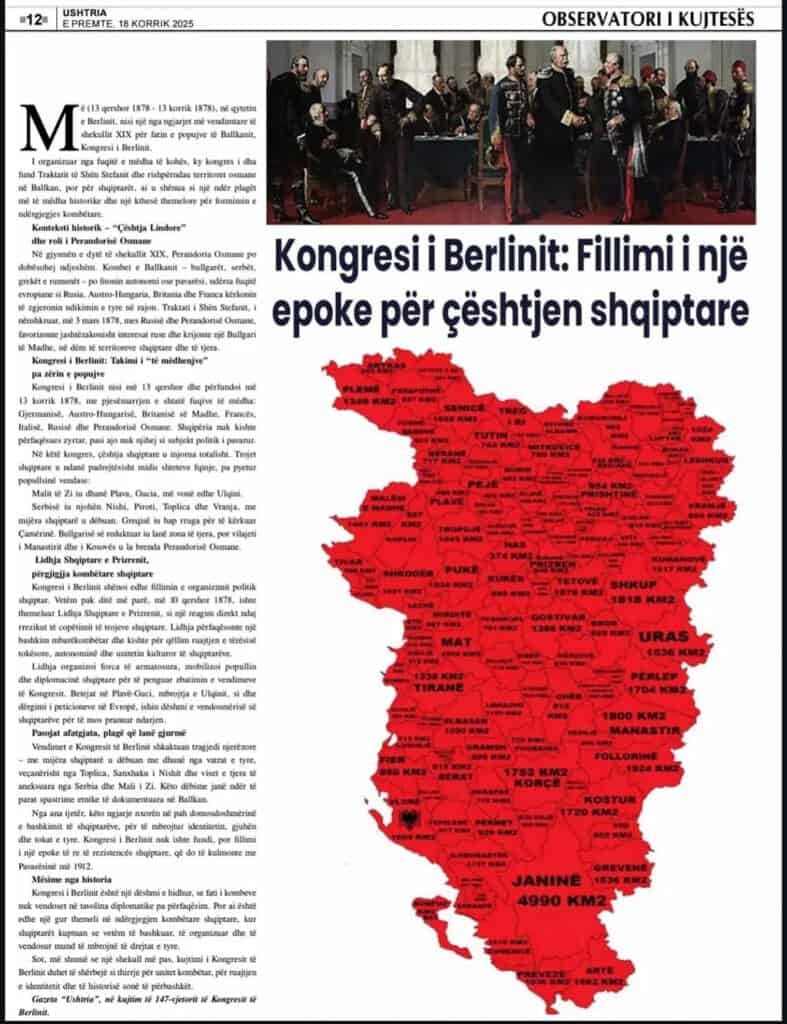
Other disputes take different forms. In July 2025, the Albanian Ministry of Defense’s weekly magazine Ushtria published a map depicting parts of northwestern Greece, including Ioannina, Preveza and Corfu, inside a “Greater Albania” outline. The accompanying article framed the 1878 Berlin Congress as a “historical injustice” against Albanians. Following strong protests from Athens, the page containing the issue was removed from the ministry’s website, a move noted by the European Parliament and widely covered in Greek media. For Greeks, this revived memories of wartime expulsions and underscored how old grievances can resurface in official narratives.
These moves are happening alongside bigger geopolitical projects. Serbia’s leadership openly promotes a “Serbian World” linking Serbia, Kosovo, Montenegro and the Republika Srpska in Bosnia under one cultural and political roof. Turkey continues to challenge Greece’s sovereignty over islands in the Aegean and claims that demilitarization obligations are not being met.
Greece faces its own minority challenges. The 2023 Albanian census recorded 23,485 people identifying as Greek, just 1 percent of Albania’s population, but Athens and the Greek minority organization Omonoia question the accuracy. They point to gaps in minority education, unresolved property disputes and restrictions on local governance.
All of this is unfolding as the United States shifts more of its focus to Asia and the EU’s enlargement process stalls. In that vacuum, Balkan governments are using identity and citizenship as tools of influence, building power across borders without moving a single soldier. The risk is that today’s citizenship statistics become tomorrow’s territorial claims. As one Serbian analysis warned, “In 10, 20 or 30 years, someone may say: ‘50,000 Bulgarians live there. This is our territory, our interest, our historic responsibility.’”
This is more than a regional curiosity. Passport wars show that in the Balkans, questions of identity are never settled. Borders may look fixed on the map, but in politics they remain open to challenge, and the struggle over who belongs where is far from over.
Featured image: The Bulgarian Embassy in Skopje, North Macedonia, where thousands of North Macedonian citizens have applied for Bulgarian citizenship in recent years.