
The wooden door creaked open as I stepped inside the small coffee house in Kadırga Yaylası, a magnificent mountain plateau tucked away in the Kürtün district of Gümüşhane Province (Αργυρούπολη) near the border with Trabzon (Τραπεζούντα). Located approximately ninety kilometers from Gümüşhane’s center and accessible through the famous Zigana Tunnel (Ζύγανα), this remote highland settlement sits at the heart of one of Turkey’s most celebrated cultural traditions.
I was on my own, no guide, no translator, with only curiosity, my camera, and a handful of Turkish phrases. My hands trembled slightly as I entered, nervous but determined to see if this mountain coffee house would resemble those I knew from Philadelphia’s Greek neighborhoods or the kafeneia (coffee houses) I’d visited in Greece.
But this journey was more than just documenting village life; it was my personal odyssey home. I am the first member of my family to return to our ancestral homeland since my family left this region two generations ago. Growing up in America, Pontian Greek echoed through our home, fragments of conversation between my parents, words that carried the rhythm of these very mountains.
A Room Filled with Light and Memory
As I crossed the threshold, brilliant mountain light flooded the space through aged wooden window frames, unadorned by curtains or blinds. These simple openings stood as a testament to the unpretentious ways of generations past. My nervousness began to dissolve in that welcoming light.
At first, I wandered cautiously, camera in hand, my faithful companion and shield. The white-washed walls surrounded us like pages from an ancient manuscript, seeming to hold the weight of countless conversations. Steam rose from tulip-shaped tea glasses, their amber contents catching the afternoon sun. The gentle clink of glass on the saucer provided rhythm to the murmured conversations around me.
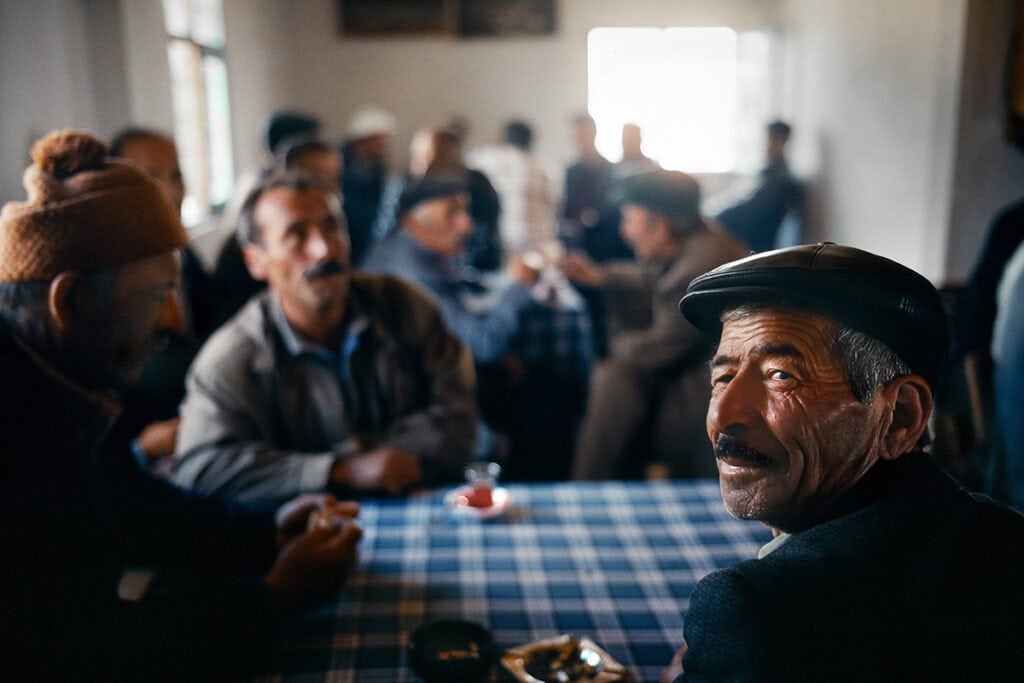
Despite the language barrier, I felt an immediate sense of recognition. The rituals, the way men gathered, felt similar to the coffeehouses of my youth, where Greek immigrants recreated the social rhythms of their homeland. Perhaps they thought I was local; perhaps my features allowed me to blend in. We communicated through gestures, a nod, a gesture, the universal language of shared humanity.
You could hear the gentle rhythm of conversation, men speaking in the measured, contemplative tones of reflection. Though I couldn’t understand their words, the cadence felt familiar, carrying the same unhurried pace of discussion I remembered from coffee houses back home. Later, I would experience the legendary Kadırga Festival, which would soon transform this very plateau. Every year on the third Friday of July, this peaceful setting becomes a living theater where thirty-five to forty thousand people gather for three days of celebration, with horsemen leading processions, traditional horon dance chains, and the ancient community bonds that have sustained mountain communities for millennia.
Now, sitting among these time-worn faces, hearing familiar cadences and intonations, I felt a profound sense of confidence, calm, and pride. Each snippet of conversation was like another piece of a vast mosaic slowly revealing itself, not through the words themselves, which remained largely a mystery, but through the familiar rhythms and occasional sounds that stirred memories of my childhood, the place where my family’s voice had originated. My camera, usually raised to capture moments, rested quietly in my lap. Sometimes the most important photographs are the ones that exist only in memory.
Echoes of Ancient Pontos
This magnificent treeless mountaintop has been a crossroads of cultures for over two millennia.
Greek merchants and sailors first arrived on these Black Sea shores between the eighth and sixth centuries BC, naming this territory Πόντος, meaning “sea.” For generations, Pontian Greek communities flourished in these highlands until the devastating population exchange of 1923 forced my ancestors from these mountains they had called home for centuries.
Yet sitting in this humble coffee house, I realized their cultural imprint had never truly left. The way men gathered to share stories, the respect for elders evident in every interaction, the unhurried pace of mountain life, these traditions mirror the customs that my own family maintained in exile. Today, thousands of Romeyka speakers, descendants of Pontian Greeks who remained in the region, still preserve a dialect remarkably similar to ancient Greek, their voices carrying forward the linguistic DNA of Pontos.
The sounds drifting through the coffee house conversations stirred something unexpected. Unlike many Pontian families, my own family rarely spoke of Pontos. It wasn’t taboo; it was simply a painful memory of loss, of leaving everything behind. Yet here, surrounded by these familiar rhythms and cadences that recalled the conversations I remembered from my childhood home, another piece of the mosaic clicked into place, not through family stories of “to chorió mas” (our village) and “i patrida mas” (our homeland), but through the living culture itself.
The Moment That Bridged Time
Then, in an instant that seemed to collapse not just decades but generations, something magical happened. When that elderly man turned toward me with his warm smile, time seemed to collapse. Through my viewfinder, I had captured countless faces over the years, but this moment captured me. In his lined features, I glimpsed traces of my own bloodline, the genetic and cultural legacy that connects me to this place across the gulf of a century. His natural warmth reflected the same philoxenia, love of strangers, that was a cornerstone of Pontian culture, the same hospitality my parents had maintained in our American home, always welcoming visitors with the phrase “Kalós írthes” (welcome).
The aroma of mountain tea filled the air, mingling with the scent of wood smoke from the kitchen. Sunlight played across the checkered tablecloth between us, illuminating his hands as they gestured expressively while speaking to his companions. In that gesture, in the rhythm of his words, I found the final pieces of my mosaic falling into place.
As I wove my way among the men at their tables, absorbing the fullness of the moment, I felt a deep sense of completion. Moving back out into the hills, I was met with a vision that felt like stepping into another time.
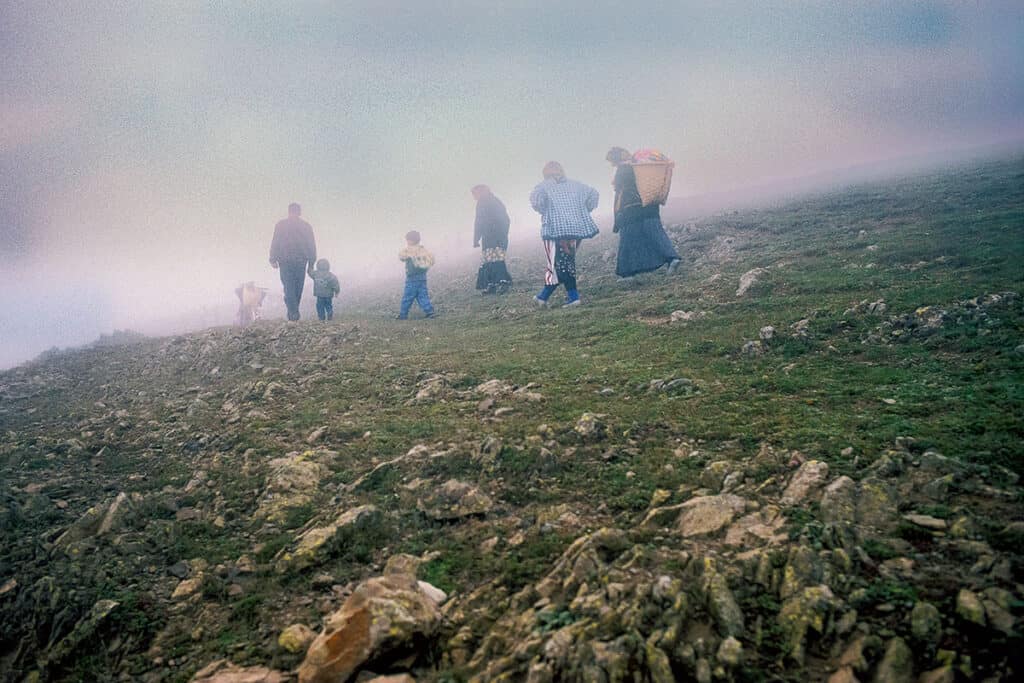
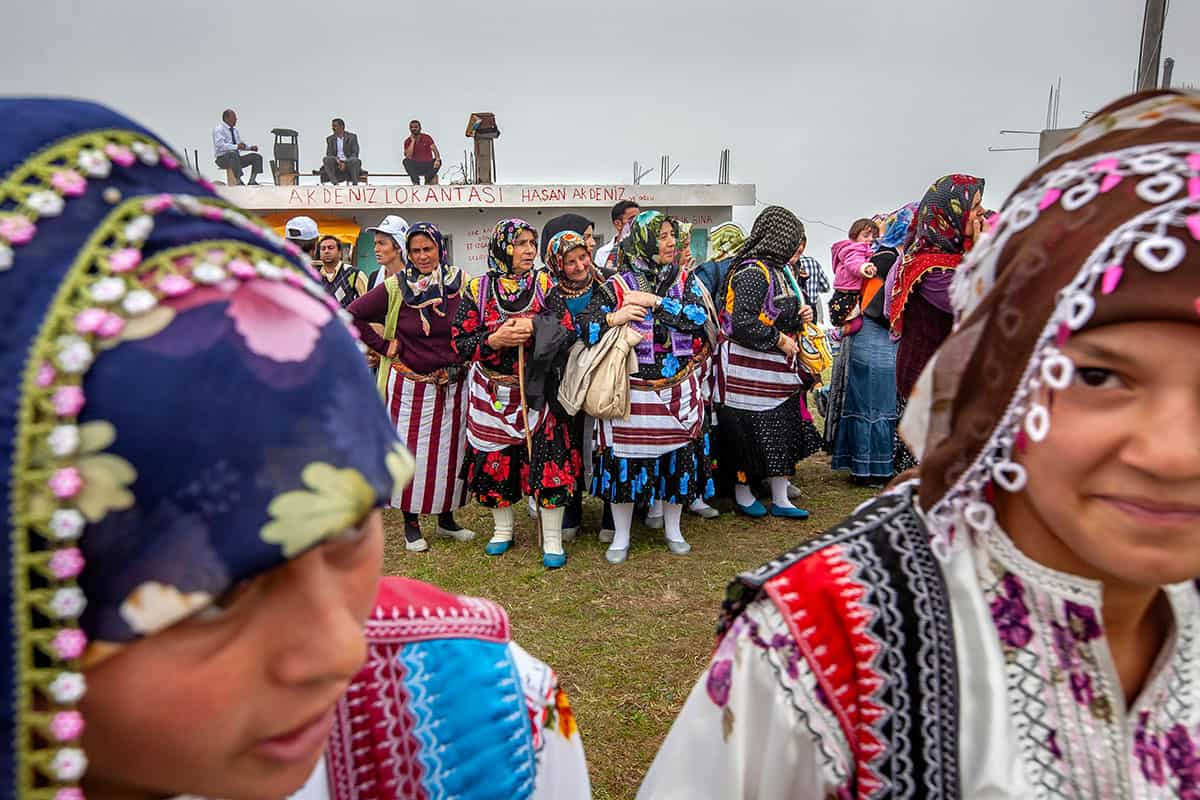
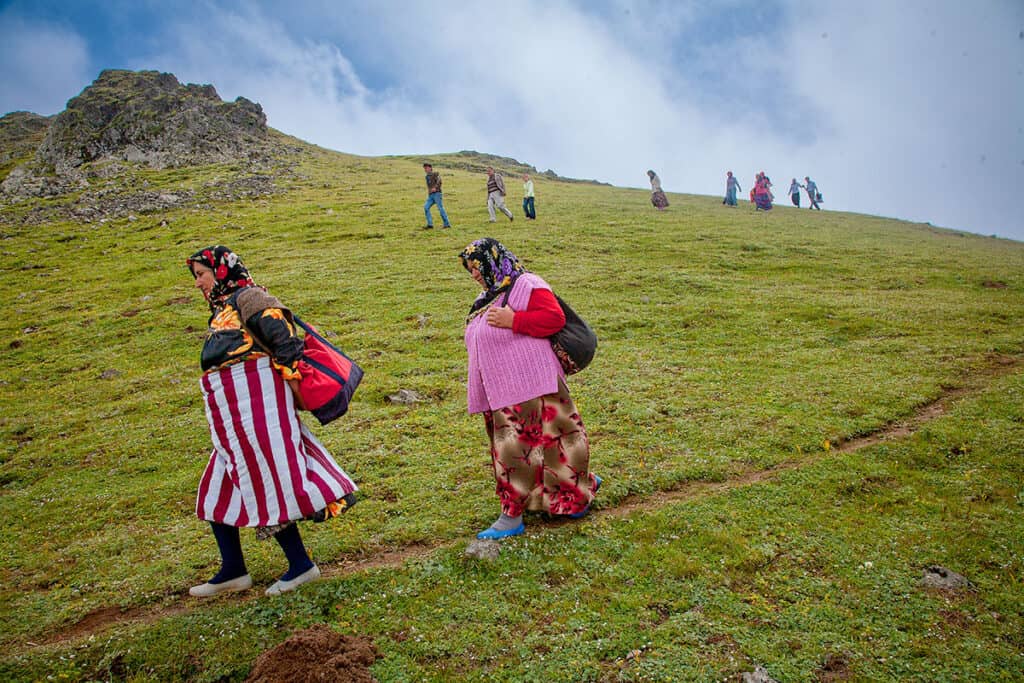
Outside, an endless river of humanity flowed across the fog-laced green hills, men, women, and children following woven footpaths back to their mountain homes and shelters. Among them, women in traditional folk attire moved gracefully, as if tracing steps laid out generations before. The sight took my breath away; it was like witnessing history come alive, each family a living thread in the tapestry of this land. I could hear and feel my own heartbeat amid the whispers of mist and the echoes of tradition.
Sometimes discovery isn’t about finding something new, but about recognizing what was always there, like ancient roots that run so deep they’ve become part of the soil itself. In that moment, across those white-washed walls and through that genuine smile, I found not just my heritage but the eternal thread that weaves strangers into the fabric of belonging. My camera had brought me here, but it was my heart that made me stay.
The Mosaic Complete
That spontaneous moment of connection inside the coffee house, and the haunting, timeless procession outside, became the capstones of a mosaic I had been unconsciously building through years of traveling these ancient pathways. Each journey, each photograph, each conversation had slowly revealed pieces of who I am. The coffee house visit wasn’t just documentation; it was recognition, the sudden formation of a complete picture.
I had entered as a nervous outsider with a camera, but I was leaving as someone who had found his place in an ancient story. In the unbroken procession over the misty hills, I found validation that coming home isn’t a single destination but a gradual awakening, like dawn breaking slowly over these eternal mountains. The bonds between people transcend the artificial boundaries created by history, politics, and time.
For the first time in my family’s modern history, one of us had returned to Pontos. The mosaic was complete. The odyssey continues.
Featured image: Women in traditional Pontic highland attire gather at the Kadırga Festival (2001), a celebration that draws thousands each summer.
About the Author
Eleftherios Kostans is a writer, photographer, and filmmaker with Cosmos Philly, who has covered stories about the Greek-American community throughout the Delaware Valley.