
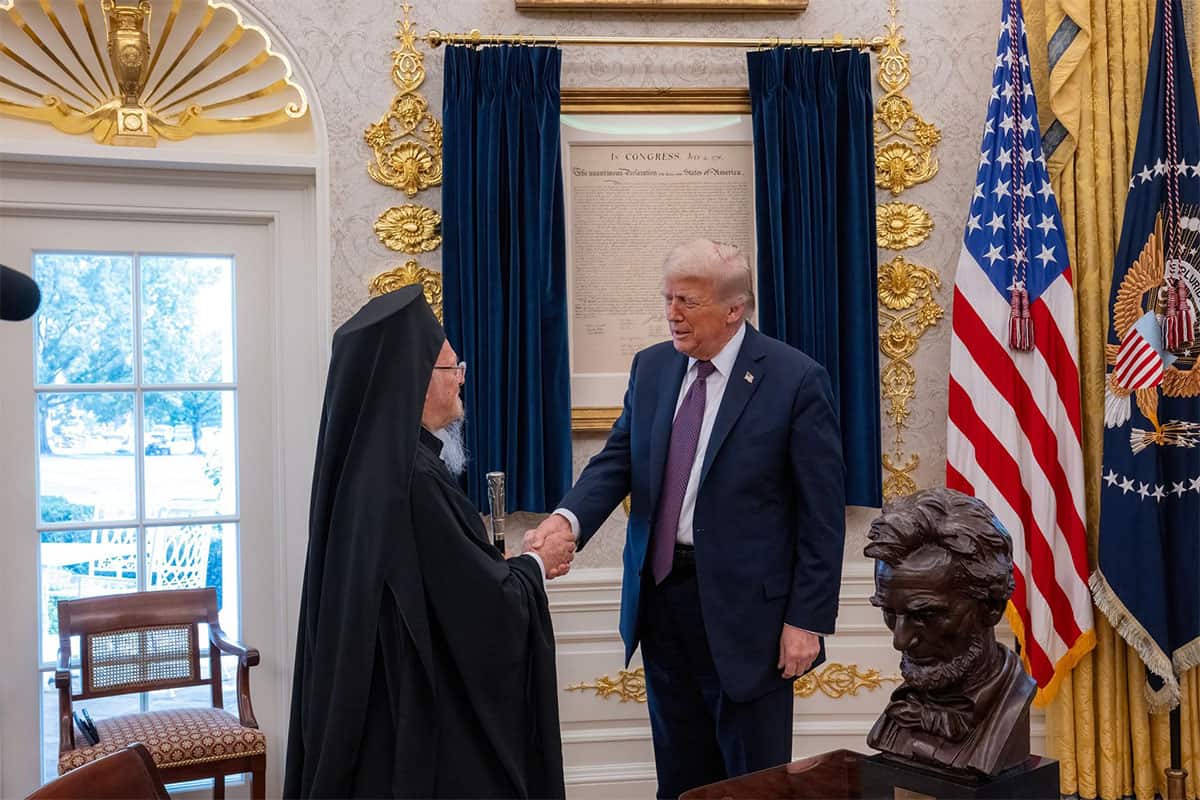
On September 15, 2025, His All-Holiness Ecumenical Patriarch Bartholomew met privately with President Donald Trump in the Oval Office. The meeting took place amid national mourning for Charlie Kirk, the conservative activist who was assassinated on September 10. The Patriarch offered his condolences to the President for Kirk’s death, adding a somber note to what was otherwise a significant diplomatic moment. For the worldwide Orthodox Church, this was an important opportunity for engagement. For Greek-Americans it was both a source of pride and a call to responsibility.
Bartholomew leads the ancient Ecumenical Patriarchate of Constantinople, a historic see that survives as a small Orthodox community in modern Turkey yet serves as the spiritual center for hundreds of millions of Orthodox Christians worldwide. He spoke with the president about the continuing decline of Orthodox life in Turkey and about the long-closed Halki Theological School, once the main seminary for training clergy. Closed by Turkish authorities in 1971, it remains a symbol of the struggle for religious freedom and of the Patriarchate’s uncertain future.
The conversation also turned to the wider Middle East, where Christian communities in places such as Syria and Iraq have been reduced by war, persecution, and economic collapse. Without political stability and international support, many sacred sites risk becoming monuments without worshippers.
Ukraine was another focus. In 2019, Bartholomew granted independence to the Orthodox Church of Ukraine, a decision that carries even more weight since Russia’s 2022 invasion. For Ukrainian believer,s the formal decree of independence known as a Tomos of autocephaly has become both a spiritual and a national sign of resilience.
Like Christians in Turkey and the Middle East, Ukrainian Orthodox believers have learned that religious freedom often depends on geopolitical forces beyond their control. These concerns are not only internal church matters. They touch on the universal principle of religious freedom and on the United States’ role in defending human rights. Greek-Americans know how quickly vibrant communities can disappear when political conditions turn hostile.
Representatives of the Patriarchate described the White House meeting as warm and constructive, despite the difficult circumstances surrounding Kirk’s recent death. Warmth, however, is only the beginning. Reopening Halki and protecting Christian minorities will require sustained diplomatic engagement by the United States and its allies. Support for Ukraine’s independent church and for Christians across the Middle East will demand policy and consistent advocacy, not only sympathetic words.
Bartholomew’s next stop will be New York, where he will receive the Templeton Prize and meet Greek-American communities. That visit gives American Orthodox Christians and their friends a chance to keep these concerns in the public eye. Local parishes can urge elected officials to press for the reopening of Halki and for stronger protection of threatened communities. National Orthodox groups can coordinate humanitarian relief and speak with one voice on behalf of religious freedom.
The White House meeting is more than a ceremonial moment. The future of the Ecumenical Patriarchate and of many ancient Christian communities depends on decisions made in capitals far from Istanbul. Pride in a historic encounter is not enough. Continued advocacy and steady civic engagement will determine whether the Patriarch’s message shapes policy or fades as a passing headline.
Featured image: Ecumenical Patriarch Bartholomew greets President Donald Trump in the Oval Office on September 15, 2025, during their meeting.