
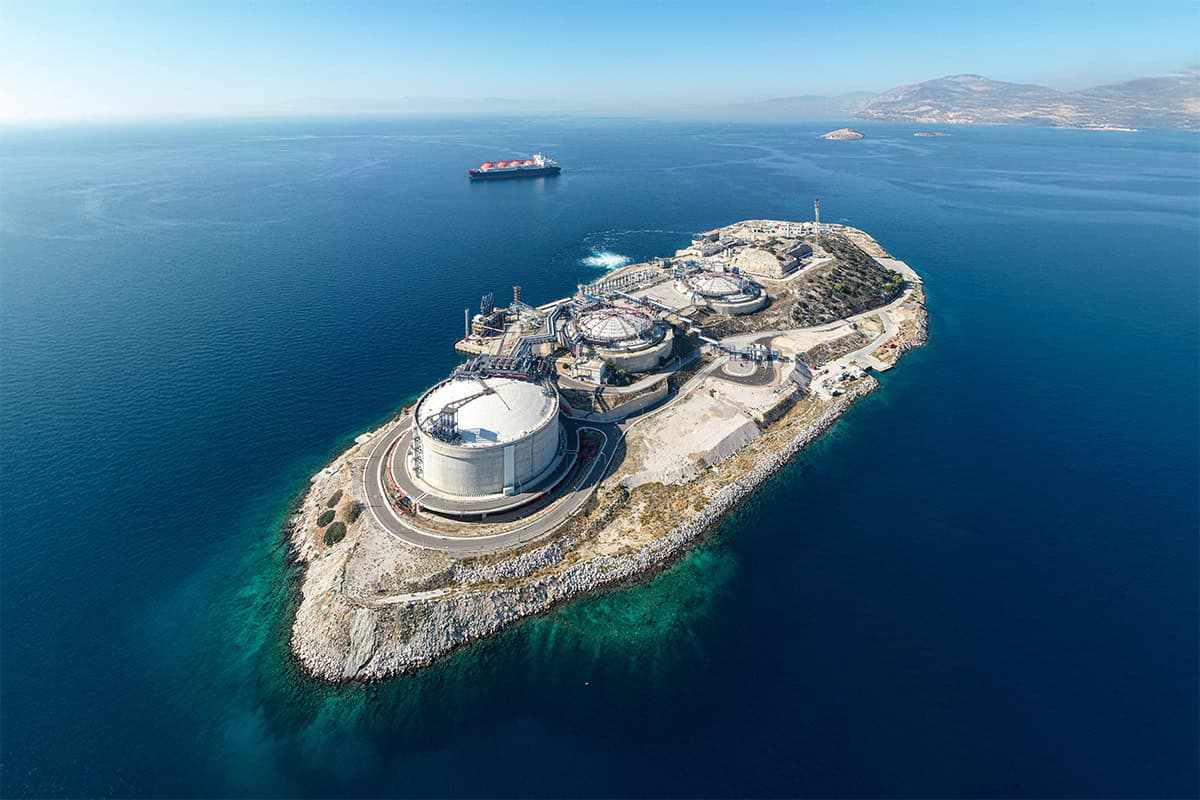
Greece has rapidly shifted from Russian pipeline gas to American liquefied natural gas (LNG), making the United States the country’s dominant supplier in 2025. The pivot strengthens Europe’s energy security but brings higher costs and new dependencies. Record renewable output is being wasted for lack of large-scale storage, prompting multi-billion-euro investment plans for batteries and grid upgrades. Greece’s challenge is to use the LNG boom as a bridge while building a resilient, renewable energy system by 2030.
Europe’s Pivot from Russian Gas
Since 2022, the European Union has pursued the RePowerEU strategy to end imports of Russian oil, gas, and coal by 2027. In September 2025, Brussels accelerated the plan, approving a complete ban on Russian LNG starting January 1, 2027, one year ahead of schedule.
At the same time, Washington and Brussels announced a framework for roughly 250 billion dollars a year in U.S. energy sales, mostly crude oil and LNG, for the next three years (this figure is drawn from official statements and has not yet been independently audited). The scale underlines how central U.S. exports have become to Europe’s supply strategy and how determined the EU is to reduce Moscow’s influence. For Greece, at the crossroads of East and West, this shift brings both opportunity and new strategic responsibilities.
Greece’s Gas Market in 2025
According to DESFA, the Greek gas transmission system operator, national gas consumption from January 1 through August 31, 2025, reached 46.32 terawatt hours (TWh), up 8.3 percent compared with the same period in 2024 and second only to the 2021 record. In August 2025 alone, consumption was 5.34 TWh, down 16 percent from July.
Breakdown of imports:
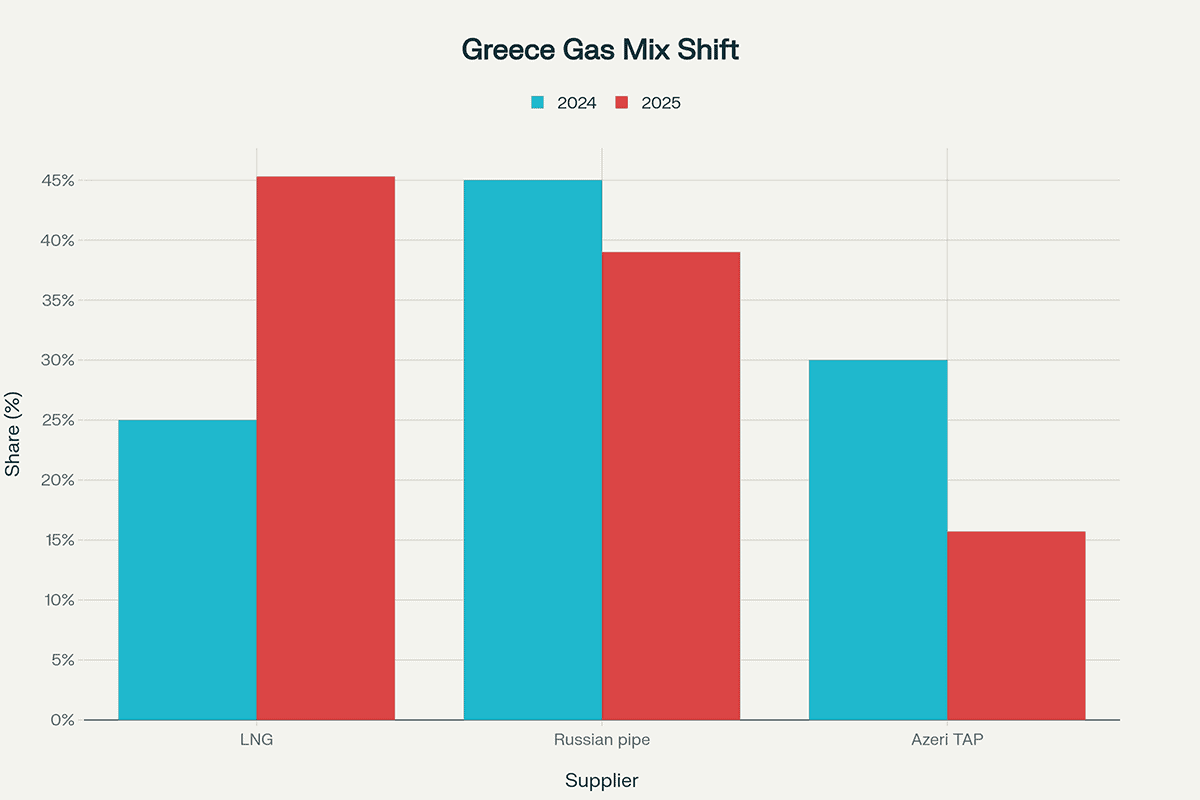
- LNG from the Revithoussa and Amfitriti terminals supplied about 21.2 TWh, or roughly 45 percent of total imports, a 76 percent increase year on year (DESFA data compiled by the Green Tank).
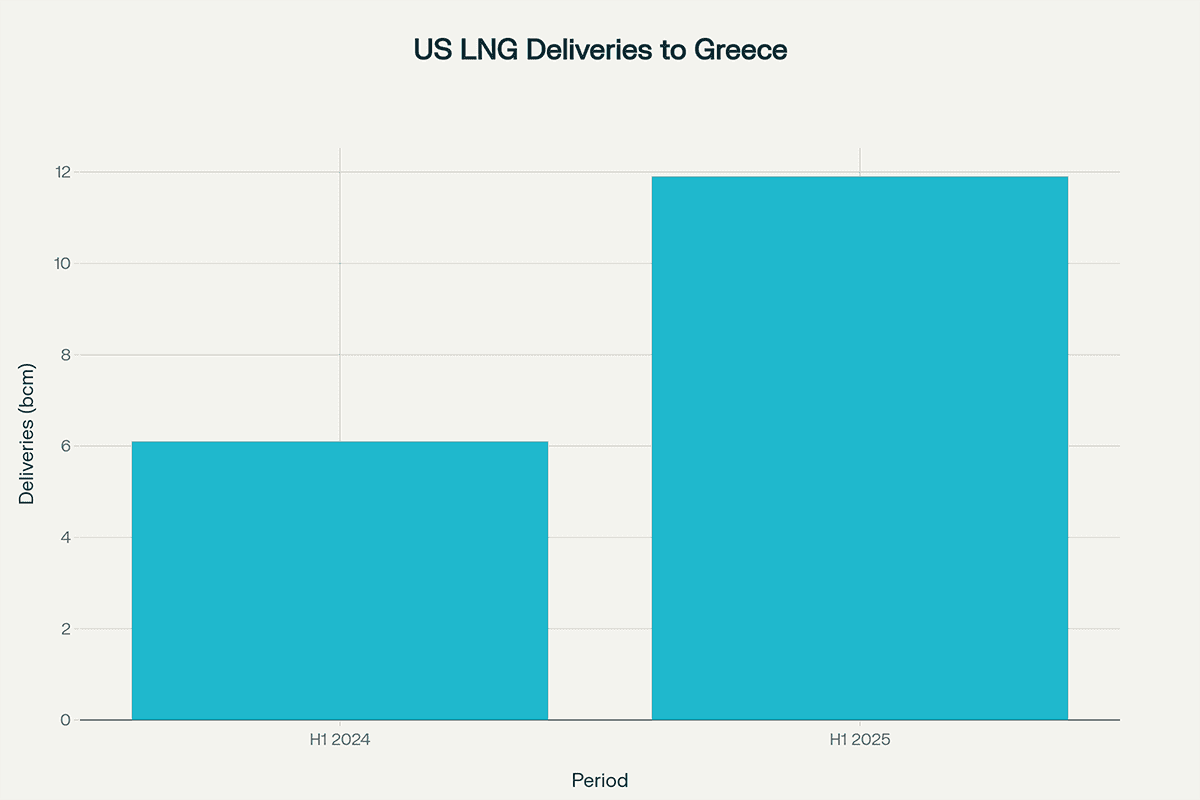
- U.S. LNG deliveries nearly doubled in the first half of 2025 to about 11.9 TWh, up from 6.1 TWh a year earlier.
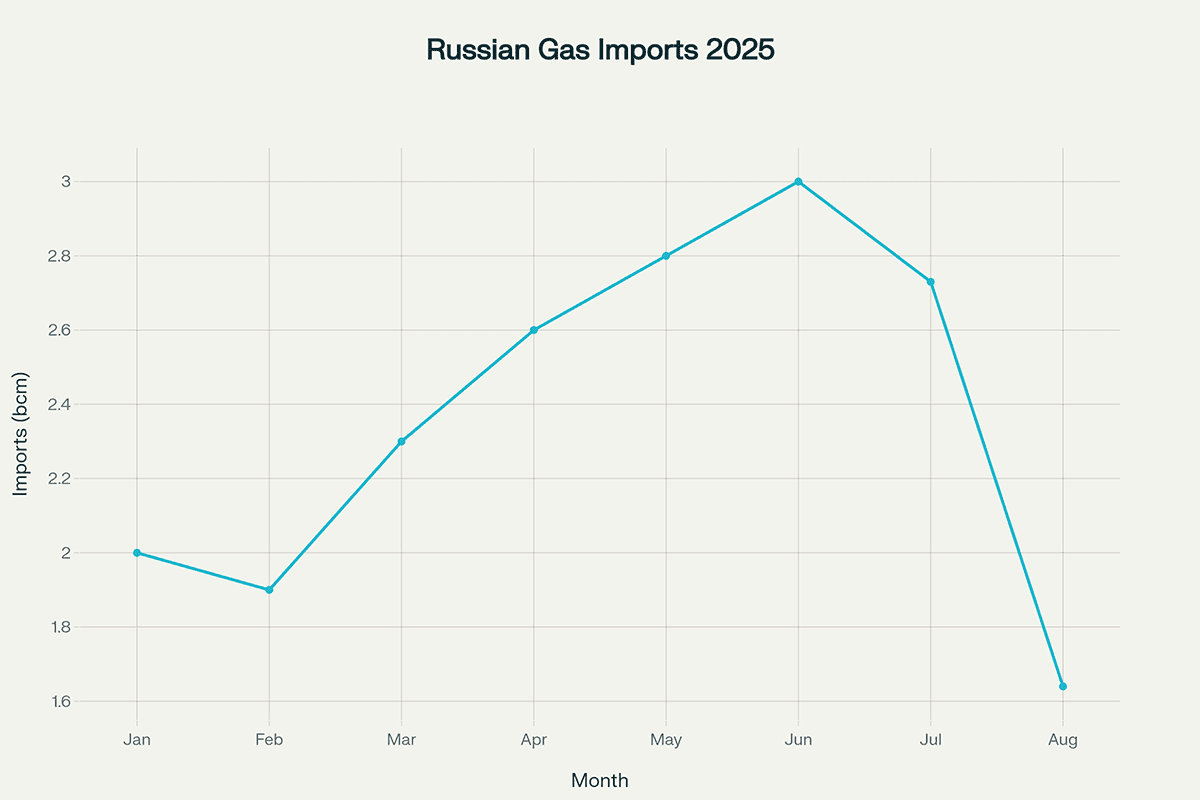
- Russian pipeline gas via the Sidirokastro entry point fell about 26 percent in the first eight months of 2025 to 18.24 TWh, and in August dropped around 40 percent from July to 1.64 TWh, about 31 percent of that month’s imports.
- Azeri gas through the TAP pipeline at Nea Mesimvria provided 7.3 TWh, down about 11 percent from a year earlier.
Analysts estimate that U.S. cargoes now make up about 80 percent of total LNG imports. DESFA’s public statistics do not break out every cargo by origin in real time, so this figure remains an informed estimate.
Power Generation and Renewable Bottlenecks
Gas-fired generation reached 32.7 TWh in the first eight months of 2025, up about 11 percent, and consumed roughly 70 percent of all gas used in Greece.
Meanwhile, Greece produced record levels of renewable energy but lacked the storage to use it all. Between January 1 and July 31, 2025, 1,385 gigawatt hours, about 8.3 percent of renewable output, were curtailed—more than double the level a year earlier. When evening demand peaks, gas plants fill the gap, keeping power prices tied to imported LNG.
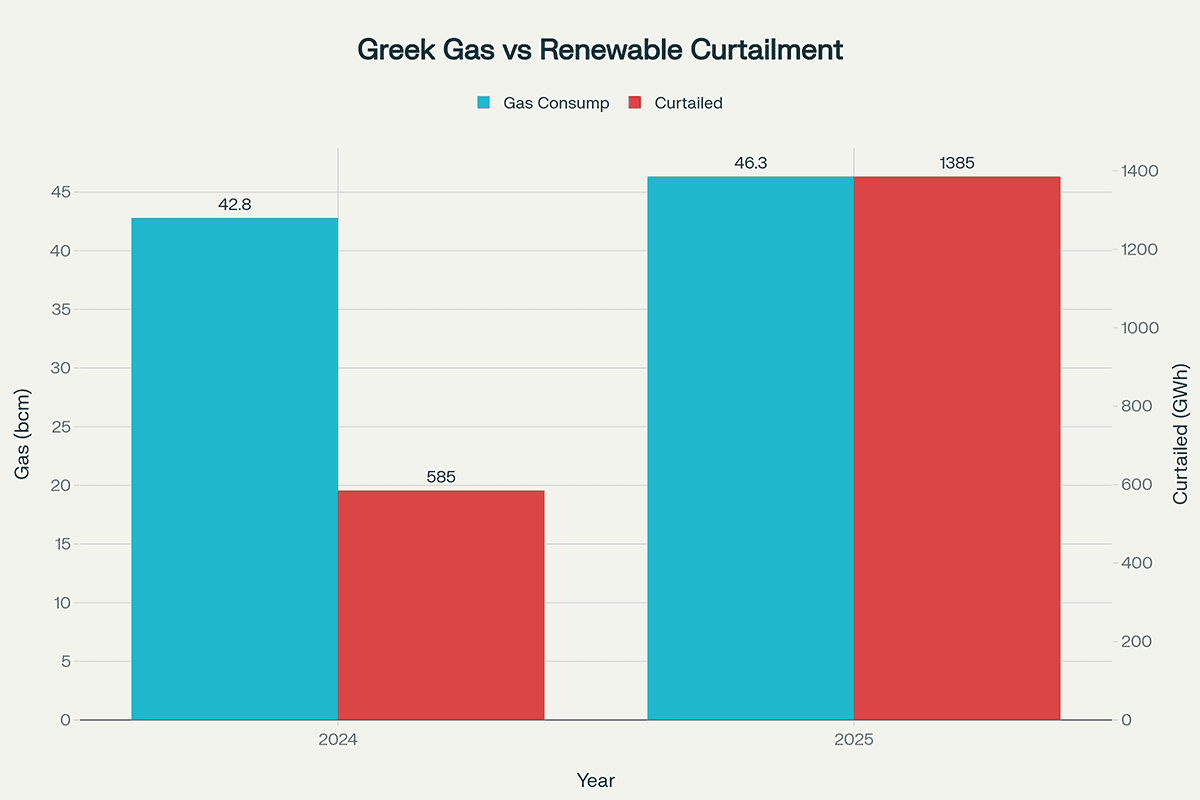
This imbalance illustrates a paradox of the green transition. Even as wind and solar capacity grow, without large-scale batteries or pumped-hydro storage, much of that clean power cannot be captured when it is produced. Until storage catches up, Greece will remain locked into gas-fired generation to meet peak demand, leaving consumers exposed to global gas price swings.
Greece as a Strategic Energy Gateway
The Trump–von der Leyen energy framework positions Greece as a key entry point for American LNG.
In September 2025, Environment and Energy Minister Stavros Papastavrou and Shipping Minister Vasilis Kikilias met U.S. energy envoy Doug Burgum, just after the Chevron–Hellenic Energy consortium joined a tender for hydrocarbon exploration south of Crete and the Peloponnese. The meetings underscored Greece’s value as a maritime hub: its ports and shipping companies dominate global LNG transport and provide easy links to inland European markets.
Europe-Wide Trends and Terminal Capacity
Across the EU, the United States now supplies more than 55 percent of LNG imports, while Russia’s share has fallen to about 17 percent and Qatar’s to roughly 11 percent, according to the International Energy Agency and Eurostat.
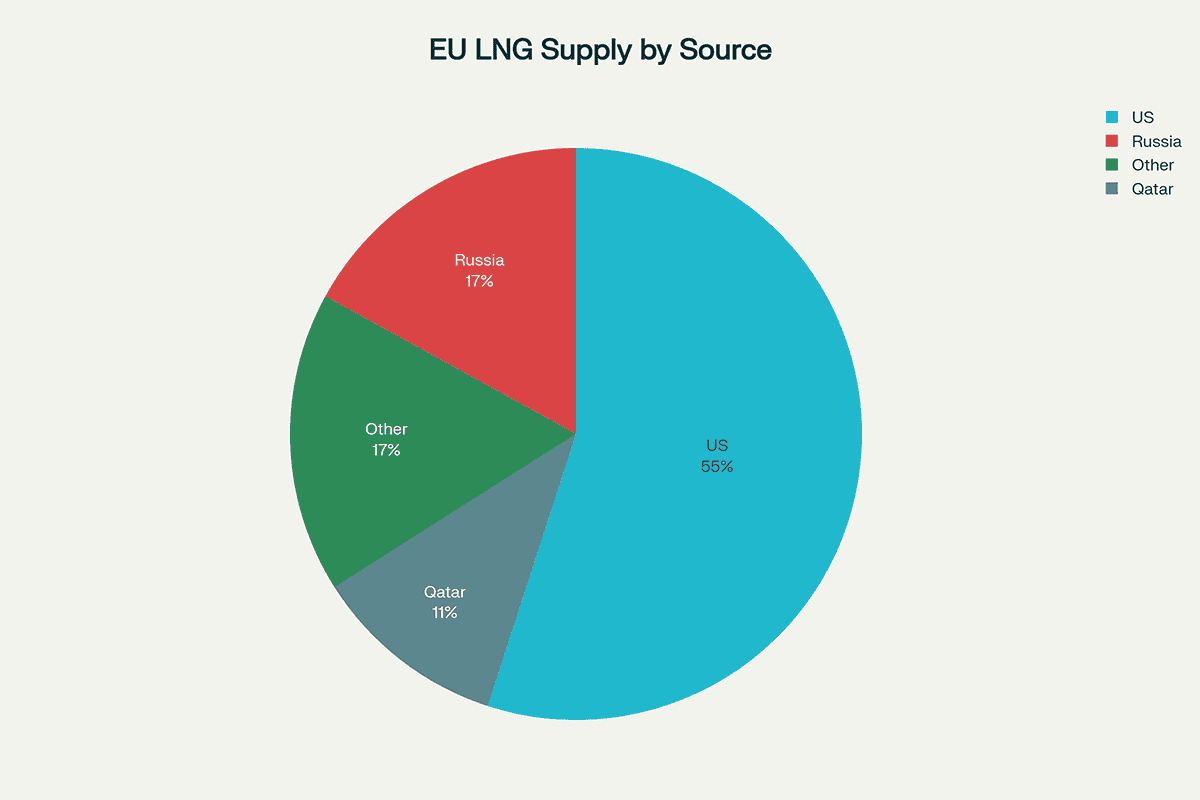
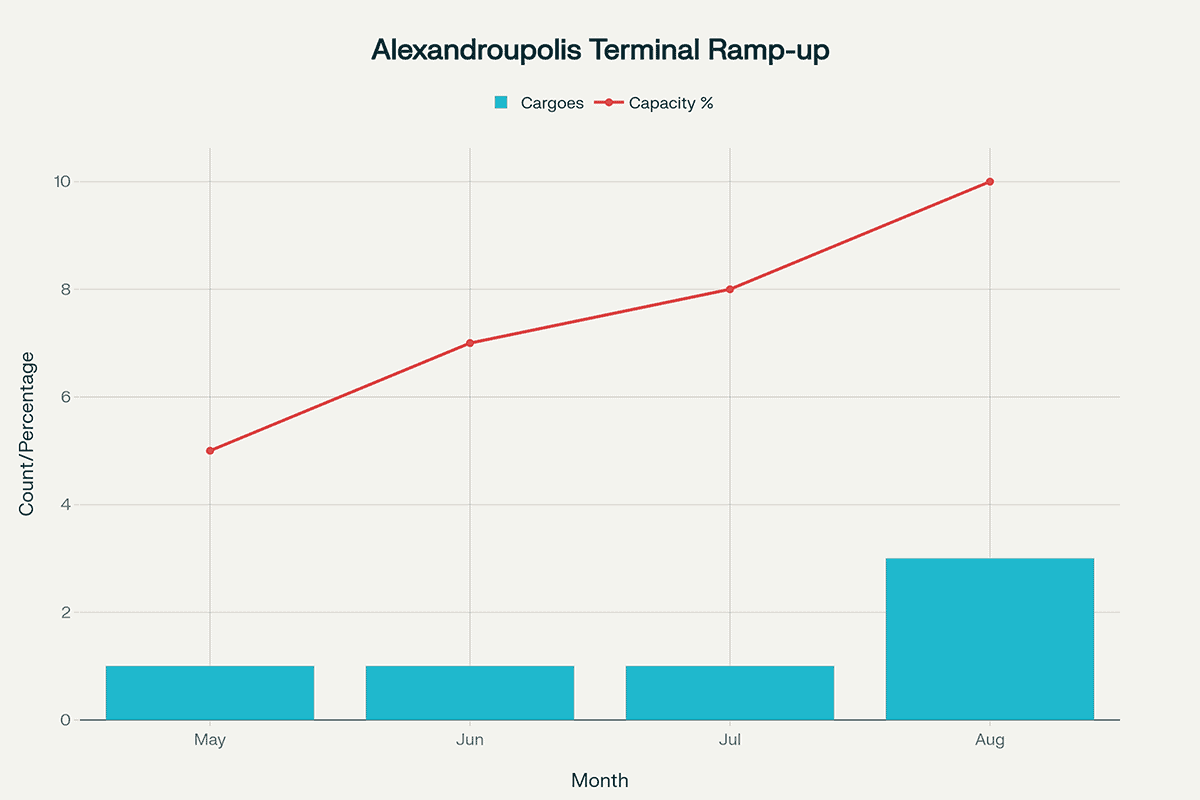
EU LNG terminals are running at roughly 42 percent of combined capacity. Revithoussa and the new Alexandroupolis floating terminal are central to Greece’s role, but verified year-to-date utilization rates have not yet been published by DESFA. S&P Global reported that Alexandroupolis received its first commissioning cargo in May 2025 and handled three commercial cargoes by August, with an early capacity factor estimated at around 10 percent during its ramp-up.
Costs and Pricing Methodology
American LNG typically costs more than pipeline gas because it must be liquefied, shipped across the trans-Atlantic shipping route in specialized vessels, and re-gasified at the terminal, costs that are reflected in the delivered price. European buyers quote prices in euros per megawatt hour or U.S. dollars per million British thermal units (mmBtu), and these vary with contract terms, spot-market conditions, and shipping distance.
Analysts at the Institute for Energy Economics and Financial Analysis (IEEFA) note that Greece consistently faces premium pricing for LNG imports because of the long Atlantic shipping distance and limited opportunities to offset costs with pipeline gas. This premium, combined with the heavy use of gas-fired plants and the curtailment of renewable output, raises the risk of higher electricity bills for both households and energy-intensive industries such as metals, cement, and chemicals.
Infrastructure Gaps and Investment Needs
Greece’s large maritime fleet gives it natural advantages in global LNG transportation and could generate value from logistics and distribution. Yet the renewable curtailment crisis highlights urgent infrastructure needs. Grid-scale energy storage and modernized transmission networks are essential to capture solar and wind output and reduce reliance on costly gas imports.
The government has begun to move on several fronts.
Battery storage. A March 2025 ministry decree set a target of 4.7 GW of standalone battery capacity by the early 2030s (3.8 GW transmission-connected and 0.9 GW distribution-connected). These projects are not backed by a single direct budget line because the technology is considered mature.
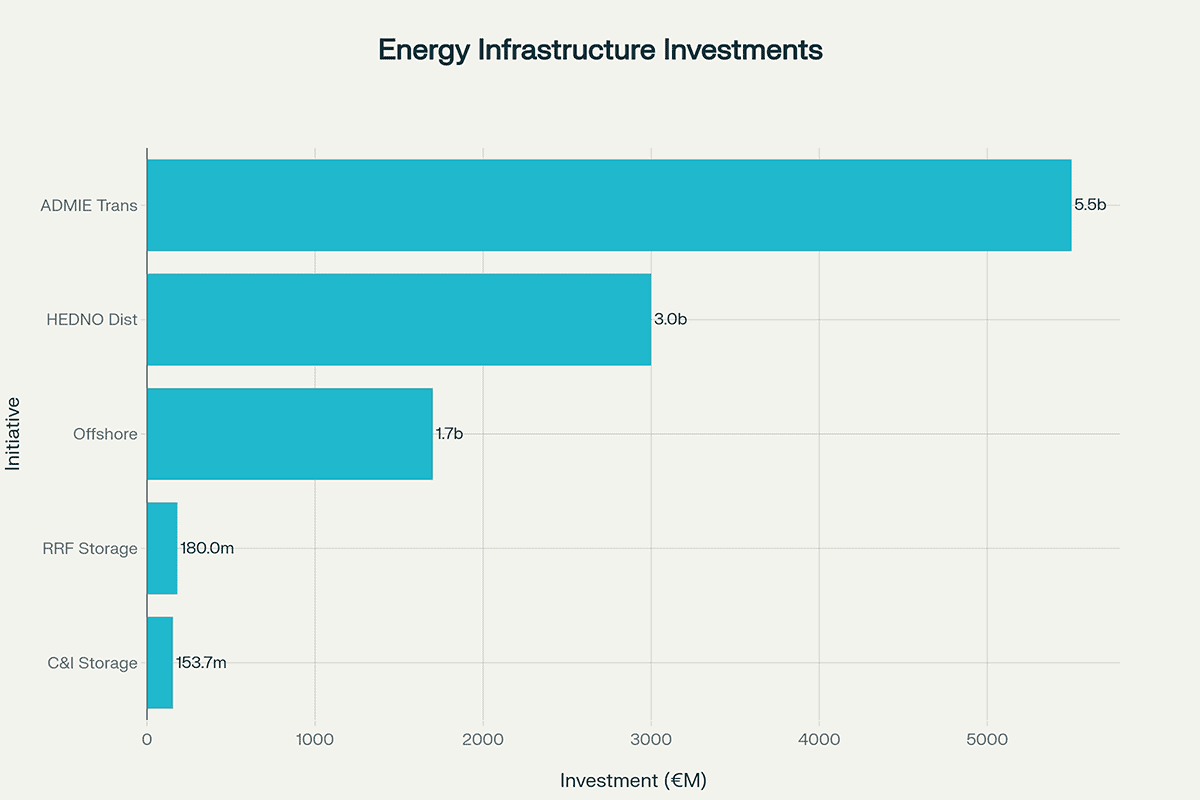
A commercial and industrial (C&I) storage program, launched in January 2025, carries a €153.7 million budget to support up to 900 MW of batteries with tiered grants covering 30–50 percent of system costs.
Under the EU Recovery and Resilience Facility call of December 2024, a state-aid scheme for up to 900 MW of grid-scale storage provides €100,000–€200,000 per MW in investment aid plus 10-year Contracts-for-Difference, implying roughly €180 million in grants and long-term operational support through 2035.
Grid modernization. ADMIE’s Ten-Year Development Plan (2025–2034) foresees about €5.5 billion for transmission upgrades, new interconnections, HVDC links, and smart-grid technologies. HEDNO, the distribution system operator, plans €3 billion of network reinforcement and smart-meter roll-out over the next five years—more than €600 million per year. In January 2025, ADMIE also issued a €1.7 billion tender for offshore cables to connect Aegean islands such as Kos and Rhodes to the mainland grid.
Taken together, these initiatives represent well over €6 billion in planned investments combining EU Recovery & Resilience funds, state-aid schemes, and utility spending. Although there is no single “battery storage budget line,” the scale of these commitments shows that Greece is beginning to match its rapid LNG expansion with equally significant upgrades to renewable-energy infrastructure.
New Risks Behind Greater Security
Replacing Russian gas strengthens energy security in the short term but creates new dependencies. Greece’s growing reliance on U.S. LNG exposes it to American energy policy shifts and potential supply disruptions. The timing mismatch between the Russian phase-out and the scaling of renewable energy leaves a vulnerable transition period.
Concentration risk is real. If U.S. export policy changes or global LNG prices spike, Greece will have few immediate alternatives. This underlines the importance of diversifying suppliers and building a resilient domestic energy base.
The Next Five Years
Greece’s challenge is to use the current LNG boom as a bridge, not a crutch. Faster investment in renewable generation and storage can cut gas dependence and protect consumers from price shocks. Diversifying suppliers and deepening regional cooperation will help maintain competitive energy markets.
The decisions Athens makes between now and 2030 will determine whether this pivot to American LNG becomes a lasting dependence or a stepping stone toward a more resilient, competitive, and sustainable energy system. If Greece can harness its maritime strengths while rapidly building storage and renewable capacity, the country could emerge from this energy revolution both more secure and more prosperous.