
In the autumn of 1918, while the guns of the Great War still thundered across Europe, another enemy reached Greece, the Spanish flu, a virus that would kill more people worldwide than the war itself.
On the Aegean island of Skyros, it came “like a thunderbolt.” Within days, people began to die in their homes, in the streets, in each other’s arms. The island had about 3,200 inhabitants. By the end of November, a thousand were gone, one of the highest death rates recorded anywhere in the world. Journalist Constantinos Faltaits, who documented the tragedy in 1919, wrote words that still haunt Greek memory:
“They were dying all the time, during the day and during the night. Without any doctors, without medication, without anyone to care for them. They were dying together, they were dying embraced.”
First cases and a divided nation
The Spanish flu reached Greece in the summer of 1918. Patras reported early cases in mid-July, with the newspaper Thessalia noting the outbreak on July 19, 1918.
Globally, the pandemic swept across continents in three waves between 1918 and 1920, infecting nearly a third of the world’s population. It killed an estimated 50 million people — more than all those who died in the First World War. Greece was hit hardest during the second wave, in the autumn of 1918, when the virus reached Europe’s southern front.
The country was still split by the National Schism, the bitter conflict between King Constantine I and Prime Minister Eleftherios Venizelos that had divided the nation between royalists and supporters of the Allies. By the time the pandemic spread, Greece had just entered the war on the Allied side. Unity was fragile, and the government’s ability to respond to a new crisis was limited. When the Ministry of the Interior issued guidance that October, it announced it had no intention of implementing special measures. Citizens were told to avoid gatherings and to rely on themselves, as noted in the Athens Social Atlas.
Thessaloniki: war and disease
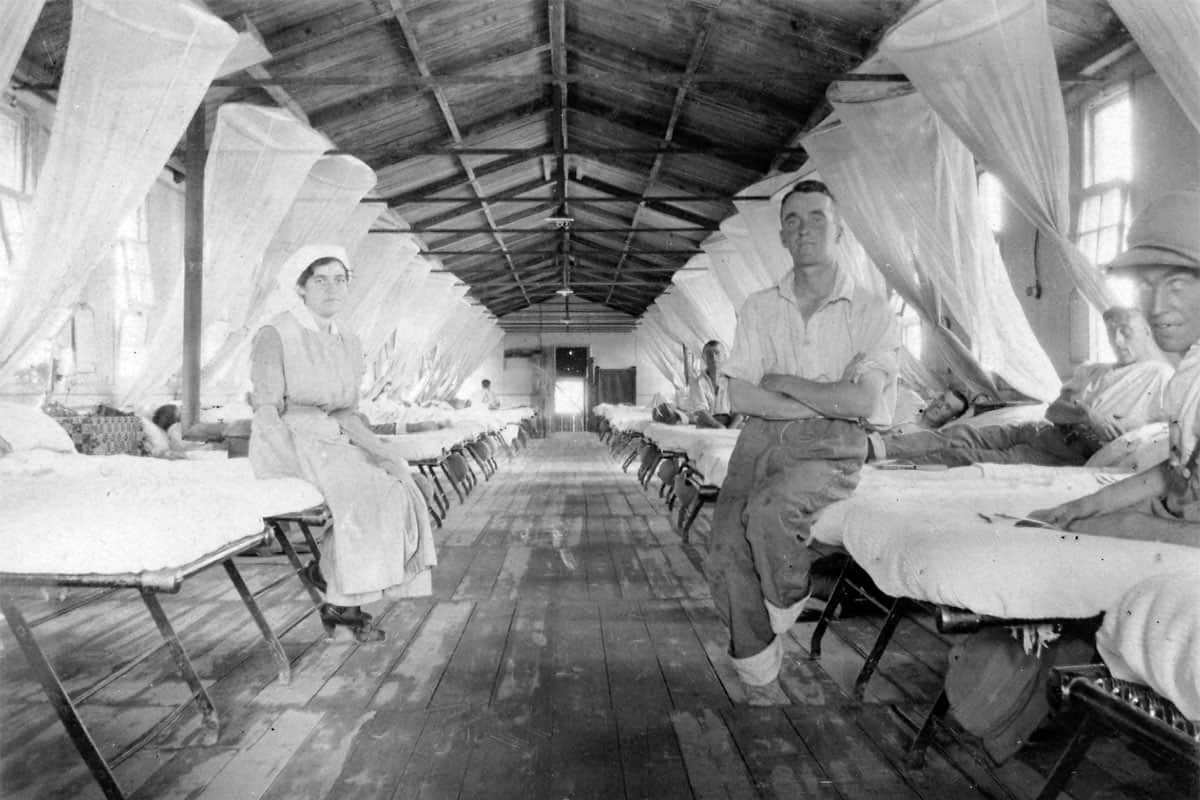
In Thessaloniki, the pandemic found a perfect storm. The city had become the headquarters of the Macedonian Front, crowded with British, French, Serbian, and Greek troops living in makeshift camps and hospitals. Even before the flu, the front was battling malaria, overcrowding, and poor sanitation, conditions that would turn Thessaloniki into one of Greece’s deadliest cities, according to The National Archives (UK).
When the virus reached Thessaloniki that autumn, it tore through exhausted soldiers and civilians alike. The city recorded 5,284 deaths, one of the highest tolls in Greece. Military hospitals became deadly centers of contagion, with reports showing extraordinarily high mortality among flu patients, many already weakened by malaria. These findings are detailed in medical records from army hospitals published in later epidemiological studies. In Thessaloniki, war and disease became indistinguishable.
Soldiers returning from the front carried the virus into nearby communities, spreading it far beyond the military lines. Across the country, 7,452 confirmed urban deaths were recorded in Athens, Thessaloniki, and Patras, though the true number was likely higher once rural and military deaths were included.
Athens, Patras, Crete, Euboea, and the islands
The virus soon reached Athens, which recorded 1,668 deaths, with the worst months being October and November 1918. Patras, a busy port city, lost around 500 residents, equal to 95 deaths for every 10,000 people. Schools, cafés, theaters, and cinemas were ordered closed.
Across the islands, newspapers described desperate scenes:
- On Andros and Naxos, whole villages were struck at once.
- In Crete, reports told of families perishing during the olive harvest, with severe outbreaks in the Aharnai area, Meramvellon, Thrapsano, and Selinou.
- In Euboea, the epidemic moved from town to town with frightening speed.
But nowhere compared to Skyros. Cut off from the mainland, with only one doctor for the entire island, its people faced the pandemic alone. Faltaits’s chronicle, preserved today at the Faltaits Museum, reads like both history and lamentation, a record of how isolation turned tragedy into annihilation.
No masks, little medicine
Unlike other countries, Greece did not promote the use of face masks or organize quarantines. Pharmacies ran out of basic medicine. Newspapers published strange cures and rumors, from garlic and vinegar to injections that later proved dangerous. Doctors debated causes and treatments as the death toll climbed.
Contemporary accounts describe Athens hospitals overflowing, with makeshift field hospitals established in Oropos and beyond to handle the surge. It was at one such field hospital that Dr. Georgios Gavalas, a physician from Santorini, died treating patients of the Spanish flu in 1918. His story, recorded by journalist Marianna Kakaounaki in Kathimerini, remains one of the few firsthand glimpses into the lives of Greek doctors who faced the epidemic without protection or rest.
In Athens, mortality peaked in November, then began to decline. By early 1919, the worst was over. There was no significant third wave in urban centers, though smaller rural outbreaks did occur in early 1919.
War within the war
The flu’s toll in Greece cannot be separated from the war itself. On the Macedonian Front, soldiers fought in mud and mosquitoes, under canvas and in overcrowded wards. Refugees from Asia Minor crowded into towns like Mytilene, where about 52,000 refugees lived among roughly 180,000 locals in 1918–19, many in abandoned Ottoman houses without adequate water or sanitation. This crisis is described in Natalia Vogeikoff-Brogan’s essay “Professors to the Rescue”.
The virus traveled the same routes as troops and supplies, from the port of Thessaloniki to the smallest island. In that sense, the pandemic was as much a military event as a medical one. It struck a mobilized, divided nation that had already endured years of hardship.
The forgotten pandemic
By 1920, the Spanish flu had disappeared from Greek headlines. The country was already facing a new catastrophe: the Asia Minor campaign and the refugee crisis that would follow. The pandemic faded into silence, remembered mostly in small communities and family stories.
In the years that followed, as Greece faced war and economic hardship, many survivors of this lost generation emigrated, carrying with them both memories of survival and silence about the pandemic that had scarred their youth.
“Even now,” said Anastasia Faltaits, the writer’s granddaughter, “reading his account gives me a knot in my stomach. The scenes are terrifying, and yet so familiar.”
Yet its lessons remain. The Spanish flu exposed what happens when a nation is unprepared, divided, and exhausted by war. It showed how disease finds the cracks in a society, the places where trust and care have broken down.
Remembering Skyros
More than a century later, visitors to Skyros can still find traces of that autumn. The island’s cemeteries hold rows of graves from 1918. Locals still tell stories of the families who “died together, embraced.”
In Santorini and Athens, descendants like Marianna Theodoropoulou still remember family members lost to the flu. Her grandfather, Dr. Georgios Gavalas, died treating patients in Oropos in 1918. More than a century later, she says, the story still feels close, proof that pandemics, like memory, echo across generations.
The Spanish flu in Greece was not only a medical disaster but a deeply human one. A century later, its silent enemy reminds us how easily the threads of a nation can fray and how memory keeps them together.
“The people of Skyros saw death come in silence, without thunder, without fire. Only the wind and the sea knew what had happened.”
— Constantinos Faltaits, 1919
Sources: Athens Social Atlas; Faltaits Museum Archive, Skyros; The National Archives (UK); Kathimerini (Marianna Kakaounaki, 2020); Natalia Vogeikoff-Brogan, “Professors to the Rescue,” 2019; peer-reviewed epidemiological studies on influenza in Greece (PMC, 2024).
Featured image: Thessaloniki, c.1917. Ward at the 50th British General Hospital in Kalamaria, where Allied medical staff treated soldiers on the Salonika Front. Australian War Memorial, H03708, public domain.