

On this day in 1943, the town of Kalavryta in the Peloponnese suffered one of the worst Nazi atrocities committed in Greece during World War II. The massacre, often called the Holocaust of Kalavryta, remains a defining chapter of the occupation.
In mid-October 1943, resistance fighters from ELAS, the Greek People’s Liberation Army, captured around eighty German soldiers near Kerpini, close to Kalavryta. ELAS was the military arm of EAM, the National Liberation Front, dominated by the Communist Party of Greece (KKE) and the largest resistance organization in occupied Greece. Negotiations for a prisoner exchange failed, and on December 7, the prisoners were executed. The next day, German troops discovered the bodies, and two surviving soldiers reported what had happened.
General Karl von Le Suire, commander of the 117th Jäger Division, ordered what he called the “severest measures.” In one internal directive, the division specified:
„Es sind gegen die männliche Bevölkerung der betroffenen Ortschaften die schärfsten Sühnemaßnahmen durchzuführen.“
“The severest reprisal measures are to be carried out against the male population of the affected localities.”
This language appears in multiple orders from late 1943 and shows that the reprisals were not improvised but formally authorized at the highest divisional level.
Operation Unternehmen Kalavryta had been prepared as a combined anti-partisan and reprisal campaign. German situation reports classified the wider region as hostile territory, stating:
„Der Raum Kalavryta gilt als Bandenstützpunkt und ist vollständig zu säubern.“
“The Kalavryta area is considered a partisan base and is to be completely cleansed.”
From December 5 onward, German units burned villages, executed civilians, and advanced toward the town. By the time they reached Kalavryta on December 9, more than 140 people in surrounding communities had already been killed.
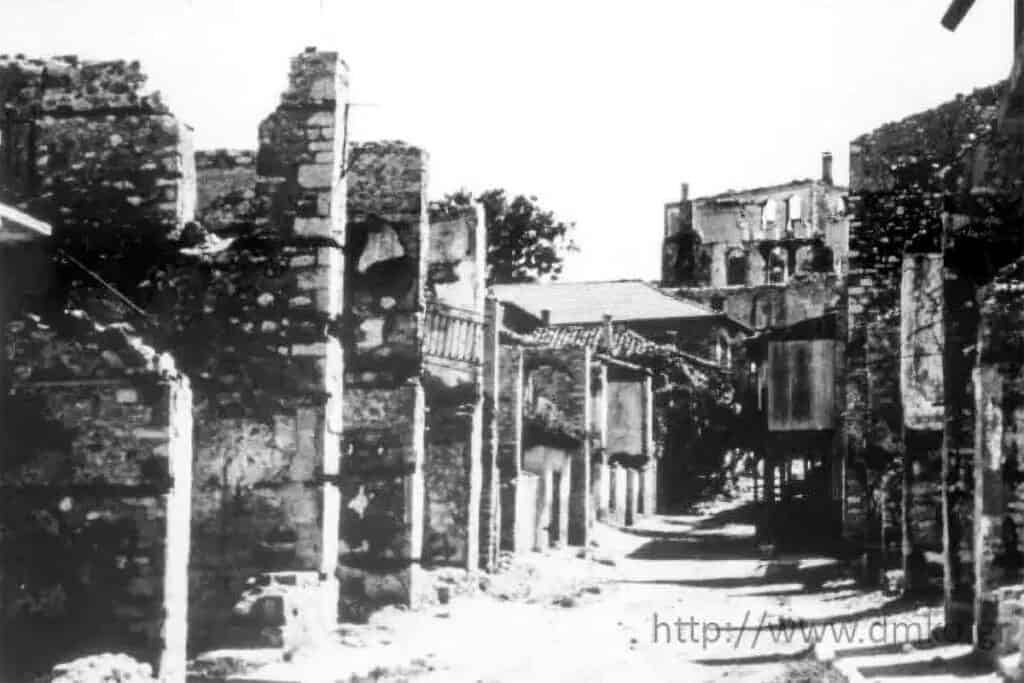
December 13: The Massacre
On the morning of December 13, German soldiers gathered all residents at the local school and separated the population. Women, elderly residents, and small children were locked inside the building. Men and boys in their teens and older were marched to a hillside overlooking the town. The orders that guided this action were explicit:
„Alle männlichen Einwohner im Alter von 15 bis 65 Jahren sind zu sondern und zu erschießen.“
“All male inhabitants aged 15 to 65 are to be separated and shot.”
Between about 438 and just under 500 males were executed by machine-gun fire. Only thirteen survived by falling early, hiding under the bodies of those killed later, and remaining still until the troops left.
The schoolhouse where the women and children were held was then set on fire. For many years, a story circulated that a German or Austrian soldier opened a back door to help them escape. Survivors and historians have since shown that no such intervention occurred, and that the trapped residents broke doors and windows themselves to get out of the burning building.
German units had been ordered to destroy communities believed to have supported ELAS. One directive stated clearly:
„Dörfer, die den Banden Unterkunft gewährt haben, sind niederzubrennen.“
“Villages that have sheltered the partisans are to be burned down.”
The destruction that followed in Kalavryta and the surrounding villages reflected this policy. Troops burned most of the town and, the next day, destroyed or damaged parts of the monasteries of Agia Lavra and Mega Spilaion. In total, Wehrmacht records and later research document roughly 693 to 696 civilian deaths between December 5 and 16 in Kalavryta and twenty-eight surrounding communities.
Aftermath, Responsibility, and Memory
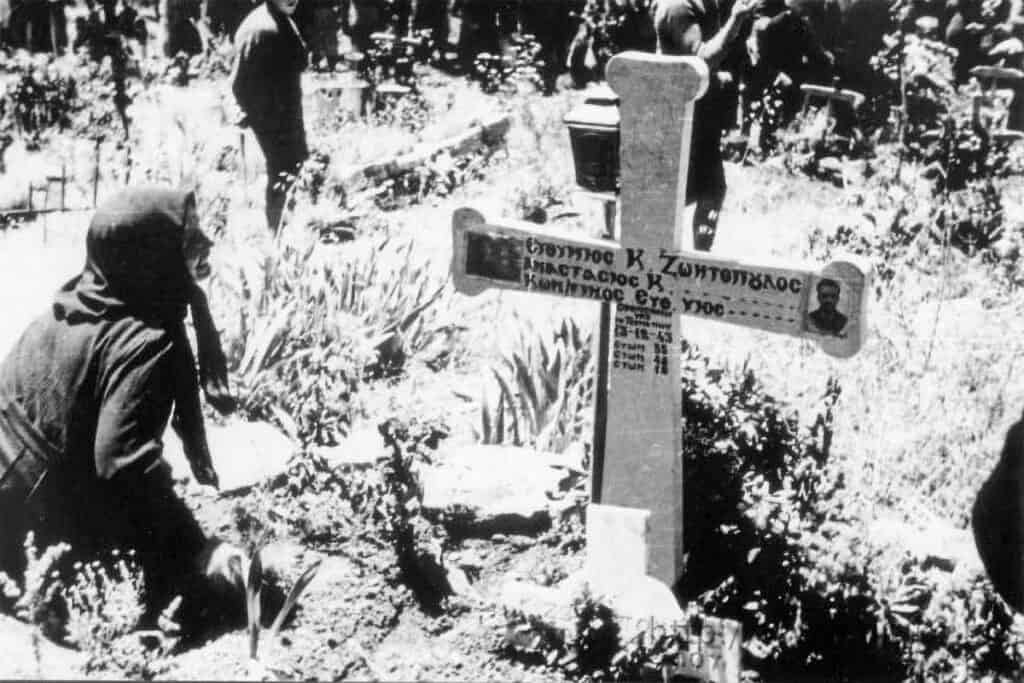
In the first postwar years, Kalavryta was known in Greece as a town of women. With most of the male population gone, women carried much of the burden of rebuilding homes, farms, and public life. The school where the women and children were imprisoned now serves as the Municipal Museum of the Kalavrytan Holocaust (DMKO), which preserves photographs, documents, and survivor testimonies that document the events and their aftermath. The church clock that stopped when the fire reached it in 1943 remains frozen at that moment as a symbol of the massacre.
German commanders justified their actions internally with language that obscured the nature of the killings. One report stated:
„Zur Wiederherstellung der Sicherheit im Peloponnes ist ein hartes Durchgreifen unerlässlich.“
“A firm crackdown is essential for restoring security in the Peloponnese.”
Official Wehrmacht correspondence required detailed updates:
„Über die durchgeführten Maßnahmen ist unverzüglich an die Division zu melden.“
“All measures carried out are to be reported to divisional command without delay.”
These records reinforce that Operation Kalavryta was executed as a formal military operation, not a spontaneous response.
The atrocity became central to Greece’s experience of the German occupation and later to the debate over reparations. In 1960, West Germany paid Greece 115 million Deutschmarks, but the agreement excluded war crimes, destroyed infrastructure, and the forced loan taken from the Bank of Greece. Those exclusions form the basis of Greece’s continuing claims.
German leaders have slowly begun to address specific massacre sites. In April 2000, Federal President Johannes Rau visited Kalavryta, laid a wreath at the memorial, and spoke of deep sorrow and shame for the crimes committed there. In 2014, President Joachim Gauck traveled to Lyngiades in Epirus, another massacre site, and publicly asked for forgiveness for Nazi crimes in Greece. In 2018, President Frank-Walter Steinmeier apologized in Athens for the “horrors” of the occupation and acknowledged Germany’s lasting moral and political responsibility, while still stating that Berlin considers the legal question of reparations closed.
Greek governments and Parliament take a different view. Studies completed in 2016 and updated in 2019–2025 estimate that Germany’s outstanding obligations for occupation damage, war crimes, and the forced loan amount to roughly €270–289 billion. Greek lawmakers argue that the 1953 London Agreement only postponed rather than settled these issues and that the 1990 Two-Plus-Four Treaty, which accompanied German reunification, did not resolve Greek claims because Greece was not a signatory.
The question has also reached German institutions directly. In 2015 a petition to the Bundestag called on Germany to acknowledge its responsibility toward Greece, repay the forced loan, and open negotiations. The petition did not shift German policy, but the public debate around it revealed the wide divide in opinion: some Germans argued strongly for compensation and historical justice, while others rejected reparations and pointed, often mistakenly, to EU funds as a substitute for wartime obligations.
Legal accountability for these crimes inside Germany has been extremely limited. As jurist Norman Paech has noted, hundreds of investigations related to war crimes in Greece produced only a single major trial, concerning the killing of six civilians in Crete; the defendant was acquitted after the court accepted the Wehrmacht’s version of events. No German court has ever handed down a substantial sentence for the massacre of Kalavryta itself.
At the local level, memory remains very active. Every year on December 13, residents take part in a solemn procession from the town up to the memorial hill where the executions took place. The priest blesses the site, the mayor reads out the names of the dead, and rifle salutes echo across the valley. German and Greek filmmakers have documented this ongoing remembrance, including the 2003 WDR documentary “Kalavrita – 60 Jahre nach dem Massaker (Kalavryta – 60 Years After the Massacre)”, which follows survivors and townspeople who say, “We want to tell this story again and again.”
Across Greece and the diaspora, Kalavryta stands alongside Distomo, Kandanos, Lyngiades, and other martyred communities as part of a shared history of occupation and retaliation. Discussions over accountability continue, shaped by new research, survivor testimony, diplomatic debate, and the wider effort to preserve memory.
Eighty-two years later, the massacre remains part of Greece’s public conversation. It raises ongoing questions about justice, acknowledgment, and how Europe confronts the legacy of World War II. For many Greeks and Greek-Americans, Kalavryta is a reminder that these questions did not end with the war and still matter today.
Further Viewing
Kalavryta in Greece: City of Widows (DW – Focus on Europe)
This short English-language report offers interviews and visual footage from Kalavryta, giving contemporary context to the legacy of the 1943 massacre. It complements the historical record by showing how residents remember and explain the events today.