
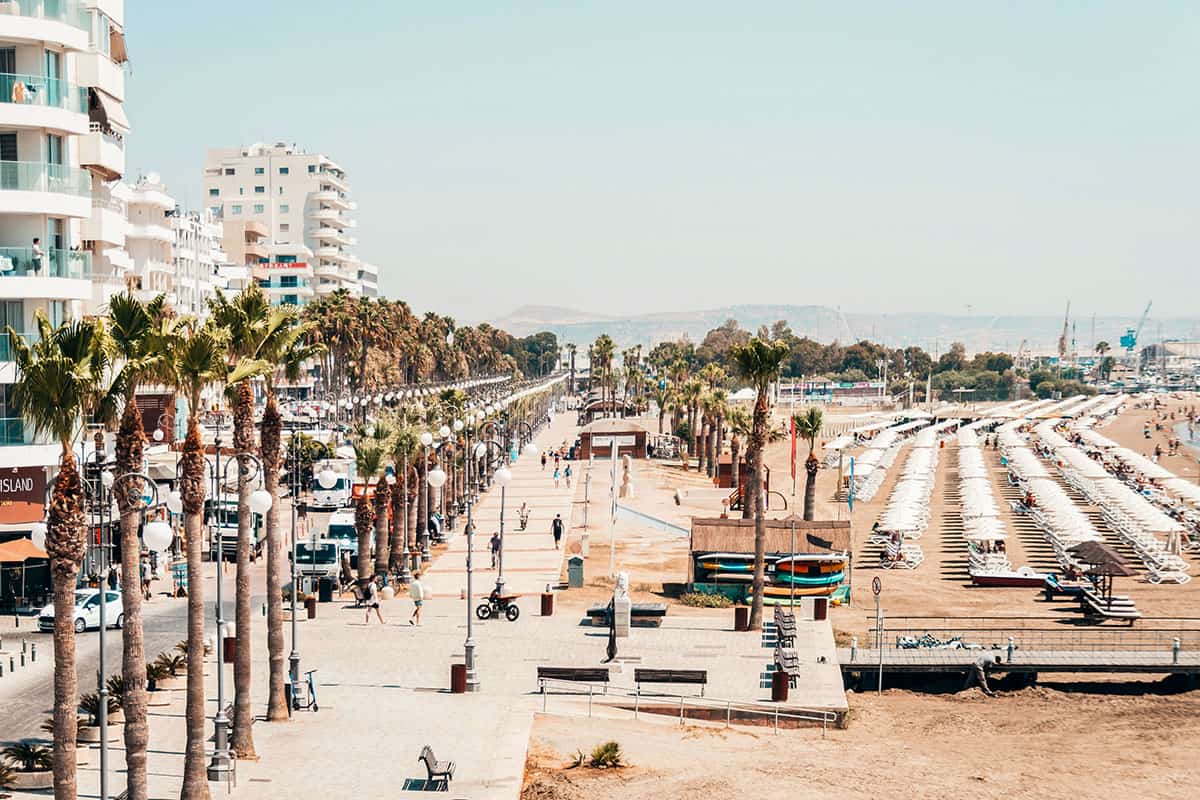
For many visitors, Larnaca has long been a place you pass through. It is the airport city, the first stop and often the last, practical and familiar, but rarely described as Cyprus’s cultural heart. In 2030, that perception is set to be challenged. Larnaca has been officially selected as a European Capital of Culture, a title that invites the city to rethink how it sees itself and how it is seen by the rest of Europe.
The decision was announced on December 11, 2025, by Deputy Minister of Culture Vasiliki Kassianidou, placing Larnaca alongside Leuven in Belgium and Nikšić in Montenegro as the three European Capitals of Culture for that year. For Cyprus, it marks only the second time the honor has been awarded, following Pafos in 2017.
How Larnaca was chosen
Larnaca’s selection followed a structured, two-year national process under the EU’s European Capital of Culture framework. The call for applications was issued on December 18, 2023, with a submission deadline of December 16, 2024. Five Cypriot cities applied.
In February 2025, an independent panel shortlisted Larnaca and Limassol as the final contenders. Both cities then entered an intensive final phase that included site visits, detailed presentations, and question-and-answer sessions in Nicosia between December 8 and 11, 2025.
After evaluating artistic vision, governance capacity, financial planning, and long-term impact, the twelve-member expert panel recommended Larnaca over Limassol, whose bid was built around the concept of “Understory,” emphasizing cultural ecosystems and participation. The final recommendation was announced the same day by the Deputy Minister of Culture.
“Common Ground” and the idea behind Larnaca 2030
Larnaca’s winning bid is built around a theme called “Common Ground.” Led by artistic director Kelly Diapoulis, the concept centers on anthropia, shared human values, as a response to social fragmentation, crisis, and exclusion.
Rather than framing culture as a sequence of flagship events, the proposal treats art as a tool for social connection and civic repair. In practice, this means cultural activity embedded in neighborhoods, public spaces, and areas long considered peripheral.
Western Larnaca, including zones near the former refinery, features prominently in this vision. Initiatives already associated with the bid include Mahalart, the Larnaca Biodesign Festival, and the Care Festival, projects that combine artistic practice with urban regeneration, environmental awareness, and community care.
The broader ambition is to move Larnaca beyond its long-standing role as a service center and reposition it as a city where culture shapes everyday life, participation, and identity.
A regional project, not just a city one
Although the title carries the city’s name, Larnaca 2030 is conceived as a regional effort. The program extends across the wider Larnaca area, encompassing multiple municipalities and community councils, with a combined population of roughly 145,000 people. About half live in the city itself.
This matters because it shifts culture away from a single center. Smaller towns, coastal communities, and inland neighborhoods are expected to play an active role, reframing culture as something that happens across lived spaces, not only in designated venues or tourist zones.
Funding and what comes with the title
The designation brings both national and European support. The Cypriot government has committed around €10 million to Larnaca’s preparation and legacy period, spanning 2026 to 2031. At the European level, the city is eligible for the Melina Mercouri Prize, a €1.5 million award funded through the EU’s Creative Europe program, subject to meeting agreed milestones during the preparation phase.
Evaluations of past European Capitals of Culture suggest that long-term impact depends less on opening ceremonies and more on governance, continuity, and post-title planning. Larnaca’s bid places explicit emphasis on that longer arc, reflecting lessons drawn from the experience of Pafos 2017.
What happens next
Between now and 2030, Larnaca will move from vision to delivery. That includes finalizing its cultural program, strengthening governance structures, expanding partnerships with local organizations, and investing in cultural spaces and public areas.
There is also a wider European context. As Cyprus continues to shape its role within European cultural policy and institutions, Larnaca’s cultural year carries added symbolic weight, particularly as discussions continue about the future of the European Capital of Culture programme itself.
For Larnaca, the title is less a final statement than an invitation. It asks whether a city defined for decades by transit, borders, and utility can reimagine itself as a place of encounter and shared life. In 2030, the answer will not be found only on stages or in programs, but in how the city’s streets, neighborhoods, and edges come together as common ground.